


 一键配货
一键配货
化合物详情
CAS533-31-3
分子式C7H6O3
分子量138.12 g/mol g/mol
危化品
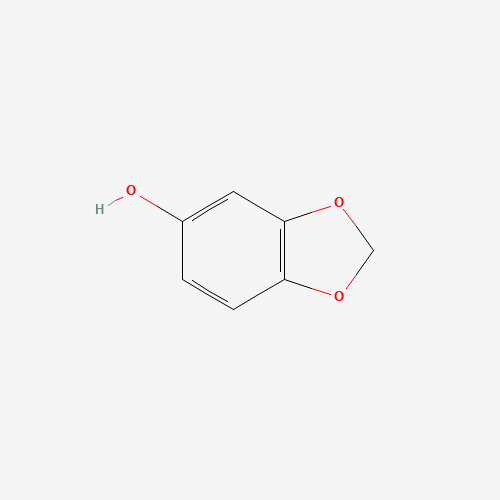
Sesamol is a member of benzodioxoles.
科学粮草官-词典编辑部,修订于:2026-07-06
Toxicity
ToxicityFate Summary
ATMOSPHERIC FATE: According to a model of gas/particle partitioning of semivolatile organic compounds in the atmosphere(1), sesamol, which has an estimated vapor pressure of 6.9X10⁻³ mm Hg at 25 °C(SRC), determined from a fragment constant method(2), is expected to exist solely as a vapor in the ambient atmosphere. Vapor-phase sesamol is degraded in the atmosphere by reaction with photochemically-produced hydroxyl radicals(SRC); the half-life for this reaction in air is estimated to be 2 hrs(SRC), calculated from its rate constant of 2.0X10⁻¹⁰ cu cm/molecule-sec at 25 °C(SRC) that was derived using a structure estimation method(2). Sesamol contains chromophores that absorb at wavelengths >290 nm(3) and, therefore, may be susceptible to direct photolysis by sunlight(SRC).
Soil Adsorption / Mobility
Using a structure estimation method based on molecular connectivity indices(1), the Koc of sesamol can be estimated to be 48(SRC). According to a classification scheme(2), this estimated Koc value suggests that sesamol is expected to have very high mobility in soil(SRC). The pKa of sesamol is 9.97(3), indicating that this compound exists as a weak anion and anions generally do not adsorb more strongly to soils containing organic carbon and clay than their neutral counterparts(4).
Environmental Bioconcentration
An estimated BCF of 5 was calculated in fish for sesamol(SRC), using an estimated log Kow of 1.57(1) and a regression-derived equation(1). According to a classification scheme(2), this BCF suggests the potential for bioconcentration in aquatic organisms is low(SRC).
Volatilization from Water / Soil
The Henry's Law constant for sesamol is estimated as 8.7X10⁻⁶ atm-cu m/mole(SRC) developed using a fragment constant estimation method(1). This Henry's Law constant indicates that sesamol is expected to volatilize from water surfaces(2). Based on this Henry's Law constant, the volatilization half-life from a model river (1 m deep, flowing 1 m/sec, wind velocity of 3 m/sec)(2) is estimated as 5 days(SRC). The volatilization half-life from a model lake (1 m deep, flowing 0.05 m/sec, wind velocity of 0.5 m/sec)(2) is estimated as 41 days(SRC). Sesamol is not expected to volatilize from dry soil surfaces(SRC) based upon an estimated vapor pressure of 6.9X10⁻³ mm Hg(SRC), determined from a fragment constant method(1).
Environmental Abiotic Degradation
The rate constant for the vapor-phase reaction of sesamol with photochemically-produced hydroxyl radicals has been estimated as 2.0X10⁻¹⁰ cu cm/molecule-sec at 25 °C(SRC) using a structure estimation method(1). This corresponds to an atmospheric half-life of about 2 hours at an atmospheric concentration of 5X10+5 hydroxyl radicals per cu cm(1). Sesamol is not expected to undergo hydrolysis in the environment due to the lack of functional groups that hydrolyze under environmental conditions(2). Sesamol contains chromophores that absorb at wavelengths >290 nm(2) and, therefore, may be susceptible to direct photolysis by sunlight(SRC).
Plant Concentrations
[Table#8607]: IkdlbnVzIHNwZWNpZXMiLCJGYW1pbHkiLCJDb21tb24gbmFtZShzKSIsIlBhcnQiLCJDb25jbiAocHBtKSIKIlNlc2FtdW0gaW5kaWN1bSIsIlBlZGFsaWFjZWFlIiwiQmVuaTsgU2VzYW1lOyBCZW5uZXNlZWQ7IFNlc2FtbyAoU3AuKTsgQWpvbmpvbGkgKFNwLikiLCJTZWVkIiwiMSwwMDAiCiJTZXNhbXVtIGluZGljdW0iLCJQZWRhbGlhY2VhZSIsIkJlbmk7IFNlc2FtZTsgQmVubmVzZWVkOyBTZXNhbW8gKFNwLik7IEFqb25qb2xpIChTcC4pIiwiU2VlZCBPaWwiLCIxLjUiCg==
Natural Pollution Sources
Sesamol is regarded as the main active constituent in sesame seed and seed oil(1-3).
Artificial Pollution Sources
Sesamol's production and use as a chemical intermediate(1) will result in its release to the environment through various waste streams(SRC).
Probable Routes of Human Exposure
Occupational exposure to sesamol may occur through inhalation and dermal contact with this compound at workplaces where sesamol is produced or used. Limited monitoring data indicate that the general population may be exposed to sesamol via ingestion of sesame seeds. (SRC)
Environmental Fate / Exposure Summary
Sesamol's production and use as a chemical intermediate will result in its release to the environment through various waste streams. Sesamol is a constituent in sesame seed and seed oil. If released to air, an estimated vapor pressure of 6.9X10⁻³ mm Hg at 25 °C indicates sesamol will exist solely as a vapor in the atmosphere. Vapor-phase sesamol will be degraded in the atmosphere by reaction with photochemically-produced hydroxyl radicals; the half-life for this reaction in air is estimated to be 2 hrs. Sesamol contains chromophores that absorb at wavelengths >290 nm and, therefore, may be susceptible to direct photolysis by sunlight. If released to soil, sesamol is expected to have very high mobility based upon an estimated Koc of 48. The pKa of sesamol is 9.97, indicating that this co...
Interactions
Ionizing radiation causes free radical-mediated damage in cellular DNA. This damage is manifested as chromosomal aberrations and micronuclei (MN) in proliferating cells. Sesamol, present in sesame seeds, has the potential to scavenge free radicals; therefore, it can reduce radiation-induced cytogenetic damage in cells. The aim of this study was to investigate the radioprotective potential of sesamol in bone marrow cells of mice and related haematopoietic system against radiation-induced genotoxicity. A comparative study with melatonin was designed for assessing the radioprotective potential of sesamol. C57BL/6 mice were administered intraperitoneally with either sesamol or melatonin (10 and 20 mg/kg body weight) 30 min prior to 2-Gy whole-body irradiation (WBI) and sacrificed after 24 h...
Toxicity Summary
IDENTIFICATION AND USE: Sesamol, generally regarded as the main antioxidative component in sesame oil, can be generated from sesamolin by roasting sesame seed or bleaching sesame oil. The content of sesamol is increased after heating oil at frying temperature for 1 to 2 hr. Sesamol possesses antioxidant, lipid lowering and antidepressant activities. It was tested as experimental therapy. HUMAN STUDIES: In patients with contact allergy to sesame oil, patch tests showed that 8 of the 13 patients were positive to sesamol. Sesamol demonstrated weak estrogenic/antiestrogenic activity when tested on human breast cancer cells. Sesamol could efficiently induce apoptosis of HepG2 cells. Oxidation product - tetramer of sesamol inhibited growth of human leukemia K562 cells. ANIMAL STUDIES: In mice...
Human Toxicity Excerpts
/ALTERNATIVE and IN VITRO TESTS/ Sesamol, a nutritional antioxidant phenolic compound present in sesame seed, has a potential therapeutic molecule effect against cancers. In this study, the interaction between sesamol and DNA was investigated by employing ultraviolet/visible (UV/Vis), fluorescence, circular dichroism (CD), Fourier transform infrared spectroscopy (FT-IR), and molecular modeling. The fluorescence analysis indicated that the fluorescence quenching mechanism of sesamol by calf thymus DNA (ctDNA) occurred through static quenching. The UV/Vis, CD, FT-IR spectra and molecular docking results implied that the primary binding mode was minor groove binding. Furthermore, the intracellular interaction of sesamol with DNA and its bioactivity effect were explored. The cell activity r...
Non-Human Toxicity Excerpts
/LABORATORY ANIMALS: Chronic Exposure or Carcinogenicity/ The carcinogenic potential of caffeic acid, sesamol and catechol was examined in male and female F344 rats and B6C3F1 mice, groups of 30 animals being treated with diets containing 2% caffeic acid, 2% sesamol or 0.8% catechol for 104 weeks (rats) or 96 weeks (mice). Histological examination revealed that caffeic acid induced forestomach squamous cell carcinoma in 57% (P less than 0.001 vs. controls) and 50% (P less than 0.001) of male and female rats, respectively, whereas sesamol was associated with squamous cell carcinoma at incidences of 31% (P less than 0.001) in male rats, and 38% (P less than 0.001) and 17% (P less than 0.05) in male and female mice, respectively. Catechol induced glandular stomach adenocarcinomas in 54% (P...
Antidote and Emergency Treatment
/SRP:/ Advanced treatment: Consider orotracheal or nasotracheal intubation for airway control in the patient who is unconscious, has severe pulmonary edema, or is in severe respiratory distress. Positive-pressure ventilation techniques with a bag valve mask device may be beneficial. Consider drug therapy for pulmonary edema ... . Consider administering a beta agonist such as albuterol for severe bronchospasm ... . Monitor cardiac rhythm and treat arrhythmias as necessary ... . Start IV administration of D5W TKO /SRP: "To keep open", minimal flow rate/. Use 0.9% saline (NS) or lactated Ringer's (LR) if signs of hypovolemia are present. For hypotension with signs of hypovolemia, administer fluid cautiously. Watch for signs of fluid overload ... . Treat seizures with diazepam (Valium) or l...









