


 一键配货
一键配货
化合物详情
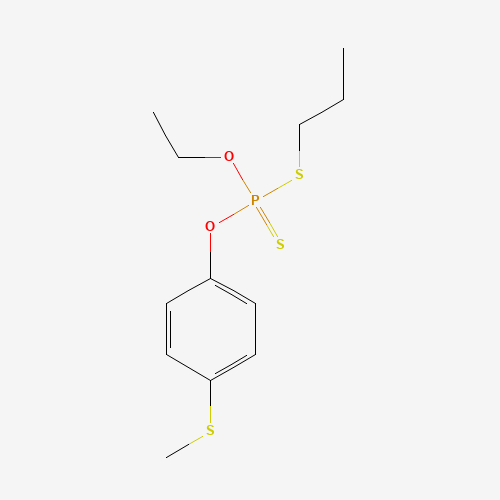
CAS35400-43-2
分子式C12H19O2PS3
分子量322.447 g/mol
非危品
Physical Description | Sulprofos is a tan-colored liquid with a sulfide-like odor. (NIOSH, 2024)
科学粮草官-词典编辑部,修订于:2026-07-06
Toxicity
ToxicityEPA Ecotoxicity
Pesticide Ecotoxicity Data from EPA: 23
Ecotoxicity Values
USDA APHIS Chemical Effects: collection=usda_chemeffect&query_type=synonym&query='^35400-43-2$'
Fate Summary
ATMOSPHERIC FATE: According to a model of gas/particle partitioning of semivolatile organic compounds in the atmosphere(1), sulprofos, which has a vapor pressure of 6.3X10⁻⁷ mm Hg at 20 °C(2), is expected to exist in both the vapor and particulate phases in the ambient atmosphere. Vapor-phase sulprofos is degraded in the atmosphere by reaction with photochemically-produced hydroxyl radicals(SRC); the half-life for this reaction in air is estimated to be 4 hours(SRC), calculated from its rate constant of 1.1X10⁻¹⁰ cu cm/molecule-sec at 25 °C(SRC) that was derived using a structure estimation method(3). Particulate-phase sulprofos may be removed from the air by wet and dry deposition(SRC). Sulprofos is also susceptible to direct photolysis; for thin films in sunlight, 50% decomposition wa...
Soil Adsorption / Mobility
Experimental Koc values for sulprofos are 12,000(1) and 13,500(2). According to a classification scheme(2), these estimated Koc values suggest that sulprofos is expected to be immobile in soil(SRC).
Environmental Biodegradation
Sulprofos exhibited significant biodegradation in the presence of nonsterile sediment/estuarine water slurries(1). The study involved a shake-flask test containing estuarine water only or water and sediment and the first order rate constants were 0.00817 1/hr in estuarine water and sediment and 0.00148 1/hr in estuarine water only(1). The respective half-lives are 3.5 days and 19.5 days(SRC). The half-life of sulprofos in soils ranges from several days to several weeks depending upon soil type, and the major metabolites are sulprofos sulfoxide and sulprofos sulfone(2). Sulprofos was rapidly degraded in a simulated pond consisting of 6 liters of pond water and 5 grams of a Lufkin sandy loam placed in an outdoor environment(3). Only about 2% of the nominal amount of sulprofos applied to t...
Environmental Bioconcentration
An estimated BCF of 3,300 was calculated for sulprofos(SRC), using a log Kow of 5.48(1) and a regression-derived equation(2). According to a classification scheme(3), this BCF suggests the potential for bioconcentration in aquatic organisms is very high(SRC).
Volatilization from Water / Soil
The Henry's Law constant for sulprofos is estimated as 8.6X10⁻⁷ atm-cu m/mole(SRC) derived from its vapor pressure, 6.3X10⁻⁷ mm Hg(1), and water solubility, 0.31 mg/l at 20 °C(1). This Henry's Law constant indicates that sulprofos is expected to be essentially nonvolatile from water surfaces(2). Sulprofos's estimated Henry's Law constant indicates that volatilization from moist soil surfaces is not expected to be an important environmental fate process(SRC). Sulprofos is not expected to volatilize from dry soil surfaces(SRC) based upon its vapor pressure(1).
Environmental Abiotic Degradation
The rate constant for the vapor-phase reaction of sulprofos with photochemically-produced hydroxyl radicals has been estimated as 1.1X10⁻¹⁰ cu cm/molecule-sec at 25 °C(SRC) using a structure estimation method(1). This corresponds to an atmospheric half-life of about 4 hours at an atmospheric concentration of 5X10+5 hydroxyl radicals per cu cm(1). The hydrolysis half lives of sulprofos at 22 °C are 26 days at pH 4, 151 days at pH 7 and 51 days at pH 9(2). It also photodegrades in water and on soil surfaces; for thin films in sunlight, 50% decomposition occurs in <2 days(2). Sulprofos was degraded roughly 82%, 90%, and 92% on cotton foliage, glass plates, and in dilute aqueous solution when exposed to sunlight for 2 days(3).
Environmental Water Concentrations
GROUNDWATER: According to the California well inventory database, none of the 34 wells sampled in Del Norte and Siskiyou counties in California between 7/1/94 and 6/30/95 had detectable levels of sulprofos(1). After a review of the literature, sulprofos was reported in groundwater from normal agricultural use in only 1 unspecified state(2). The number of detections and the state were not reported. According to EPA's Pesticides in Groundwater Database, sulprofos was not found in groundwater samples from California (n=2) in 1987-1988, Indiana (n=161) in 1987-1988, and Hawaii (n=8) in 1986; of the 59 wells sampled in Iowa in 1985-1987, only one contained sulprofos at 1.3 -1.4 ug/L(3).
Food Survey Values
Sulprofos was not found on any of the 81 commodities (6970 produce samples) in a 1989 pesticide screening program in San Antonio, TX(2). The detection limit was 0.75 ppm.
Plant Concentrations
Results of five field studies reporting the half-lives of dislodgeable residues on cotton plants in Arizona were: 1.0, 0.9, 0.76, 0.8, and 0.6 days(1). In these studies 0 to 12.3 mm of rain fell and the mean temperature ranged from 27.0 to 31.4 °C. A similar study in Texas resulted in a half-life of 0.5 days(1). In a study of foliar washoff, sulprofos was applied to mature cotton plants as an emulsifiable concentrate with a water carrier and simulated rain (51 mm in 1 hr) was applied at different times after application(2). Residues became increasingly resistant to washoff with increasing time interval between application and initial rainfall with 92%, 75%, and 50% washoff when the initial rain occurred 2, 29, and 146 hours after application. The mean amount of insecticide washed from t...
ICSC Environmental Data
The substance is very toxic to aquatic organisms. The substance may cause long-term effects in the aquatic environment. This substance may be hazardous to the environment. Special attention should be given to fish and wildlife. This substance does enter the environment under normal use. Great care, however, should be taken to avoid any additional release, for example through inappropriate disposal.
Artificial Pollution Sources
Sulprofos's former production and use as a pesticide(1), resulted in its direct release to the environment(SRC). All registrations for sulprofos have been cancelled. The last tolerance for sulprofos (cottonseed) was cancelled in 1999(2).
Probable Routes of Human Exposure
Since sulprofos is no longer registered or used as a pesticide in the United States(1), the potential for occupational exposure and general population exposure is considered low.(SRC).
Environmental Fate / Exposure Summary
Sulprofos's former production and use as a pesticide, resulted in its direct release to the environment. If released to air, a vapor pressure of 6.3X10⁻⁷ mm Hg at 20 °C indicates sulprofos will exist in both the vapor and particulate phases in the ambient atmosphere. Vapor-phase sulprofos will be degraded in the atmosphere by reaction with photochemically-produced hydroxyl radicals; the half-life for this reaction in air is estimated to be 4 hours. Particulate-phase sulprofos will be removed from the atmosphere by wet and dry deposition. Sulprofos absorbs light in the environmental UV spectrum and is susceptible to direct photolysis. A half-life of less than 2 days was observed for thin films of sulprofos exposed to direct sunlight. If released to soil, sulprofos is expected to have no...
Symptoms
nausea, vomiting, abdominal cramps, diarrhea, salivation; headache, dizziness, lassitude (weakness, exhaustion); rhinorrhea (discharge of thin nasal mucus), chest tightness; blurred vision, miosis; cardiac irreg; muscle fasciculation; dyspnea (breathing difficulty)
Interactions
Anticholinesterase (organophosphorus) insecticides antagonize polarizing muscle relaxants. Phenothiazines /and thioxanthenes/: ...May enhance toxic effects of organophosphorus insecticides. /Insecticides, organophosphorus/
Target Organs
respiratory system, central nervous system, cardiovascular system, blood cholinesterase
Adverse Effects
ACGIH Carcinogen - Not Classifiable.
Exposure Routes
inhalation, ingestion
USGS Health-Based Screening Levels for Evaluating Water-Quality
Reference: Smith, C.D. and Nowell, L.H., 2024. Health-Based Screening Levels for evaluating water-quality data (3rd ed.). DOI:10.5066/F71C1TWP









