


 一键配货
一键配货
化合物详情
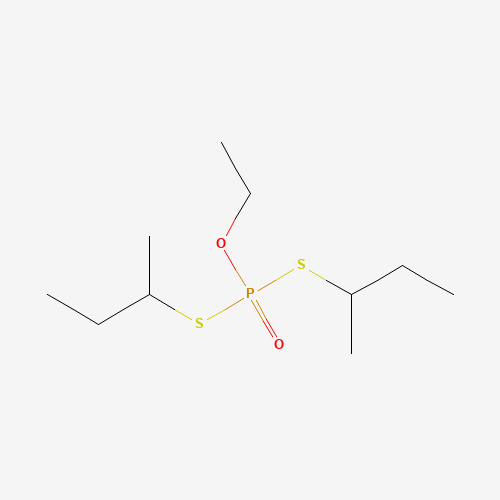
CAS95465-99-9
分子式C10H23O2PS2
分子量270.392 g/mol
非危品
Cadusafos is an organothiophosphate insecticide and an organic thiophosphate. It has a role as a nematicide, an agrochemical and an EC 3.1.1.7 (acetylcholinesterase) inhibitor.
科学粮草官-词典编辑部,修订于:2026-07-06
Toxicity
ToxicityEPA Ecotoxicity
Pesticide Ecotoxicity Data from EPA: 9
Ecotoxicity Values
LC50; Species: /Lepomis macrochirus/ (Bluegill sunfish); Concentration: 0.17 mg/L for 96 hr /Conditions of bioassay not specified/
Fate Summary
ATMOSPHERIC FATE: According to a model of gas/particle partitioning of semivolatile organic compounds in the atmosphere(1), cadusafos, which has a vapor pressure of 9.0X10⁻⁴ mm Hg at 25 °C(2), is expected to exist solely as a vapor in the ambient atmosphere. Vapor-phase cadusafos is degraded in the atmosphere by reaction with photochemically-produced hydroxyl radicals(SRC); the half-life for this reaction in air is estimated to be 3 hours(SRC), calculated from its rate constant of 1.2X10⁻¹⁰ cu cm/molecule-sec at 25 °C(SRC) that was derived using a structure estimation method(3). A half-life of <115 days in light has been reported, but the medium and wavelengths were not specified(2).
Soil Adsorption / Mobility
Koc values ranging from 77.50 to 621.43 were determined for cadusafos in 6 soils from the Martinique, French West Indies and Languedoc, South of France(1). Koc values of 144 to 351 were also reported for cadusafos(2). According to a classification scheme(3), Koc values in the ranges of 50-150, 150-500, and 500-2000 indicate high, moderate and low mobility, respectively. Clay and cation exchange capacity of the soils affected adsorption-desorption parameters(1). Higher Koc values were observed for those soils with higher clay and cation exchange capacity(1).
Environmental Biodegradation
AEROBIC: Half-lives ranging from 37.3 to 42.6 days at 25 °C and 27.0 to 37.8 days at 35 °C were determined for cadusafos in 6 soils from the Martinique, French West Indies and Languedoc, South of France(1). Soil half-lives of 14 to 16 days were reported for cadusafos, summer half-life of 11.4 days and 20 days in the winter were also reported(2). Soil half-life decreased directly proportional to soil moisture and indirectly proportional to soil temperature(2).
Environmental Bioconcentration
An estimated BCF of 175 was calculated in fish for cadusafos(SRC), using a log Kow of 3.9(1) and a regression-derived equation(2). According to a classification scheme(3), this BCF suggests the potential for bioconcentration in aquatic organisms is high, provided the compound is not metabolized by the organism(SRC). However, bioconcentration studies on structurally similar ethoprophos which had a BCF range of 4 to 17 measured in juvenile sheepshead minnow (Cyprinodon variegatus)(4), suggests that bioconcentration may be lower than that indicated by the regression-derived equations.
Volatilization from Water / Soil
The Henry's Law constant for cadusafos is estimated as 1.3X10⁻⁶ atm-cu m/mole(SRC) derived from its vapor pressure, 9.0X10⁻⁴ mm Hg(1), and water solubility, 245 mg/L(1). This Henry's Law constant indicates that cadusafos is expected to volatilize from water surfaces(2). Based on this Henry's Law constant, the volatilization half-life from a model river (1 m deep, flowing 1 m/sec, wind velocity of 3 m/sec)(2) is estimated as 45 days(SRC). The volatilization half-life from a model lake (1 m deep, flowing 0.05 m/sec, wind velocity of 0.5 m/sec)(2) is estimated as 340 days(SRC). Cadusafos' Henry's Law constant indicates that volatilization from moist soil surfaces may occur(SRC). Cadusafos is not expected to volatilize from dry soil surfaces(SRC) based upon its vapor pressure(1).
Environmental Abiotic Degradation
The rate constant for the vapor-phase reaction of cadusafos with photochemically-produced hydroxyl radicals has been estimated as 1.2X10⁻¹⁰ cu cm/molecule-sec at 25 °C(SRC) using a structure estimation method(1). This corresponds to an atmospheric half-life of about 3 hours at an atmospheric concentration of 5X10+5 hydroxyl radicals per cu cm(1). A half-life of <115 days in light has been reported, but the medium and the wavelengths were not specified(2). Ethoprophos, a structurally similar chemical to cadusafos, is stable in neutral and weakly acidic media and is rapidly hydrolyzed in alkaline media(3); the hydrolytic half-life of ethoprophos in distilled water was reported as 25 days(4).
Environmental Water Concentrations
SURFACE WATER: Pesticide residues in surface waters in the Suerte River Basin, Costa Rica that drain into the Tortuguero conservation area were 0.03-0.5, 0.6-3, and 0.08-0.2 ug/L in the Suerte River, streams, and the conservation area, respectively. Cadusafos was found to occur with a frequency of 48, 48, and 25% of water samples from the Suerte River, streams, and the conservation area, respectively; samples were collected from June 1993 to December 1996(1).
Food Survey Values
Cadusafos was not detected in peel, rind or juice of kinnow (Citrus reticulata) 15 days after application(1). Residual traces were found in the fruit, but never exceeded a cumulative cadusafos concentration of 0.008 g/g(1).
Ecotoxicity Excerpts
/FIELD STUDIES/ Pesticides used in banana production may enter watercourses and pose ecological risks for aquatic ecosystems. The occurrence and effects of pesticides in a stream draining a banana plantation was evaluated using chemical characterization, toxicity testing and macrobenthic community composition. All nematicides studied were detected in the surface waters of the banana plantation during application periods, with peak concentrations following applications. Toxicity tests were limited to the carbofuran application and no toxicity was observed with the acute tests used. However, since pesticide concentrations were generally below the lowest LC50 value for crustaceans but above calculated aquatic quality criteria, there remains a risk of chronic toxicity. Accurate ecological a...
Effluent Concentrations
Cadusafos was not found in banana packing plant effluents in the Suerte River Basin, Costa Rica; samples were collected from June 1993 to December 1996(1).
Artificial Pollution Sources
Cadusafos' production may result in its release to the environment through various waste streams; its use outside the US as a nematicide and insecticide(1) results in its direct release to the environment(SRC).
Sediment/Soil Concentrations
SEDIMENT: Cadusafos was detected in 1 of 37 sediment samples from streams in the Suerte River Basin, Costa Rica at a concentration of 16 ug/kg dry weight; samples were collected from June 1993 to December 1996(1).
Probable Routes of Human Exposure
UNREVIEWED | Occupational exposure to cadusafos may occur through inhalation and dermal contact with this compound at workplaces where cadusafos is produced(SRC). Exposure to cadusafos among the general population should be low or non-existent(SRC), since cadusafos is no longer registered for use in the US(1,2).
Environmental Fate / Exposure Summary
Cadusafos' production may result in its release to the environment through various waste streams; its use outside the US as a nematicide and insecticide will result in its direct release to the environment. If released to air, a vapor pressure of 9.0X10⁻⁴ mm Hg at 25 °C indicates cadusafos will exist solely as a vapor in the atmosphere. Vapor-phase cadusafos will be degraded in the atmosphere by reaction with photochemically-produced hydroxyl radicals; the half-life for this reaction in air is estimated to be 3 hours. A half-life of <115 days in light has been reported, but the medium and wavelengths were not specified. If released to soil, cadusafos is expected to have high to low mobility, depending on soil type, based upon Koc values of 77.5 to 621.43. Volatilization from moist soil...
Effect Level
collection=toxvaldb&kind=^EL$
Lethal Dose
collection=toxvaldb&kind=^LD$
Toxicity Data
LC50 (rat) = 32 mg/m3/4h
Adverse Effects
ACGIH Carcinogen - Not Classifiable.
Lethal Concentration
collection=toxvaldb&kind=^LC$
RAIS Toxicity Values
Oral Chronic Reference Dose Reference: OPP
Human Toxicity Excerpts
/SIGNS AND SYMPTOMS/ Re-exposures. Persons who have been clinically poisoned by organophosphate pesticides should not be re-exposed to cholinesterase inhibiting chemicals until symptoms and signs have resolved completely and blood cholinesterase activities have returned to at least 80 percent of pre-poisoning levels. If blood cholinesterase was not measured prior to poisoning, blood enzyme activities should reach at least minimum normal levels before the patient is returned to a pesticide contaminated environment. /Organophosphate pesticides/
Non-Human Toxicity Values
LD50 Rat (male) oral 679 mg/kg
Reference and Risk Values
collection=toxvaldb&kind=^RRV$
Non-Human Toxicity Excerpts
/LABORATORY ANIMALS: Subchronic or Prechronic Exposure/ Groups of 2 male and 2 female beagle dogs were given technical Cadusafos capsule at doses of 0, 0.001, 0.005, 0.02, 0.10 and 1.0 mg/kg for 14 days. Clinical signs and food consumption were measured daily. Hematological and blood chemistries were determined on each dog during the pretest period and prior to the terminal sacrifice. Plasma and red blood cell (RBC) cholinesterase (ChE) activities were determined twice at pretest and once after Days 3, 7, 10 and 14. Brain ChE activity was determined at the end of the study along with gross pathology and histology. There were no clinical signs or adverse effects on food consumption, body weight or weight gain in treated dogs of either sex. There were no treatment-related effects on any h...
Evidence for Carcinogenicity
Cancer Classification: Group E Evidence of Non-carcinogenicity for Humans
Antidote and Emergency Treatment
Pralidoxime. Before administration of pralidoxime, draw a blood sample (heparinized) for cholinesterase analysis (since pralidoxime tends to reverse the cholinesterase depression). Administration pralidoxime (Protopam, 2-PAM), a cholinesterase reactivator, in cases of severe poisoning by organophosphate pesticides in which respiratory depression, muscle weakness, and/or twitching are severe. When administered early (usually less than 48 hours after poisoning) pralidoxime relieves the nicotinic as well as the muscarinic effects of poisoning. Pralidoxime works by reactivating the cholinesterase and also by slowing the "aging" process of phosphorylated cholinesterase to a non-reactivatable form. ... Dosage of pralidoxime may be repeated in 1-2 hours, then at 10-12 hour intervals if needed....









