


 一键配货
一键配货
化合物详情
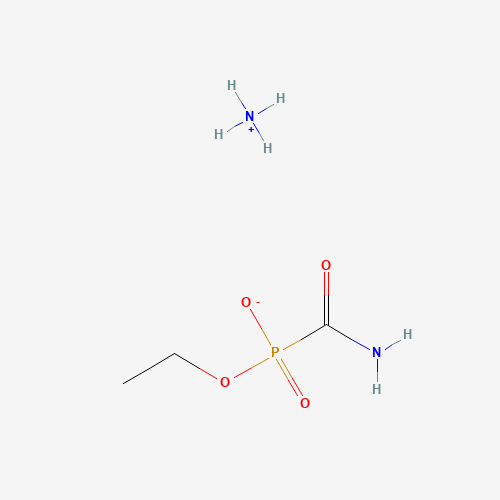
CAS25954-13-6
分子式C3H11N2O4P
分子量170.1042 g/mol
非危品
科学粮草官-词典编辑部,修订于:2026-07-06
Toxicity
ToxicityEPA Ecotoxicity
Pesticide Ecotoxicity Data from EPA: 26
Soil Adsorption / Mobility
In field studies (conducted in DE, FL, and IL), greenhouse studies, and soil column studies, fosamine-ammonium was found to leach very little, either downward or laterally(1); most undegraded fosamine-ammonium remained in the upper 4 inches of soil(1).
Environmental Biodegradation
Laboratory studies in biometer flasks on two soil types (pHs of 6.4 and 6.5) treated with C-14 fosamine-ammonium demonstrated rapid degradation by microbial action(1); 14-CO2 evolution in nonsterile soils reached 45-75% after 90 days(1); in soil sterilized by a single autoclaving at steam pressure for 15 min, 14-CO2 evolution was only 8-18%(2).
Environmental Bioconcentration
Based upon a water solubility of 1.79 kg/L at 25 °C(1), the BCF of fosamine-ammonium can be estimated to be 0.2 from a recommended regression derived equation(2,SRC). The BCF value indicates that bioconcentration in aquatic organisms is not an important fate process(SRC). In bioaccumulation studies using channel catfish and (14)C fosamine-ammonium, fosamine-ammonium BCFs of less than 1 were measured(2).
Volatilization from Water / Soil
Based upon a vapor pressure of 4X10⁻⁶ mm Hg(1) and a water solubility of 1.79 kg/l at 25 °C(1), the Henry's Law constant for fosamine-ammonium can be estimated to be 5X10-13 atm-cu m/mole (SRC). This value of Henry's Law constant indicates that fosamine-ammonium is essentially nonvolatile from water(2).
Environmental Abiotic Degradation
The rate constant for the vapor phase reaction of fosamine-ammonium with photochemically produced hydroxyl radicals has been estimated to be 4.9X10⁻¹¹ cu cm/molecule-sec at 25 °C which corresponds to an atmospheric half-life of about 7.9 hours at an atmospheric concn of 5X10+5 hydroxyl radicals per cu cm(1,SRC). In aqueous hydrolysis studies using buffered water at 20 °C, less than 3% of initial fosamine-ammonium degraded over a 4 week period at pHs of 7 and 9(2); however, at pH 5, a degradation half-life of about 10 days was observed(2). Fosamine-ammonium was found to be stable (less than 2% degradation over 4 weeks) to direct photolysis and photosensitized photolysis (using riboflavin and anthraquinone sensitizers) in photolysis studies using sunlight and water at pH 7.9 and a Brandyw...
Artificial Pollution Sources
Fosamine-ammonium's use as a contact herbicide(1-3) releases the compound directly to the environment through applications in sprays and other routes of application(SRC).
Probable Routes of Human Exposure
Occupational exposure to fosamine-ammonium occurs through dermal contact and inhalation of dust and sprays, especially to workers applying the compound as a herbicide(1).
Environmental Fate / Exposure Summary
Fosamine-ammonium's use as a contact herbicide releases the compound directly tothe environment through applications in sprays and other routes of application. If released to the atmosphere, fosamine-ammonium will degrade rapidly in the vapor phase by reaction with photochemically produced hydroxyl radicals (half-life of about 7.9 hr). Particulate phase fosamine-ammonium will be removed physically from air by wet and dry deposition. If released to soil or water, fosamine-ammonium can degrade through biodegradation and aqueous hydrolysis; however, hydrolysis will be important only in very acidic soils and water. Results of field, greenhouse and soil column studies have demonstrated that fosamine-ammonium is unlikely to leach under environmental conditions. Field and greenhouse persistenc...
Toxicity Data
LC50 (rat) > 57,000 mg/m3/1h
Non-Human Toxicity Values
LC50 Rat oral 24000 mg/kg
Non-Human Toxicity Excerpts
Fosamine ammonium has been reported to be teratogenic to avian embryos following spray application of the eggs. The embryotoxic and teratogenic potential of fosamine ammonium was examined in mallards (Anas platyrhynchos) and bobwhite (Colinus virginianus). At 96 hr of development, eggs were briefly immersed in distilled water or in fosamine ammonium formulation in distilled water at concentrations of 1.5, 6.5, or 30% fosamine ammonium. At 6.5% ai, fosamine ammonium reduced hatching success in bobwhite and mallards to 85 and 33% of that in the distilled water controls. At 30% ai, fosamine ammonium caused 95 to 100% mortality in both species by the time of hatching. Early embryonic growth was impaired by 30% fosamine ammonium in both species. There was no evidence of teratogenesis of the...
Antidote and Emergency Treatment
2. B. IF THE AMOUNT OF INGESTED HERBICIDES WAS SMALL, IF EFFECTIVE EMESIS HAS ALREADY OCCURRED, OR IF TREATMENT IS DELAYED, ADMINISTER THE ACTIVATED CHARCOAL AND SORBITOL BY MOUTH. C. IF SERIOUS DEHYDRATION AND ELECTROLYTE DEPLETION HAVE OCCURRED AS A RESULT OF VOMITING AND DIARRHEA, MONITOR BLOOD ELECTROLYTES AND AND FLUID BALANCE AND ADMINISTER INTRAVENOUS INFUSIONS OF GLUCOSE, NORMAL SALINE RINGER'S SOLUTION, OR RINGER'S LACTATE TO RESTORE EXTRACELLULAR FLUID VOLUME AND ELECTROLYTES. FOLLOW THIS WITH ORAL NUTRIENTS AS SOON AS FLUIDS CAN BE RETAINED. FLUIDS SERVE TO SUPPORT EXCRETION OF THE TOXICANTS. D. SUPPORTIVE MEASURES ARE ORDINARILY SUFFICIENT FOR SUCCESSFUL MANAGEMENT OF EXCESSIVE EXPOSURES TO THESE HERBICIDES. /OTHER HERBICIDES/









