


 一键配货
一键配货
化合物详情
CAS7292-16-2
分子式C13H21O4PS
分子量304.342 g/mol
非危品
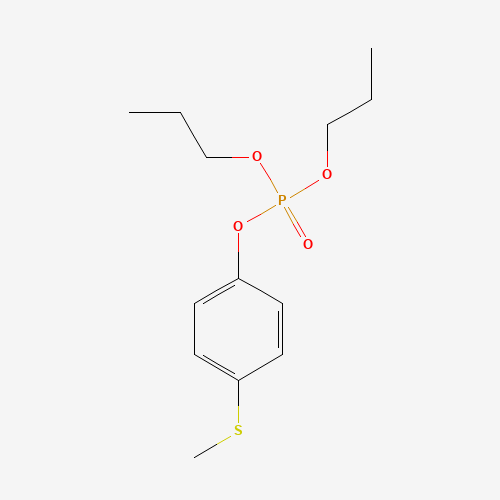
Propaphos is an organophosphate insecticide and a dialkyl aryl phosphate. It has a role as an agrochemical and an EC 3.1.1.7 (acetylcholinesterase) inhibitor. It is functionally related to a 4-(methylsulfanyl)phenol.
科学粮草官-词典编辑部,修订于:2026-07-06
Toxicity
ToxicityEcotoxicity Values
LC50 Carp 4.8 ppm (48 hr) /Conditions of bioassay not specified/
Fate Summary
ATMOSPHERIC FATE: According to a model of gas/particle partitioning of semivolatile organic compounds in the atmosphere(1), propaphos, which has a vapor pressure of 9.0X10⁻⁷ mm Hg at 25 °C(2)), will exist in both the vapor and particulate phases in the ambient atmosphere. Vapor-phase propaphos is degraded in the atmosphere by reaction with photochemically-produced hydroxyl radicals(SRC); the half-life for this reaction in air is estimated to be 6.4 hours(SRC), calculated from its rate constant of 6.0X10⁻¹¹ cu cm/molecule-sec at 25 °C(SRC) that was derived using a structure estimation method(3). Particulate-phase propaphos may be removed from the air by wet and dry deposition(SRC).
Soil Adsorption / Mobility
Using a structure estimation method based on molecular connectivity indices(1), the Koc for propaphos can be estimated to be 400(SRC). According to a classification scheme(2), this estimated Koc value suggests that propaphos is expected to have moderate mobility in soil.
Environmental Bioconcentration
An estimated BCF of 22 was calculated for propaphos(SRC), using a log Kow of 3.67(1) and a regression-derived equation(2). According to a classification scheme(3), this BCF suggests the potential for bioconcentration in aquatic organisms is low, provided the compound is not altered physically or chemically after being released into the environment(SRC).
Volatilization from Water / Soil
The Henry's Law constant for propaphos is 2.9X10⁻⁹ atm-cu m/mole(SRC) derived from its vapor pressure, 9.0X10⁻⁷ mm Hg(1), and water solubility, 125 mg/l(2). This Henry's Law constant indicates that propaphos is expected to be essentially nonvolatile from water surfaces(3). Phopaphos' Henry's Law constant indicates that volatilization from moist soil surfaces is not expected to occur(SRC). Propaphos is not expected to volatilize from dry soil surfaces(SRC) based upon its vapor pressure(1).
Environmental Abiotic Degradation
The rate constant for the vapor-phase reaction of propaphos with photochemically-produced hydroxyl radicals has been estimated as 6.0X10⁻¹¹ cu cm/molecule-sec at 25 °C(SRC) using a structure estimation method(1). This corresponds to an atmospheric half-life of about 6.4 hours at an atmospheric concentration of 5X10+5 hydroxyl radicals per cu cm(1). In natural waters, oxidation on the sulfur atom is the main route of degradation and the second route is hydrolysis producing phenolic compounds(2). When an aqueous solution of propaphos was irradiated with a xenon lamp, propaphos was almost completely degraded in the range of 290-320 nm after 60 minutes(3). After 60 minutes of irradiation at 330, 340, and 360 nm, the percent recovery from solution was approximately 20, 60, and 80, respective...
Environmental Water Concentrations
SURFACE WATER: Propaphos was not detected (detection limit=0.01 ng/l) in water (Apr 1992-Mar 1993) from 7 rivers flowing into Lake Biwa, Japan(1).
Milk Concentrations
Many of the organophosphorus insecticides are excreted in the milk ... /Organophosphorus insecticides/
Ecotoxicity Excerpts
/OTHER TERRESTRIAL SPECIES/ Toxic to bees.
Artificial Pollution Sources
Propaphos' production may have result in its release to the environment through various waste streams; its use as an insecticide(1) will result in its direct release to the environment(SRC). Propaphos is registered for use in Japan and Taiwan(2).
Probable Routes of Human Exposure
Secondary exposure of children through contact with their parents' contaminated clothing can also occur. /Organophosphorus pesticides/
Environmental Fate / Exposure Summary
Propaphos' production may result in its release to the environment through various waste streams; its use as an insecticide results in its direct release to the environment. If released to air, a vapor pressure of 9.0X10⁻⁷ mm Hg at 25 °C indicates propaphos will exist in both the vapor and particulate phases in the ambient atmosphere. Vapor-phase propaphos will be degraded in the atmosphere by reaction with photochemically-produced hydroxyl radicals; the half-life for this reaction in air is estimated to be 6.4 hours. Particulate-phase propaphos will be removed from the atmosphere by wet and dry deposition. If released to soil, propaphos is expected to have moderate mobility based upon an estimated Koc of 400. Volatilization from moist soil surfaces is not expected to be an important fa...
Interactions
Because different classes of enzymes may be inhibited, the effects of organophosphorus pesticide poisoning may be complex and potentially at least could involve interactions with drugs as well as with other pesticides or chemicals. Potentiation may also involve solvents or other components of formulated pesticides. Certain drugs such a phenothiazines, antihistamines, CNS depressants, barbiturates, xanthines (theophylline), aminoglycosides and parasympathomimetic agents are to be avoided because of increased toxicity. /Organophosphorus pesticides/
Adverse Effects
Other Poison - Organophosphate
Non-Human Toxicity Values
LD50 Rabbit oral 82.5 mg/kg
Non-Human Toxicity Excerpts
/LABORATORY ANIMALS: Chronic Exposure or Carcinogenicity/ In 2 yr studies, /the NOEL/ for rats 0.08, mice 0.05 mg/kg bw.









