

 一键配货
一键配货
化合物详情
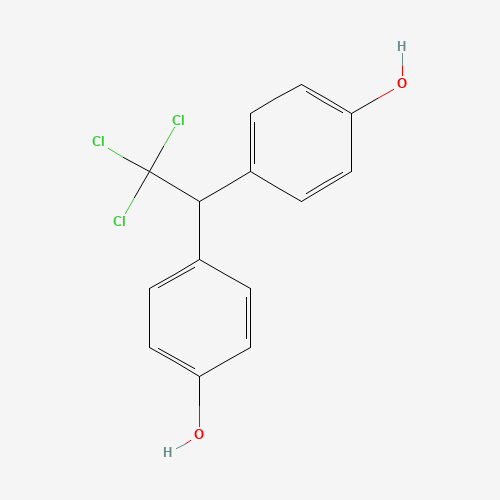
CAS2971-36-0
分子式C14H11Cl3O2
分子量317.595 g/mol
非危品
1,1,1-trichloro-2,2-bis(4-hydroxyphenyl)ethane is a bisphenol. It is functionally related to a 1,1,1-trichloro-2,2-diphenylethane.
科学粮草官-词典编辑部,修订于:2026-07-06
Toxicity
ToxicitySymptoms
High levels of methoxychlor/HPTE may cause fatigue, lethargy, tremors, convulsions and seizures. (T10, L167)
Effect Level
collection=toxvaldb&kind=^EL$
Lethal Dose
collection=toxvaldb&kind=^LD$
Toxicity Data
LD50: 3460 mg/kg (Oral, Rat) (L167)
Health Effects
Animal studies show that HPTE may affect the reproductive system, causing harm to the ovaries, uterus, and mating cycle in females, and the testes and prostate in males, as well as decreased fertility in both sexes. Low dose HPTE exposure may also cause EEG pattern changes. (T10, L167)
Exposure Routes
Internal (Blood)
Toxicity Summary
2,2-bis(p-hydroxyphenyl)-1,1, 1-trichloroethane (HPTE), acts as an estrogen analogue. HPTE is an estrogen receptor alpha agonist, and also acts as an antagonist at the estrogen receptor beta and androgen receptor. HPTE specifically inhibits the P450 cholesterol side-chain cleavage enzyme (P450scc, CYP11A1) resulting in decreased androgen production testicular Leydig cells along with decreased progesterone production by ovarian cells (A7861). HPTE directly inhibit human CYP17A1 activity (17α-hydroxylase/17,20-lyase). The IC50 value of HPTE is 1.13±0.10 uM. The observed changed in EEG patterns as well as tremors, convulsion and seizures with acute methoxychlor/HPTE exposure may be due to the inhibition of key sodium/potassium and calcium channels by HPTE.
Minimum Risk Level
Intermediate Oral: 0.005 mg/kg/day (L134)
Carcinogen Classification
No indication of carcinogenicity (not listed by IARC). (L135)