


 一键配货
一键配货
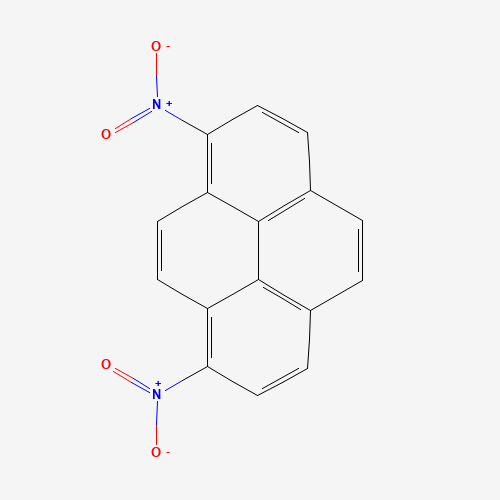
化合物详情
CAS42397-65-9
分子式C16H8N2O4
分子量292.2457 g/mol
非危品
1,8-Dinitropyrene can cause cancer according to The World Health Organization's International Agency for Research on Cancer (IARC).
科学粮草官-词典编辑部,修订于:2026-07-06
Toxicity
ToxicityFate Summary
ATMOSPHERIC FATE: According to a model of gas/particle partitioning of semivolatile organic compounds in the atmosphere(1), 1,8-dinitropyrene, which has an estimated vapor pressure of 9.1X10⁻¹⁰ mm Hg at 25 °C(SRC), determined from a fragment constant method(2), is expected to exist solely in the particulate phase in the ambient atmosphere. Particulate-phase 1,8-dinitropyrene may be removed from the air by wet or dry deposition(SRC). 1,8-Dinitropyrene absorbs at wavelengths >310 nm(3), and therefore may be susceptible to direct photolysis by sunlight(SRC).
Soil Adsorption / Mobility
Using a structure estimation method based on molecular connectivity indices(1), the Koc of 1,8-dinitropyrene can be estimated to be 1.4X10+5(SRC). According to a classification scheme(2), this estimated Koc value suggests that 1,8-dinitropyrene is expected to be immobile in soil.
Environmental Biodegradation
AEROBIC: Biodegradation data under environmental conditions were not available(SRC, 2010). Resistence to microbial degradation of higher molecular weight nitropolyaromatic hydrcarbons is due partly to their strong adsorption to soil organic matter and low solubility(1). /Nitro-polyaromatic hydrocarbons/
Environmental Bioconcentration
An estimated BCF of 480 was calculated in fish for 1,8-dinitropyrene(SRC), using an estimated log Kow of 4.57(1) and a regression-derived equation(2). According to a classification scheme(3), this BCF suggests the potential for bioconcentration in aquatic organisms is high, provided the compound is not metabolized by the organism(SRC).
Volatilization from Water / Soil
The Henry's Law constant for 1,8-dinitropyrene is estimated as 1.3X10⁻¹⁰ atm-cu m/mole(SRC) using a fragment constant estimation method(1). This Henry's Law constant indicates that 1,8-dinitropyrene is expected to be essentially nonvolatile from water surfaces(2). 1,8-Dinitropyrene is not expected to volatilize from dry soil surfaces(SRC) based upon an estimated vapor pressure of 9.1X10⁻¹⁰ mm Hg(SRC), determined from a fragment constant method(3).
Environmental Abiotic Degradation
1,8-Dinitropyrene is not expected to undergo hydrolysis in the environment due to the lack of functional groups that hydrolyze under environmental conditions(1). Half-lives of 0.7 and 5.7 days were reported when the compound was exposed to light at >310 nm in DMSO and following coating on to silica, respectively(2).
Effluent Concentrations
1,8-Dinitropyrene concentration in emissions from a diesel power plant on the Harvard campus in Massachusetts was less than 8 ppm in the soluble organic fraction. Concentration ranged from not detected to 4 ppm in the soluble organic fraction of diesel-powered mobile emission sources; sampling was conducted in 1983. The emission rate of 1,8-dinitropyrene from the power plant was <6X10⁻⁸ lb/BTU (quantification limit), with an annual contribution to Boston ambient air of <0.14 tons from both the plant and mobile diesel sources(1). The concentration of 1,8-nitropyrene in emission particulates from diesel (1986 model) and gasoline (1989 model) engine vehicles was reported as 0.44 and 0.45 pmol/mg particulate, respectively(2). Exhaust particle concentrations of 3.4 and 0.013-0.7 mg/kg have b...
Atmospheric Concentrations
SOURCE DOMINATED: The concentration ranges for 1,8-dinitropyrene were 58.3-293.0 pg/cu m (indoors) and 3.2-22.5 pg/cu m (outdoors) in air samples from a Taiwanese temple in Taichung County, central Taiwan; the source was attributed to burning of incense. Atmospheric concentrations ranged from 2.8-12.0 pg/cu m and the overall indoor emission average was 180.5 pg/cu m(1). The mean concentration of 1,8-dinitropyrene in ambient air samples collected from two industrial areas (River Rouge, MI 2-4 km from industries including steel mills, coke ovens, power plants, a refinery, and chemical works, 1982-1983 and from Dearborn, MI - steel mills and coke ovens, 1980-1983) was reported to be 0.0131 and 0.0200 ug/g particulates, respectively(2).
Artificial Pollution Sources
1,8-Dinitropyrene is a nitrated polycyclic aromatic hydrocarbon which is formed as a result of combustion of petrochemical fuel, preparation of food with grilling, cigarette smoking, activities associated with occupational settings such as the coke-oven industry, or photochemical reactions of polycyclic aromatic hydrocarbons with ambient or atmospheric hydroxyl radicals and NO2 which form nitrated polycyclic aromatic hydrocarbons(1). These processes may result in the release of 1,8-dinitropyrene to the environment through various waste streams(SRC).
Probable Routes of Human Exposure
Occupational exposure to 1,8-dinitropyrene may occur through inhalation and dermal contact with this compound at workplaces where 1,8-dinitropyrene is formed. The most likely pathway by which the general public is exposed to 1,8-dinitropyrene is by inhalation due to the release of this substance from combustion of diesel fuels and in smoke. (SRC)
Environmental Fate / Exposure Summary
1,8-Dinitropyrene is a nitrated polycyclic aromatic hydrocarbon which is formed as a result of combustion of petrochemical fuel, preparation of food with grilling, cigarette smoking, activities associated with occupational settings such as the coke-oven industry, or photochemical reactions of polycyclic aromatic hydrocarbons with ambient or atmospheric hydroxyl radicals and NO2 which form nitrated polycyclic aromatic hydrocarbons. These processes may result in the release of 1,8-dinitropyrene to the environment through various waste streams. If released to air, an estimated vapor pressure of 9.1X10⁻¹⁰ mm Hg at 25 °C indicates 1,8-dinitropyrene will exist solely in the particulate phase in the atmosphere. Particulate-phase 1,8-dinitropyrene will be removed from the atmosphere by wet or d...
Interactions
/GENOTOXICITY/ ... The lambda/lacZ transgenic mouse (Muta Mouse) /was used/ to examine induction of mutations in multiple organs. A commercially available mixture of DNPs (1,3-, 1,6-, 1,8-, and unidentified isomer (s) with a content of 20.2, 30.4, 35.2, and 14.2%, respectively) was injected intragastrically at 200 and 400 mg/kg once each week for 4 weeks. Seven days after the final treatment, liver, lung, colon, stomach, and bone marrow were collected for mutation analysis. The target transgene was recovered by the lambda packaging method and mutation of lacZ gene was analyzed by a positive selection with galE(-) E. coli. In order to determine the sequence alterations by DNPs, the mutagenicity of the lambda cII gene was also examined by the positive selection with hfl(-) E. coli. Since...
Adverse Effects
NTP Carcinogen - Reasonably anticipated to be a human carcinogen.
RAIS Toxicity Values
Oral Slope Factor Reference: CALEPA
Human Toxicity Excerpts
/GENOTOXICITY/ The genotoxicities of 8 nitroarenes, i.e., 1-nitropyrene, 1,3-dinitropyrene, 1,6-dinitropyrene, 1,8-dinitropyrene, 2,7-dinitrofluorene, 3-nitrofluoranthene, 1-nitro-3-hydroxypyrene and 1-nitro-3-acetoxypyrene, were examined in DNA repair tests using human isolated hepatocytes. Out of the tested nitroarenes, 5 compounds, i.e., 1-nitropyrene, 1,3-dinitropyrene, 1,6-dinitropyrene, 1,8-dinitropyrene and 1-nitro-3-acetoxypyrene, clearly elicited positive responses of DNA repair. Among the chemicals which elicited positive responses, the levels of unscheduled DNA synthesis induced by the three dinitropyrene isomers were much higher than those of the other nitroarenes. Three chemicals, i.e., 2,7-dinitrofluorene, 3-nitrofluoranthene and 1-nitro-3-hydroxypyrene, elicited negative...
Carcinogen Classification
IARC Monographs: Volume 105: (2013) Diesel and Gasoline Engine Exhausts and Some Nitroarenes
Evidence for Carcinogenicity
1,8-Dinitropyrene is reasonably anticipated to be a human carcinogen based on sufficient evidence of malignant tumor formation in multiple species of experimental animals, at multiple sites, and by multiple routes of exposure.
Antidote and Emergency Treatment
/SRP:/ Advanced treatment: Consider orotracheal or nasotracheal intubation for airway control in the patient who is unconscious, has severe pulmonary edema, or is in severe respiratory distress. Positive-pressure ventilation techniques with a bag valve mask device may be beneficial. Consider drug therapy for pulmonary edema ... . Consider administering a beta agonist such as albuterol for severe bronchospasm ... . Monitor cardiac rhythm and treat arrhythmias as necessary ... . Start IV administration of D5W /SRP: "To keep open", minimal flow rate/. Use 0.9% saline (NS) or lactated Ringer's if signs of hypovolemia are present. For hypotension with signs of hypovolemia, administer fluid cautiously. Watch for signs of fluid overload ... . Treat seizures with diazepam or lorazepam ... . Use...









