


 一键配货
一键配货
化合物详情
CAS23560-59-0
分子式C9H12ClO4P
分子量250.616 g/mol
非危品
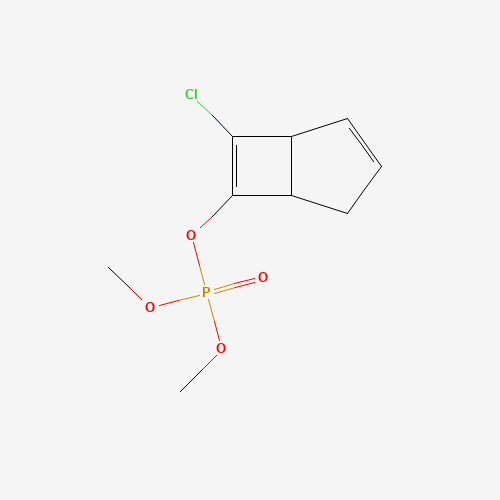
Heptenophos is an organophosphate insecticide, an organochlorine compound and a trialkyl phosphate. It has a role as an acaricide, an agrochemical and an EC 3.1.1.7 (acetylcholinesterase) inhibitor. It derives from a hydride of a bicyclo[3.2.0]hepta-2,6-diene.
科学粮草官-词典编辑部,修订于:2026-07-06
Toxicity
ToxicityEcotoxicity Values
LC50 Daphnia 2.2 ug/L/48 hr /Conditions of bioassay not specified/
Fate Summary
ATMOSPHERIC FATE: According to a model of gas/particle partitioning of semivolatile organic compounds in the atmosphere(1), heptenophos, which has a vapor pressure of 1.28X10⁻³ mm Hg at 25 °C(2), is expected to exist solely as a vapor in the ambient atmosphere. Vapor-phase heptenophos is degraded in the atmosphere by reaction with photochemically-produced hydroxyl radicals(SRC); the half-life for this reaction in air is estimated to be 4.4 hours(SRC), calculated from its rate constant of 8.7X10⁻¹¹ cu cm/molecule-sec at 25 °C(SRC) that was derived using a structure estimation method(3). Heptenophos may absorb light with wavelengths >290 nm and may be expected to be susceptible to direct photolysis by sunlight(SRC).
Soil Adsorption / Mobility
Using a structure estimation method based on molecular connectivity indices(1), the Koc for heptenophos can be estimated to be 508(SRC). According to a classification scheme(2), this estimated Koc value suggests that heptenophos is expected to have low mobility in soil.
Environmental Biodegradation
Heptenophos is rapidly degraded in soil with a field half-life of 1.4 days, depending on temperature and soil type(1). In active fresh field sandy loam soil and autoclaved soil, 22% and 0%, respectively, of the applied (6-14C)-heptenophos was released as CO2 after 240 hours(2). Field and laboratory research indicate heptenophos has short persistence in soil; half-lives ranged from 1 to 25 hr(2).
Environmental Bioconcentration
An estimated BCF of 2.0 was calculated for heptenophos(SRC), using a log Kow of 2.32(1) and a regression-derived equation(2). According to a classification scheme(3), this BCF suggests the potential for bioconcentration in aquatic organisms is low.
Volatilization from Water / Soil
The Henry's Law constant for heptenophos is 1.69X10⁻⁷ atm-cu m/mole(SRC) derived from its vapor pressure, 1.28X10⁻³ mm Hg(1), and water solubility, 2,500 mg/l(2). This Henry's Law constant indicates that heptenophos is expected to be essentially nonvolatile from water surfaces(3). This Henry's Law constant indicates that volatilization from moist soil surfaces is not expected(SRC). Heptenophos is not expected to volatilize from dry soil surfaces(SRC) based upon its vapor pressure(1).
Environmental Abiotic Degradation
The rate constant for the vapor-phase reaction of heptenophos with photochemically-produced hydroxyl radicals has been estimated as 8.7X10⁻¹¹ cu cm/molecule-sec at 25 °C(SRC) using a structure estimation method(1). This corresponds to an atmospheric half-life of about 4.4 hours at an atmospheric concentration of 5X10+5 hydroxyl radicals per cu cm(1). Heptenophos is hydrolyzed in acidic and alkaline media(2). A range of 3-23 days was reported for half-lives for hydrolysis for heptenophos; however, no experimental details were provided(3). Heptenophos may absorb light with wavelengths >290 nm and may be expected to be susceptible to direct photolysis by sunlight(SRC).
Food Survey Values
Heptenophos was not found in the Danish National Pesticide Monitoring Program 1995-1996 in selected food commodities(1). Heptenophos was detected in 1.2% of parsley samples at maximum and mean concentrations of 0.14 and 0.006 ppm, respectively, in a monitoring program of fresh vegetables, fruits, and other selected food items in Belgium 1991-1993(2).
Milk Concentrations
Many of the organophosphorus insecticides are excreted in the milk ... /Organophosphorus insecticides/
Ecotoxicity Excerpts
/PLANTS/ Non-phytotoxic when used as directed, except to some varieties of apple, sweet cherry, and rose.
Artificial Pollution Sources
Heptenophos' production may have resulted in its release to the environment through various waste streams; its use as an insecticide(1) will have resulted in its direct release to the environment(SRC).
Probable Routes of Human Exposure
Secondary exposure of children through contact with their parents' contaminated clothing can also occur. /Organophosphorus pesticides/
Environmental Fate / Exposure Summary
Heptenophos' former production may have resulted in its release to the environment through various waste streams; its use as an insecticide will have resulted in its direct release to the environment. If released to air, a vapor pressure of 1.28X10⁻³ mm Hg at 25 °C indicates heptenophos will exist solely as a vapor in the ambient atmosphere. Vapor-phase heptenophos will be degraded in the atmosphere by reaction with photochemically-produced hydroxyl radicals; the half-life for this reaction in air is estimated to be 4.4 hrs. Heptenophos may absorb light with wavelengths >290 nm and may be susceptible to direct photolysis by sunlight. If released to soil, heptenophos is expected to have low mobility based upon an estimated Koc of 508. Volatilization from moist soil surfaces is not expect...
Interactions
Because different classes of enzymes may be inhibited, the effects of organophosphorus pesticide poisoning may be complex and potentially at least could involve interactions with drugs as well as with other pesticides or chemicals. Potentiation may also involve solvents or other components of formulated pesticides. Certain drugs such a phenothiazines, antihistamines, CNS depressants, barbiturates, xanthines (theophylline), aminoglycosides and parasympathomimetic agents are to be avoided because of increased toxicity. /Organophosphorus pesticides/
Toxicity Data
LC50 (rat) = 400 mg/m3/4h
Adverse Effects
Other Poison - Organophosphate
Human Toxicity Excerpts
/SIGNS AND SYMPTOMS/ The clinical picture of organophosphorus intoxication results from accumulation of ACh at nerve endings. ...The symptoms can be summarized in three groups as follows: (a) Muscarinic manifestations- increased bronchial secretion, excessive sweating, salivation, and lachrymation; pinpoint pupils, bronchoconstriction, abdominal cramps (vomiting and diarrhea); and bradycardia. (b) Nicotinic manifestations- fasciculation of fine muscles and, in more severe cases, of diaphragm and respiratory muscles; and tachycardia. (c) Central nervous system manifestations- headache, dizziness, restlessness, and anxiety; mental confusion, convulsions, and coma; and depression of the respiratory centre. All these symptoms can occur in different combinations and can vary in time of onset...
Non-Human Toxicity Values
LC50 Rat inhalation 0.95 mg/L air/4 hr
Non-Human Toxicity Excerpts
/LABORATORY ANIMALS: Developmental or Reproductive Toxicity/ Many organophosphorus insecticides are embryotoxic at doses that are toxic for the mother. /Organophosphorus Pesticides/
Antidote and Emergency Treatment
Pralidoxime. Before administration of pralidoxime, draw a blood sample (heparinized) for cholinesterase analysis (since pralidoxime tends to reverse the cholinesterase depression). Administration pralidoxime (Protopam, 2-PAM), a cholinesterase reactivator, in cases of severe poisoning by organophosphate pesticides in which respiratory depression, muscle weakness, and/or twitching are severe. When administered early (usually less than 48 hours after poisoning) pralidoxime relieves the nicotinic as well as the muscarinic effects of poisoning. Pralidoxime works by reactivating the cholinesterase and also by slowing the "aging" process of phosphorylated cholinesterase to a non-reactivatable form. ... Dosage of pralidoxime may be repeated in 1-2 hours, then at 10-12 hour intervals if needed....









