


 一键配货
一键配货
化合物详情
CAS18854-01-8
分子式C13H16NO4PS
分子量313.309 g/mol
非危品
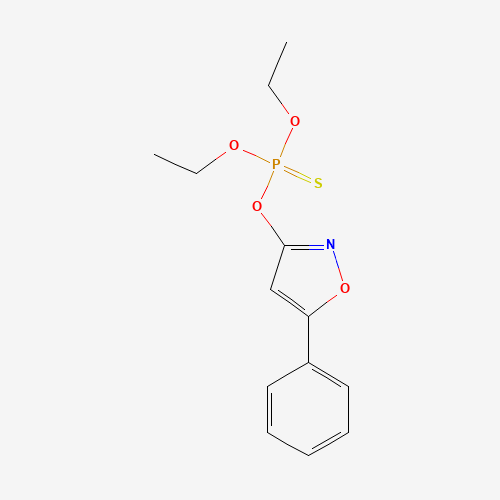
Isoxathion is an organic thiophosphate that is O,O-diethyl hydrogen phosphorothioate in which the hydrogen of the hydroxy group is replaced by a 5-phenyl-1,2-oxazol-3-yl group. It has a role as an agrochemical and an EC 3.1.1.7 (acetylcholinesterase) inhibitor. It is an organothiophosphate insecticide and an organic thiophosphate. It is functionally related to a 5-phenylisoxazol-3-ol.
科学粮草官-词典编辑部,修订于:2026-07-06
Toxicity
ToxicityFate Summary
ATMOSPHERIC FATE: According to a model of gas/particle partitioning of semivolatile organic compounds in the atmosphere(1), isoxathion, which has an estimated vapor pressure of 2.2X10⁻⁶ mm Hg at 25 °C(SRC), determined from a fragment constant method(2), will exist in both the vapor and particulate phases in the ambient atmosphere. Vapor-phase isoxathion is degraded in the atmosphere by reaction with photochemically-produced hydroxyl radicals(SRC); the half-life for this reaction in air is estimated to be 3 hrs(SRC), calculated from its rate constant of 1.2X10⁻¹⁰ cu cm/molecule-sec at 25 °C(SRC) that was derived using a structure estimation method(3). Particulate-phase isoxathion may be removed from the air by wet and dry deposition(SRC).
Soil Adsorption / Mobility
The Koc of isoxathion in turf grass soil is 14,568(1). According to a classification scheme(2), this estimated Koc value suggests that isoxathion is expected to be immobile in soil. Rf (retention factor) values for isoxathion were reported as 0.63, 0.50, and 0.62, using three Japanese soils - Hiratsuka (sandy loam, 69.8% sand, 19.6% silt, 10.6% clay, 3.2% organic matter, pH 5.9), Tanashi (loam, 60.5% sand, 30.2% silt, 9.3% clay, 8.4% organic matter, pH 6.0), and Yasu (sandy loam, 56.6% sand, 29.9% silt, 1.56% clay, 1.8% organic matter, pH 4.9), respectively(3).
Environmental Biodegradation
30 ppm of 14C-labeled isoxathion was incubated in 50 g of three Japanese soils - Hiratsuka (sandy loam, 69.8% sand, 19.6% silt, 10.6% clay, 3.2% organic matter, pH 5.9), Tanashi (loam, 60.5% sand, 30.2% silt, 9.3% clay, 8.4% organic matter, pH 6.0), and Yasu (sandy loam, 56.6% sand, 29.9% silt, 1.56% clay, 1.8% organic matter, pH 4.9). Soils were maintained at 60% field capacity for non-flooded conditions and at 150% field capacity for flooded conditions. %14C-isoxathion recovered from non-flooded Hiratsuka soil was 75, 51, and 32 after 20, 40, and 60 days, respectively, initial half-life = 44 days; % recovered from flooded Hiratsuka soil - 46, 14, and 5, respectively, initial half-life = 18 days. %14C-isoxathion recovered from non-flooded Tanashi soil was 69, 17, and 10 after 10, 30, a...
Environmental Bioconcentration
An estimated BCF of 150 was calculated for isoxathion(SRC), using a log Kow of 3.73(1) and a regression-derived equation(2). According to a classification scheme(3), this BCF suggests the potential for bioconcentration in aquatic organisms is high(SRC). However, aquatic organisms readily metabolize this class of compounds(4) and organophosphates can be altered chemically(5) once released into the environment.
Volatilization from Water / Soil
The Henry's Law constant for isoxathion is estimated as 6.1X10⁻⁸ atm-cu m/mole(SRC) using a fragment constant estimation method(1). This Henry's Law constant indicates that isoxathion is expected to be essentially nonvolatile from water surfaces(2). Isoxathion is not expected to volatilize from dry soil surfaces(SRC) based upon an estimated vapor pressure of 8.58X10⁻⁶ mm Hg (SRC), determined from a fragment constant method(3).
Environmental Abiotic Degradation
The rate constant for the vapor-phase reaction of isoxathion with photochemically-produced hydroxyl radicals has been estimated as 1.2X10⁻¹⁰ cu cm/molecule-sec at 25 °C(SRC) using a structure estimation method(1). This corresponds to an atmospheric half-life of about 3 hours at an atmospheric concentration of 5X10+5 hydroxyl radicals per cu cm(1). Hydrolysis is expected to be an important environmental fate process as the P-O bond characteristic of organophosphates is labile to attack by hydroxide at neutral pH(2). Aqueous solutions of 10-15 ppm isoxation and isoxathion with 5 ppm humic material were irradiated in Pyrex-glass vessels with artificial light(3). Photodegradation rate constants of 4.7X10⁻²/day, 5.9X10⁻²/day, 5.1X10⁻²/day, and 3.9X10⁻²/day in solution samples not containing...
Environmental Water Concentrations
SURFACE WATER: Isoxathion was detected, not quantified (detection limit = 0.1 ng/ml) in surface water runoff associated with nine golf courses in Singapore, sampled between April and May, 1994(1). The compound was detected, not quantified in samples from the Minaga River and Minaga Reservoir, Hiroshima Prefecture, Japan, collected in July-October, 1997 and in September-November, 1998(2). Isoxathion was not detected (detection limit = 0.02 ug/l) in samples collected monthly during May to September, 1996 from the Shinano River, Japan(3).
Milk Concentrations
Many of the organophosphorus insecticides are excreted in the milk ... /Organophosphorus insecticides/
Effluent Concentrations
Isoxathion, 200-4,300 g applied at a rate of 0.50 g/sq m, was not detected in drainage samples from 24 Japanese golf courses, monitored from 1994 to 1996; detection limit less than 0.001 mg/l(1).
Atmospheric Concentrations
SOURCE DOMINATED: Isoxathion was detected, not quantified in air samples collected from golf courses in the Kanagawa Prefecture, Japan; levels were higher in daytime(1).
Artificial Pollution Sources
Isoxathion's former production may have resulted in its release to the environment through various waste streams; it's use as an insecticide(1) may have resulted in its direct release to the environment(SRC).
Probable Routes of Human Exposure
Secondary exposure of children through contact with their parents' contaminated clothing can also occur. /Organophosphorus pesticides/
Environmental Fate / Exposure Summary
Isoxathion's former production and use as an insecticide may have resulted in its direct release to the environment. If released to air, an estimated vapor pressure of 2.2X10⁻⁶ mm Hg at 25 °C indicates isoxathion will exist in both the vapor and particulate phases in the ambient atmosphere. Vapor-phase isoxathion will be degraded in the atmosphere by reaction with photochemically-produced hydroxyl radicals; the half-life for this reaction in air is estimated to be 3 hrs. Particulate-phase isoxathion will be removed from the atmosphere by wet and dry deposition. If released to soil, isoxathion is expected to have no mobility based upon a Koc of 14,568. Volatilization from moist soil surfaces is not expected to be an important fate process based upon an estimated Henry's Law constant of 6...
Interactions
Because different classes of enzymes may be inhibited, the effects of organophosphorus pesticide poisoning may be complex and potentially at least could involve interactions with drugs as well as with other pesticides or chemicals. Potentiation may also involve solvents or other components of formulated pesticides. Certain drugs such a phenothiazines, antihistamines, CNS depressants, barbiturates, xanthines (theophylline), aminoglycosides and parasympathomimetic agents are to be avoided because of increased toxicity. /Organophosphorus pesticides/
Toxicity Data
LC50 (rat) = 4,200 mg/m3/4h
Adverse Effects
Other Poison - Organophosphate
Non-Human Toxicity Excerpts
/LABORATORY ANIMALS: Developmental or Reproductive Toxicity/ Many organophosphorus insecticides are embryotoxic at doses that are toxic for the mother. /Organophosphorus Pesticides/









