


 一键配货
一键配货
化合物详情
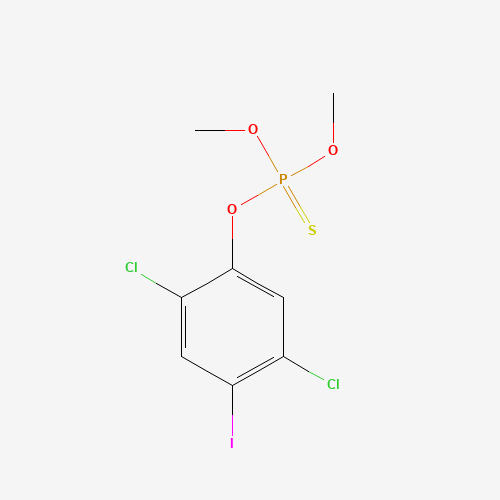
CAS18181-70-9
分子式C8H8Cl2IO3PS
分子量412.997 g/mol
非危品
Iodofenphos is an organic thiophosphate.
科学粮草官-词典编辑部,修订于:2026-07-06
Toxicity
ToxicityEcotoxicity Values
LC50 BLUEGILL 0.42-0.75 MG/L/96 HR
Fate Summary
ATMOSPHERIC FATE: According to a model of gas/particle partitioning of semivolatile organic compounds in the atmosphere(1), iodofenphos, which has a measured vapor pressure of 8.25X10⁻⁷ mm Hg at 25 °C(2), will exist in both the vapor and particulate phases in the ambient atmosphere. Vapor-phase iodofenphos is degraded in the atmosphere by reaction with photochemically produced hydroxyl radicals(SRC); the half-life for this reaction in air is estimated to be about 7 hours(3,SRC). Particulate-phase iodofenphos may be physically removed from the air by dry deposition(SRC).
Soil Adsorption / Mobility
The Koc of iodofenphos is estimated as approximately 24,000(SRC), using a measured log Kow of 5.51(1) and a regression-derived equation(2,SRC). According to a recommended classification scheme(3), this estimated Koc value suggests that iodofenphos will be immobile in soil(SRC).
Environmental Biodegradation
Iodofenphos had measured half-lives of 70.5 and 85.1 days in illuminated and non-illuminated soil, respectively(1). The main degradation product was 2,5-dichloro-4-iodophenol indicating that the main decomposition reaction was the cleavage of the aryl ester bond(1). Degradation was due to both abiotic and biotic reactions.
Environmental Bioconcentration
Biotransformation of a series of organophosphorus compounds by the 9,000 g supernatant of rainbow trout (Oncorhynchus mykiss) liver was tested in an in vitro system fortified either with NADPH-generating cofactors or with reduced glutathione. Elimination rate constants for both systems were calculated from linear decay curves when substrate concentrations were used that were considerably lower than the Km values of the concerned enzymatic reactions. The results reveal a large variation in both the oxidative and the glutathione-mediated biotransformation rate of the organophosphorus compounds. Half-lives ranged from 25 to 1,216 min in the NADPH system and from 18 to 381 min in the glutathione system. Elimination rate constants in the glutathione system were related to Hammett sigma const...
Volatilization from Water / Soil
The Henry's Law constant for iodofenphos is estimated as 4.5X10⁻⁶ atm-cu m/mole(SRC) from its experimental values for vapor pressure, 8.25X10⁻⁷ mm Hg(1), and water solubility, 0.10 mg/l(2). This value indicates that iodofenphos will slowly volatilize from water surfaces(3,SRC). Based on this Henry's Law constant, the volatilization half-life from a model river (1 m deep, flowing 1 m/sec, wind velocity of 3 m/sec) is estimated as approximately 17 days(3,SRC). The volatilization half-life from a model lake (1 m deep, flowing 0.05 m/sec, wind velocity of 0.5 m/sec) is estimated as approximately 130 days(3,SRC). Iodofenphos's values for vapor pressure(1) and Henry's Law constant(1,2,SRC) indicate that volatilization from dry and moist soil surfaces is not expected to be an important environ...
Environmental Abiotic Degradation
The rate constant for the vapor-phase reaction of iodofenphos with photochemically produced hydroxyl radicals has been estimated as 5.6X10⁻¹² cu cm/molecule-sec at 25 °C(SRC) using a structure estimation method(1,SRC). This corresponds to an atmospheric half-life of about 7 days at an atmospheric concentration of 5X10+5 hydroxyl radicals per cu cm(1,SRC). The photolysis of iodofenphos was studied using artificial sunlight and a day/night rhythm for a period of 96 days. Half-lives of 0.4 and 1.9 days were measured for iodofenphos in illuminated and non-illuminated rainwater, respectively(2). Iodofenphos had measured half-lives of 70.5 and 85.1 days in illuminated and non-illuminated soil, respectively(2). The main degradation product was 2,5-dichloro-4-iodophenol indicating that the main...
Environmental Water Concentrations
SURFACE WATER: Surface waters in the Hogeveense Polder, The Netherlands, sampled from August 1989-January 1990, contained from 0.2 to 0.4 ug/l iodofenphos(1).
Plant Concentrations
Photolysis of ... iodofenphos ... was studied in the dark and under artificial sunlight conditions in rain water and on standard soil surface. Iodofenphos was readily degraded under the conditions used. ... The major degrdn product identified from iodofenphos was 2,5-dichloro-4-iodophenol. ... Metabolites were found in both media in the dark and under artificial sun light.
Artificial Pollution Sources
Iodofenphos's former use(1) as a contact and stomach insecticide and acaricide for control of flies and mosquitoes in public hygiene, indoor pests such as ants, bedbugs, cockroaches, fleas and warehouse pests(2) has resulted in its direct release to the environment(SRC).
Probable Routes of Human Exposure
Occupational exposure to iodofenphos may be through ingestion and inhalation of vapors or droplets, or by absorption through the skin(1).
Environmental Fate / Exposure Summary
Iodofenphos's former use as a contact and stomach insecticide and acaricide has resulted in its direct release to the environment. If released to the atmosphere, iodofenphos will exist in both the vapor and particulate phases in the ambient atmosphere, based on a measured vapor pressure of 8.25X10⁻⁷ mm Hg at 25 °C. Vapor-phase iodofenphos is degraded in the atmosphere by reaction with photochemically-produced hydroxyl radicals with a half-life of about 7 hours. Particulate-phase iodofenphos may be physically removed from the air by dry deposition. An estimated Koc of 24,000 suggests that iodofenphos will be immobile in soil. Volatilization from dry and moist soil surfaces is not expected to be significant. Iodofenphos had measured half-lives of 70.5 and 85.1 days in illuminated and non-...
Interactions
ANTICHOLINESTERASE (ORGANOPHOSPHORUS) INSECTICIDES ANTAGONIZE POLARIZING MUSCLE RELAXANTS. PHENOTHIAZINES /AND THIOXANTHENES/: ... MAY ENHANCE TOXIC EFFECTS OF ORGANOPHOSPHORUS INSECTICIDES. /INSECTICIDES, ORGANOPHOSPHORUS/
Toxicity Data
LC (rat) > 246 mg/m3/6h
Adverse Effects
Other Poison - Organophosphate
Populations at Special Risk
Work ... must not be carried out by young persons under 18 yr, expectant or nursing mothers, or persons for whom work with toxic chemicals is contraindicated on account of their state of health; the same applies to alcoholics. Contraindications for work with organophosphorus pesticides are organic diseases of the CNS, mental disorders & epilepsy, pronounced endocrine & vegetative disorders, pulmonary tuberculosis, bronchial asthma, chronic respiratory diseases, cardiovascular diseases and circulatory disorders, gastrointestinal diseases (peptic ulcer), gastroenterocolitis, diseases of the liver & kidneys, eye diseases (chronic conjunctivitis and keratitis). /Organophosphorus pesticides/









