


 一键配货
一键配货
化合物详情
CAS126-75-0
分子式C8H19O3PS2
分子量258.338 g/mol
非危品
Demeton-S is an organothiophosphorus compound.
科学粮草官-词典编辑部,修订于:2026-07-06
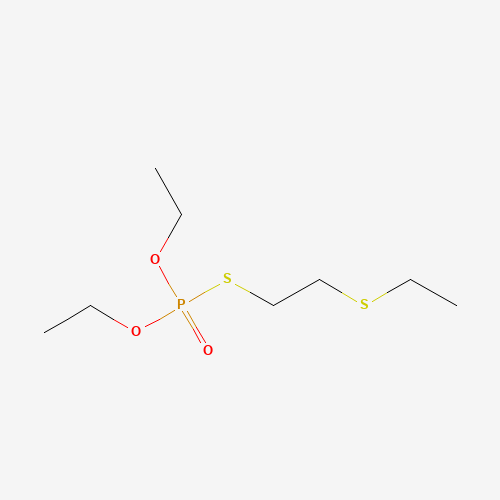
Toxicity
ToxicityFate Summary
ATMOSPHERIC FATE: According to a model of gas/particle partitioning of semivolatile organic compounds in the atmosphere(1), demeton-S, which has a vapor pressure of 2.6X10⁻⁴ mm Hg at 25 °C(2), is expected to exist in both the vapor and particulate phase. Vapor-phase demeton-S is degraded in the atmosphere by reaction with photochemically generated hydroxyl radicals. The half-life for this reaction in air is estimated as 5 hours from its rate constant of 8X10-11 cm/molec-sec(SRC), derived using a structure estimation method(3). Particulate-phase demeton-S may be removed from the air by wet or dry deposition(SRC). Demeton-S was photodegraded when applied to soil surfaces and exposed to natural sunlight(4), suggesting photolysis in the atmosphere is possible(SRC).
Soil Adsorption / Mobility
The Koc value for demeton-S was reported as 70 in an unspecified soil(1). According to a classification scheme(2), this Koc value suggests that demeton-S is expected to have high mobility in soil(SRC).
Environmental Biodegradation
AEROBIC: The half-life of demeton-S-methyl in soil was reported as 26 days(1), suggesting that demeton-S may be susceptible to biodegradation in soil(SRC).
Environmental Bioconcentration
An estimated BCF of 8 was calculated in fish for demeton-S(SRC), using a water solubility of 2,000 mg/L(1) and a regression-derived equation(2). According to a classification scheme(3), this BCF suggests the potential for bioconcentration in aquatic organisms is low(SRC).
Volatilization from Water / Soil
The Henry's Law constant for isosystox is estimated as 4.9X10⁻⁸ atm-cu m/mole(SRC) derived from its vapor pressure, 2.6X10⁻⁴ mm Hg(1), and water solubility, 2,000 mg/L(1). This Henry's Law constant indicates that isosystox is expected to be essentially nonvolatile from moist soil and water surfaces(2). Isosystox is not expected to volatilize from dry soil surfaces(SRC) based upon its vapor pressure(1).
Environmental Abiotic Degradation
The rate constant for the vapor-phase reaction of demeton-S with photochemically-produced hydroxyl radicals has been estimated as 8X10-11 cu cm/molec-sec(SRC), using a structure estimation method(1). This corresponds to an atmospheric half-life of 5 hours at a hydroxyl radical concentration of 5X10+5 hydroxyl radicals per cu cm(1). The chemical hydrolysis half-life of demeton-S was reported as 53 days at pH 5.7 and 27 °C, with 1,2-bis(ethylthio)ethane identified as its major hydrolysis byproduct(2). The half-life increased to 347 days at 15 °C(2). Demeton-S was photolyzed 69, 74, and 24% when incorporated into 3 different soils and irradiated in natural sunlight for 8 days(3), suggesting direct or indirect photolysis may be an important fate process for this compound(SRC).
ICSC Environmental Data
This substance may be hazardous to the environment. Special attention should be given to fish and bees. This substance does enter the environment under normal use. Great care, however, should be taken to avoid any additional release, for example through inappropriate disposal.
Artificial Pollution Sources
Demeton-S's former production and use as a component of the insecticide demeton(1) resulted in its direct release to the environment(SRC).
Probable Routes of Human Exposure
Since demeton is no longer registered for use in the United States, current occupational exposure and exposure to the general population is expected to be low or non existent. (SRC)
Environmental Fate / Exposure Summary
Demeton-S's former production and use as a component of the insecticide demeton resulted in its direct release to the environment. If released to air, a vapor pressure of 2.6X10⁻⁴ mm Hg at 25 °C indicates demeton-S will exist in both the vapor and particulate phases in the atmosphere. Vapor-phase demeton-S will be degraded in the atmosphere by reaction with photochemically-produced hydroxyl radicals; the half-life for this reaction in air is estimated to be 5 hours. Particulate-phase demeton-S will be removed from the atmosphere by wet or dry deposition. Demeton-S undergoes photolysis on soil surfaces indicating that it may be susceptible to photolysis in the atmosphere. If released to soil, demeton-S is expected to have high mobility based upon a Koc value of 70 measured in an unspecif...
Symptoms
Ingestion Exposure: Abdominal cramps. Diarrhoea. Further see Inhalation.
Adverse Effects
Other Poison - Organophosphate
Exposure Routes
The substance can be absorbed into the body by inhalation of its aerosol, through the skin and by ingestion.
Non-Human Toxicity Values
LD50 Guinea pig ip 5.5 mg/kg
Non-Human Toxicity Excerpts
/OTHER TOXICITY INFORMATION/ The IC50s for inhibition of cortical AChE activity were: parathion, 390 uM; paraoxon, 0.005 uM; malathion, 210 uM; malaoxon, 0.036 uM; demeton-S, 2.9 uM; DFP, 0.52 uM; and echothiophate, 0.006 uM. The IC50s for inhibition of hippocampal AChE activity were: parathion, 180 uM; paraoxon, 0.003 uM; malathion, 160 uM; malaoxon, 0.035 uM; demeton-S, 1.9 uM; DFP, 0.55 uM; and echothiophate, 0.004 uM. Disulfoton did not inhibit AChE activity over the tested concentration range. Only echothiophate competed with QNB /(quinuclidinyl benzilate, a muscarinic antagonist)/ binding and only at concentrations >100 uM. All organophosphates competed with CD /(cis-methyldioxolane, an agonist that binds to a subtype of muscarinic receptors)/ binding. The inhibition constants (Ki...
USGS Health-Based Screening Levels for Evaluating Water-Quality
Reference: Smith, C.D. and Nowell, L.H., 2024. Health-Based Screening Levels for evaluating water-quality data (3rd ed.). DOI:10.5066/F71C1TWP









