

 一键配货
一键配货
化合物详情
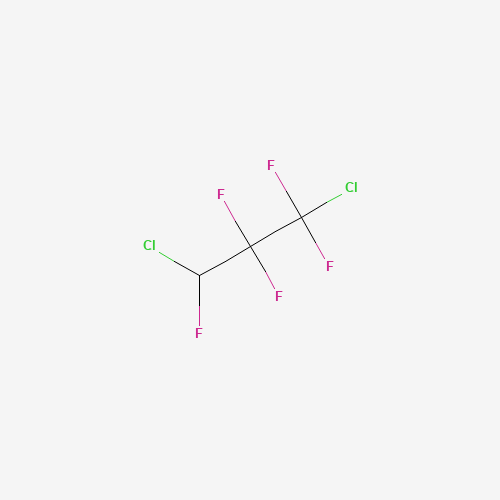
CAS507-55-1
分子式C3HCl2F5
分子量202.938 g/mol
非危品
Physical Description | 1,3-dichloro-1,1,2,2,3-pentafluoropropane is a colorless odorless liquid. Nonflammable.
科学粮草官-词典编辑部,修订于:2026-07-06
Toxicity
ToxicityFate Summary
ATMOSPHERIC FATE: According to a model of gas/particle partitioning of semivolatile organic compounds in the atmosphere(1), 1,3-dichloro-1,1,2,2,3-pentafluoropropane, which has a vapor pressure of 286 mm Hg at 25 °C(2), is expected to exist solely as a vapor in the ambient atmosphere. Vapor-phase 1,3-dichloro-1,1,2,2,3-pentafluoropropane is degraded in the atmosphere by reaction with photochemically-produced hydroxyl radicals(SRC); the half-life for this reaction in air is estimated to be 4.9 years(SRC), calculated from its rate constant of 9.0X10⁻¹⁵ cu cm/molecule-sec at 25 °C(3). Measured absorption coefficients for 1,3-dichloro-1,1,2,2,3-pentafluoropropane indicate that photolysis in the troposphere does not compete with removal by reaction with the hydroxyl radical(4). Stratospheric...
Soil Adsorption / Mobility
Using a structure estimation method based on molecular connectivity indices(1), the Koc for 1,3-dichloro-1,1,2,2,3-pentafluoropropane can be estimated to be 700(SRC). According to a classification scheme(2), this estimated Koc value suggests that 1,3-dichloro-1,1,2,2,3-pentafluoropropane is expected to have low mobility in soil.
Environmental Biodegradation
1,3-Dichloro-1,1,2,2,3-pentafluoropropane, present at 9.4 mg/l, reached 15% of its theoretical BOD in a 28 day closed bottle test, and therefore 1,3-dichloro-1,1,2,2,3-pentafluoropropane is not expected to biodegrade rapidly(1).
Environmental Bioconcentration
An estimated BCF of 50 was calculated for 1,3-dichloro-1,1,2,2,3-pentafluoropropane(SRC), using a log Kow of 3.1(1) and a regression-derived equation(2). According to a classification scheme(3), this BCF suggests the potential for bioconcentration in aquatic organisms is moderate(SRC).
Volatilization from Water / Soil
The Henry's Law constant for 1,3-dichloro-1,1,2,2,3-pentafluoropropane is estimated as 2.76 atm-cu m/mole(SRC) using a fragment constant estimation method(1). This Henry's Law constant indicates that 1,3-dichloro-1,1,2,2,3-pentafluoropropane is expected to volatilize rapidly from water surfaces(2). Based on this estimated Henry's Law constant, the volatilization half-life from a model river (1 m deep, flowing 1 m/sec, wind velocity of 3 m/sec)(2) is estimated as 1.5 hours(SRC). The volatilization half-life from a model lake (1 m deep, flowing 0.05 m/sec, wind velocity of 0.5 m/sec)(2) is estimated as 5.6 days(SRC). 1,3-Dichloro-1,1,2,2,3-pentafluoropropane's estimated Henry's Law constant indicates that volatilization from moist soil surfaces may occur(SRC). The potential for volatiliza...
Environmental Abiotic Degradation
The rate constant for the vapor-phase reaction of 1,3-dichloro-1,1,2,2,3-pentafluoropropane with photochemically-produced hydroxyl radicals has been measured as 9.0X10⁻¹⁵ cu cm/molecule-sec at 25 °C(1). This corresponds to an atmospheric half-life of about 4.9 years at an atmospheric concentration of 5X10+5 hydroxyl radicals per cu cm(2). 1,3-Dichloro-1,1,2,2,3-pentafluoropropane is not expected to undergo hydrolysis in the environment due to the lack of hydrolyzable functional groups(3). Photolysis of 1,3-dichloro-1,1,2,2,3-pentafluoropropane does not compete with hydroxyl radical reactions in the troposphere, but can become environmentally significant in the stratosphere where released chlorine radicals may participate in ozone-destroying reactions.
Artificial Pollution Sources
1,3-Dichloro-1,1,2,2,3-pentafluoropropane's (HCFC-225cb) production and use as a cleaning agent replacement for CFC-113(1) may result in its release to the environment through various waste streams(SRC).
Probable Routes of Human Exposure
Occupational exposure to 1,3-dichloro-1,1,2,2,3-pentafluoropropane may occur through inhalation and dermal contact with this compound at workplaces where 1,3-dichloro-1,1,2,2,3-pentafluoropropane is produced or used. (SRC)
Environmental Fate / Exposure Summary
1,3-Dichloro-1,1,2,2,3-pentafluoropropane's (HCFC-225cb) production and use as a cleaning agent replacement for CFC-113 may result in its release to the environment through various waste streams. If released to air, a vapor pressure of 286 mm Hg at 25 °C indicates 1,3-dichloro-1,1,2,2,3-pentafluoropropane will exist solely as a vapor in the ambient atmosphere. Vapor-phase 1,3-dichloro-1,1,2,2,3-pentafluoropropane will be degraded in the atmosphere by reaction with photochemically-produced hydroxyl radicals; the half-life for this reaction in air is estimated to be 4.9 years. Measured absorption coefficients for 1,3-dichloro-1,1,2,2,3-pentafluoropropane indicate that photolysis in the troposphere does not compete with removal by reaction with the hydroxyl radical. Stratospheric photolysi...
Toxicity Data
LC50 (rat) = 31,660 ppm/4h
Adverse Effects
Neurotoxin - Acute solvent syndrome