


 一键配货
一键配货
化合物详情
CAS21548-32-3
分子式C6H12NO3PS2
分子量241.268 g/mol
危化品
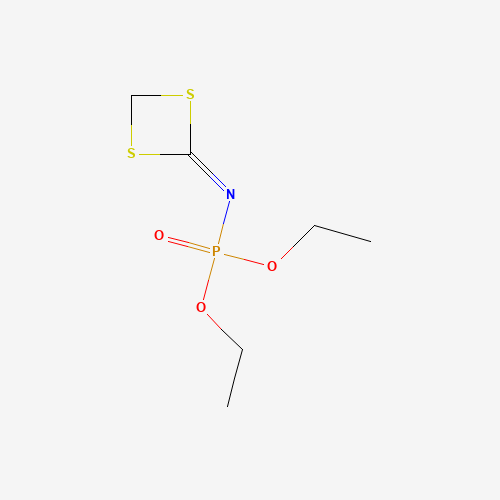
Physical Description | Fosthietan is a pale yellow liquid with a mercaptan-like odor. Used as a nematocide and insecticide. Not registered as a pesticide in the U.S. (EPA, 1998)
科学粮草官-词典编辑部,修订于:2026-07-06
Toxicity
ToxicityFate Summary
ATMOSPHERIC FATE: According to a model of gas/particle partitioning of semivolatile organic compounds in the atmosphere(1), fosthietan, which has a vapor pressure of 6.45X10⁻⁶ mm Hg at 25 deg(2), will exist in both the vapor and particulate phases in the ambient atmosphere. Vapor-phase fosthietan is degraded in the atmosphere by reaction with photochemically-produced hydroxyl radicals(SRC); the half-life for this reaction in air is estimated to be 40 minutes(SRC), calculated from its rate constant of 5.79X10⁻¹¹ cu cm/molecule-sec at 25 °C(SRC) that was derived using a structure estimation method(3). Particulate-phase fosthietan may be removed from the air by wet and dry deposition(SRC).
Soil Adsorption / Mobility
The Koc of fosthietan is estimated as 11(SRC), using a water solubility of 5.00X10+4 mg/L(1) and a regression-derived equation(2). According to a classification scheme(3), this estimated Koc value suggests that fosthietan is expected to have very high mobility in soil.
Environmental Bioconcentration
An estimated BCF of 1 was calculated for fosthietan(SRC), using a water solubility of 5.00X10+4 mg/L(1) and a regression-derived equation(2). According to a classification scheme(3), this BCF suggests the potential for bioconcentration in aquatic organisms is low(SRC).
Volatilization from Water / Soil
The Henry's Law constant for fosthietan is estimated as 4.11X10⁻¹¹ atm-cu m/mole(SRC) derived from its vapor pressure, 6.45X10⁻⁶ mm Hg(1), and water solubility, 5.00X10+4 mg/L(2). This Henry's Law constant indicates that fosthietan is not expected to volatilize from moist soil or water surfaces(3). Fosthietan is not expected to volatilize from dry soil surfaces(SRC) based upon its vapor pressure(1).
Environmental Abiotic Degradation
The rate constant for the vapor-phase reaction of fosthietan with photochemically-produced hydroxyl radicals has been estimated as 5.79X10⁻¹¹ cu cm/molecule-sec at 25 °C(SRC) using a structure estimation method(1). This corresponds to an atmospheric half-life of about 40 minutes at an atmospheric concentration of 5X10+5 hydroxyl radicals per cu cm(1). Measured hydrolysis data for this substance were not available. Phosphate esters such as phosthietan do hydrolyze. However, half-lives for compounds that contain this functional group are typically less than 10 years at pH 7(2).
Artificial Pollution Sources
Fosthietan's former production and use as an insecticide(1) may have resulted in its direct release to the environment(SRC).
Probable Routes of Human Exposure
Occupational exposure and general population exposure should be low or non-existent since fosthietan is no longer produced or used. (SRC)
Environmental Fate / Exposure Summary
Fosthietan's former production and use as an insecticide may have resulted in its direct release to the environment. If released to air, a vapor pressure of 6.45X10⁻⁶ mm Hg at 25 °C indicates fosthietan will exist in both the vapor and particulate phases in the ambient atmosphere. Vapor-phase fosthietan will be degraded in the atmosphere by reaction with photochemically-produced hydroxyl radicals; the half-life for this reaction in air is estimated to be 40 minutes. Particulate-phase fosthietan will be removed from the atmosphere by wet and dry deposition. If released to soil, fosthietan is expected to have very high mobility based upon an estimated Koc of 11. Volatilization from moist soil surfaces is not expected to be an important fate process based upon an estimated Henry's Law cons...
Adverse Effects
Other Poison - Organophosphate
Antidote and Emergency Treatment
Enhanced elimination. Dialysis and hemoperfusion are not generally indicated because of the large volume of distribution... /Organophosphates and carbamates/









