


 一键配货
一键配货
化合物详情
CAS96182-53-5
分子式C13H23N2O3PS
分子量318.372 g/mol
非危品
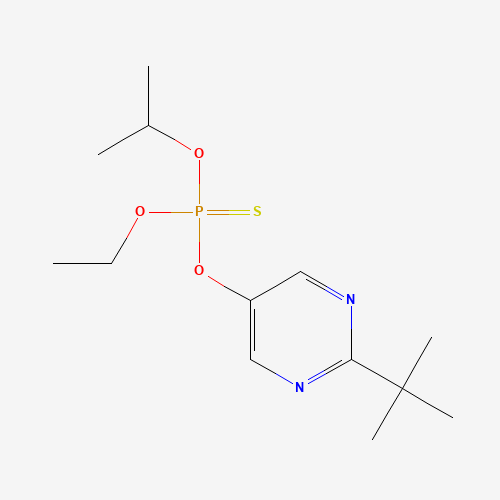
Tebupirimfos is an organothiophosphate insecticide and an organic thiophosphate. It has a role as an EC 3.1.1.7 (acetylcholinesterase) inhibitor. It is functionally related to a 2-tert-butylpyrimidin-5-ol.
科学粮草官-词典编辑部,修订于:2026-07-06
Toxicity
ToxicityEPA Ecotoxicity
Pesticide Ecotoxicity Data from EPA: 44
Ecotoxicity Values
LC50 Bufo bufo japonicus (0.34 g, 2.9 cm, tadpole) 40,000 ug/L/3, 6, 24, 48 hr; static
Fate Summary
ATMOSPHERIC FATE: According to a model of gas/particle partitioning of semivolatile organic compounds in the atmosphere(1), tebupirimfos, which has an estimated vapor pressure of 3.75X10⁻⁵ mm Hg at 20 °C (2), is expected to exist in both the vapor and particulate phases in the ambient atmosphere. Vapor-phase tebupirimfos is degraded in the atmosphere by reaction with photochemically-produced hydroxyl radicals(SRC); the half-life for this reaction in air is estimated to be 3 hours(SRC), calculated from its rate constant of 1.13X10⁻¹⁰ cu cm/molecule-sec at 25 °C(SRC) that was derived using a structure estimation method(3). Tebupirimfos was reported to have an aqueous photolysis half-life of 31 hours(4), suggesting direct photolysis may occur in the atmosphere.
Soil Adsorption / Mobility
Using a structure estimation method based on molecular connectivity indices(1), the Koc for tebupirimfos can be estimated to be 1845(SRC). According to a classification scheme(2), this estimated Koc value suggests that tebupirimfos is expected to have low mobility in soil(SRC).
Environmental Biodegradation
The half-life of tebupirimfos at 2 ppm in a sandy loam flooded with pond water and maintained under anaerobic conditions was 194 days(1). The degradation products observed were desisopropyltebupirimfos, desethyltebupirimfos, t-butylhydroxypyrimidine, and the S-ethyl isomer of isopropyltebupirimfos(1). The half-lives of tebupirimfos in aerobic and anaerobic soil metabolism studies were reported as 343 and 279 days respectively(1). The half-life of tebupirimfos from a field dissipation study in Minnesota was reported as 73 days, and the half-life in a field in Illinois was 140 days(1).
Environmental Bioconcentration
An estimated BCF of 334 was calculated for tebupirimfos(SRC), using an estimated log Kow of 4.19(1) and a regression-derived equation(2). According to a classification scheme(3), this BCF suggests the potential for bioconcentration in aquatic organisms is high(SRC).
Volatilization from Water / Soil
The Henry's Law constant for tebupirimfos is estimated as 2.8X10⁻⁶ atm-cu m/mole(SRC) derived from its vapor pressure, 3.75X10⁻⁵ mm Hg(1), and water solubility, 5 mg/l(1). This Henry's Law constant indicates that tebupirimfos is expected to volatilize from water surfaces(2). Based on this Henry's Law constant, the volatilization half-life from a model river (1 m deep, flowing 1 m/sec, wind velocity of 3 m/sec)(3) is estimated as 15 days(SRC). The volatilization half-life from a model lake (1 m deep, flowing 0.05 m/sec, wind velocity of 0.5 m/sec)(3) is estimated as 174 days(SRC). Tebupirimfos's estimated Henry's Law constant indicates that volatilization from moist soil surfaces may occur(SRC). Tebupirimfos is not expected to volatilize from dry soil surfaces(SRC) based upon its vapor p...
Environmental Abiotic Degradation
The rate constant for the vapor-phase reaction of tebupirimfos with photochemically-produced hydroxyl radicals has been estimated as 1.13X10⁻¹⁰ cu cm/molecule-sec at 25 °C(SRC) using a structure estimation method(1). This corresponds to an atmospheric half-life of about 3 hours at an atmospheric concentration of 5X10+5 hydroxyl radicals per cu cm(1). Tebupirimfos is hydrolyzed under alkaline conditions(2), but the rate of hydrolysis is not known. The aqueous photolysis half-life of tebupirimfos was reported as 31 hours(3).
Milk Concentrations
Many of the organophosphorus insecticides are excreted in the milk ... /Organophosphorus insecticides/
ICSC Environmental Data
The substance is very toxic to aquatic organisms. This substance does enter the environment under normal use. Great care, however, should be taken to avoid any additional release, for example through inappropriate disposal.
Artificial Pollution Sources
Tebupirimfos's production may result in its release to the environment through various waste streams(SRC); it's use as an insecticide(1) may result in its direct release to the environment(SRC).
Probable Routes of Human Exposure
Secondary exposure of children through contact with their parents' contaminated clothing can also occur. /Organophosphorus pesticides/
Other Environmental Concentrations
Occupational exposure to tebupirimfos may occur through inhalation and dermal contact with this compound at workplaces where tebupirimfos is produced or used. (SRC)
Environmental Fate / Exposure Summary
Tebupirimfos's production may result in its release to the environment through various waste streams; it's use as an insecticide may result in its direct release to the environment. If released to air, a vapor pressure of 3.75X10⁻⁵ mm Hg at 20 °C indicates tebupirimfos will exist in both the vapor and particulate phases in the ambient atmosphere. Vapor-phase tebupirimfos will be degraded in the atmosphere by reaction with photochemically-produced hydroxyl radicals; the half-life for this reaction in air is estimated to be 3 hours. Particulate-phase tebupirimfos will be removed from the atmosphere by wet and dry deposition. If released to soil, tebupirimfos is expected to have low mobility based upon an estimated Koc of 1845. Volatilization from moist soil surfaces is expected to be an i...
Symptoms
Symptoms of low dose exposure include excessive salivation and eye-watering. Acute dose symptoms include severe nausea/vomiting, salivation, sweating, bradycardia, hypotension, collapse, and convulsions. Increasing muscle weakness is a possibility and may result in death if respiratory muscles are involved. Hypertension, hypoglycemia, anxiety, headache, tremor and ataxia may also result.
Treatment
If the compound has been ingested, rapid gastric lavage should be performed using 5% sodium bicarbonate. For skin contact, the skin should be washed with soap and water. If the compound has entered the eyes, they should be washed with large quantities of isotonic saline or water. In serious cases, atropine and/or pralidoxime should be administered. Anti-cholinergic drugs work to counteract the effects of excess acetylcholine and reactivate AChE. Atropine can be used as an antidote in conjunction with pralidoxime or other pyridinium oximes (such as trimedoxime or obidoxime), though the use of '-oximes' has been found to be of no benefit, or possibly harmful, in at least two meta-analyses. Atropine is a muscarinic antagonist, and thus blocks the action of acetylcholine peripherally.
Effect Level
collection=toxvaldb&kind=^EL$
Lethal Dose
collection=toxvaldb&kind=^LD$
Toxicity Data
LC50 (rat) = 36 mg/m3/4H
Health Effects
Acute exposure to cholinesterase inhibitors can cause a cholinergic crisis characterized by severe nausea/vomiting, salivation, sweating, bradycardia, hypotension, collapse, and convulsions. Increasing muscle weakness is a possibility and may result in death if respiratory muscles are involved. Accumulation of ACh at motor nerves causes overstimulation of nicotinic expression at the neuromuscular junction. When this occurs symptoms such as muscle weakness, fatigue, muscle cramps, fasciculation, and paralysis can be seen. When there is an accumulation of ACh at autonomic ganglia this causes overstimulation of nicotinic expression in the sympathetic system. Symptoms associated with this are hypertension, and hypoglycemia. Overstimulation of nicotinic acetylcholine receptors in the central...
Adverse Effects
Other Poison - Organophosphate
Exposure Routes
The substance can be absorbed into the body in hazardous amounts by ingestion, through the skin and by inhalation.
Toxicity Summary
Tebupirimfos is a cholinesterase or acetylcholinesterase (AChE) inhibitor. A cholinesterase inhibitor (or 'anticholinesterase') suppresses the action of acetylcholinesterase. Because of its essential function, chemicals that interfere with the action of acetylcholinesterase are potent neurotoxins, causing excessive salivation and eye-watering in low doses, followed by muscle spasms and ultimately death. Nerve gases and many substances used in insecticides have been shown to act by binding a serine in the active site of acetylcholine esterase, inhibiting the enzyme completely. Acetylcholine esterase breaks down the neurotransmitter acetylcholine, which is released at nerve and muscle junctions, in order to allow the muscle or organ to relax. The result of acetylcholine esterase inhibitio...
RAIS Toxicity Values
Oral Chronic Reference Dose Reference: OPP
Human Toxicity Excerpts
/SIGNS AND SYMPTOMS/ Principal effects /of anticholinesterases as toxic components of insecticides/ on eye, whether from local contact or systemic poisoning, are miosis and spasm of accommodation for near vision. /Anticholinesterases/
Carcinogen Classification
No indication of carcinogenicity to humans (not listed by IARC).
Non-Human Toxicity Values
LD50 Mouse (female) oral 9.3 mg/kg
Reference and Risk Values
collection=toxvaldb&kind=^RRV$
Non-Human Toxicity Excerpts
/LABORATORY ANIMALS: Chronic Exposure or Carcinogenicity/ A 12-month mouse cholinesterase study /was conducted/ with a NOEL for cholinesterase inhibition of 0.3 ppm in males (0.13 mg/kg/day) and <0.3 ppm in females (0.16 mg/kg/day). The lowest-observed-effect level (LOEL) in males was 1.0 ppm (0.43 mg/kg/day) and in females, 0.3 ppm (0.16 mg/kg/day). The NOEL for systemic effects was 3.0 ppm (1.23 and 1.63 mg/kg/day in males and females, respectively). Levels tested were 0.3, 1.0, and 3.0 ppm.
Antidote and Emergency Treatment
Pralidoxime. Before administration of pralidoxime, draw a blood sample (heparinized) for cholinesterase analysis (since pralidoxime tends to reverse the cholinesterase depression). Administration pralidoxime (Protopam, 2-PAM), a cholinesterase reactivator, in cases of severe poisoning by organophosphate pesticides in which respiratory depression, muscle weakness, and/or twitching are severe. When administered early (usually less than 48 hours after poisoning) pralidoxime relieves the nicotinic as well as the muscarinic effects of poisoning. Pralidoxime works by reactivating the cholinesterase and also by slowing the "aging" process of phosphorylated cholinesterase to a non-reactivatable form. ... Dosage of pralidoxime may be repeated in 1-2 hours, then at 10-12 hour intervals if needed....
USGS Health-Based Screening Levels for Evaluating Water-Quality
Reference: Smith, C.D. and Nowell, L.H., 2024. Health-Based Screening Levels for evaluating water-quality data (3rd ed.). DOI:10.5066/F71C1TWP









