


 一键配货
一键配货
化合物详情
CAS89-80-5
分子式C10H18O
分子量154.2493 g/mol
非危品
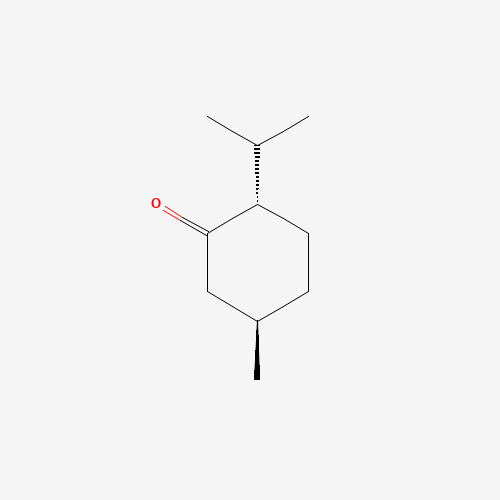
(-)-menthone is a menthone that is cyclohexanone substituted by a methyl and an isopropyl group at positions 5 and 2 respectively (the 2S,5R-stereoisomer). It is an enantiomer of a (+)-menthone.
科学粮草官-词典编辑部,修订于:2026-07-06
Toxicity
ToxicityFate Summary
ATMOSPHERIC FATE: According to a model of gas/particle partitioning of semivolatile organic compounds in the atmosphere(1), menthone, which has an estimated vapor pressure of 0.28 mm Hg at 25 °C(2), is expected to exist solely as a vapor in the ambient atmosphere. Vapor-phase menthone is degraded in the atmosphere by reaction with photochemically-produced hydroxyl radicals(SRC); the half-life for this reaction in air is estimated to be 14 hours(SRC) from its estimated rate constant of 2.6X10⁻¹¹ cu cm/molecule-sec(SRC), determined by a fragment constant estimation method(3).
Soil Adsorption / Mobility
The Koc of menthone is estimated as approximately 120(SRC), using a water solubility of 688 mg/l(1) and a regression-derived equation(2). According to a classification scheme(3), this estimated Koc value suggests that menthone is expected to have high mobility in soil(SRC).
Environmental Bioconcentration
An estimated BCF of 15 was calculated for menthone(SRC), using a water solubility of 688 mg/l(1) and a regression-derived equation(2). According to a classification scheme(3), this BCF suggests the potential for bioconcentration in aquatic organisms is low(SRC).
Volatilization from Water / Soil
The Henry's Law constant for menthone is estimated as 1.6X10⁻⁴ atm-cu m/mole(SRC) using a fragment constant estimation method(1). This Henry's Law constant indicates that menthone is expected to volatilize from water surfaces(2). Based on this Henry's Law constant, the volatilization half-life from a model river (1 m deep, flowing 1 m/sec, wind velocity of 3 m/sec)(2) is estimated as approximately 0.5 days(SRC). The volatilization half-life from a model lake (1 m deep, flowing 0.05 m/sec, wind velocity of 0.5 m/sec)(2) is estimated as approximately 8 days(SRC). Menthone's Henry's Law constant(1,SRC) indicates that volatilization from moist soil surfaces may occur(SRC). Menthone is not expected to volatilize from dry soil surfaces(SRC) based upon an estimated vapor pressure of 0.28 mm Hg...
Environmental Abiotic Degradation
The rate constant for the vapor-phase reaction of menthone with photochemically-produced hydroxyl radicals has been estimated as 2.6X10⁻¹¹ cu cm/molecule-sec at 25 °C(SRC) using a structure estimation method(1). This corresponds to an atmospheric half-life of about 14 hours at an atmospheric concentration of 5X10+5 hydroxyl radicals per cu cm(1). Menthone is not expected to undergo hydrolysis in the environment due to the lack of hydrolyzable functional groups(2) nor to directly photolyze due to the lack of absorption in the environmental UV spectrum.
Environmental Water Concentrations
SURFACE WATER: Menthone was identified, not quantified, in several streams and brooks in Switzerland(1).
Effluent Concentrations
Menthone was identified, not quantified, in the exudate of garden wastes(1).
Natural Pollution Sources
Menthone is found naturally in many essential oils, such as pennyroyal, peppermint and geranium(1).
Artificial Pollution Sources
Menthone's production and use in perfumes and flavor compositions(1) may result in its release to the environment through various waste streams(SRC).
Probable Routes of Human Exposure
Occupational exposure to menthone may occur through inhalation and dermal contact with this compound at workplaces where menthone is produced or used. The general population may be exposed to menthone through dermal contact with perfumes and ingestion of products containing menthone. (SRC)
Environmental Fate / Exposure Summary
Menthone's production and use in perfumes and flavor compositions may result in its release to the environment through various waste streams. Menthone is found naturally in many essential oils, such as pennyroyal, peppermint and geranium. If released to air, an estimated vapor pressure of 0.28 mm Hg at 25 °C indicates menthone will exist solely as a vapor in the ambient atmosphere. Vapor-phase menthone will be degraded in the atmosphere by reaction with photochemically-produced hydroxyl radicals; the half-life for this reaction in air is estimated to be 14 hours. If released to soil, menthone is expected to have high mobility based upon an estimated Koc of 120. Volatilization from moist soil surfaces is expected to be an important fate process based upon an estimated Henry's Law constan...
Adverse Effects
Skin Sensitizer - An agent that can induce an allergic reaction in the skin.
Non-Human Toxicity Values
LD50 Mouse sc 2180 mg/kg
Non-Human Toxicity Excerpts
Menthone was a mild skin irritant and of low acute dermal toxicity in rabbits. No evidence of sensitizing potential was found in a volunteer study with a dilute solution. In rats, menthone demonstrated a moderate to low acute oral toxicity. On repeated oral administration, menthone produced increases in liver, kidney and spleen weights of rats. Mutagenic activity was reported in the bacterium Salmonella typhimurium (Ames test).









