


 一键配货
一键配货
化合物详情
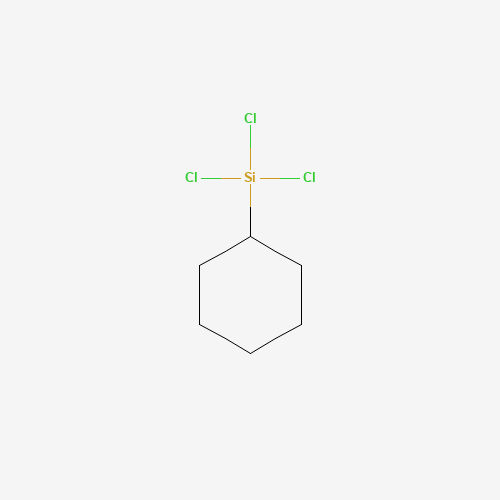
CAS98-12-4
分子式C6H11Cl3Si
分子量217.59 g/mol g/mol
危化品
Physical Description | Cyclohexyltrichlorosilane appears as a colorless to pale yellow liquid with a pungent odor. Corrosive to metals and tissue.
科学粮草官-词典编辑部,修订于:2026-07-06
Toxicity
ToxicityEnvironmental Abiotic Degradation
Silane compounds decompose upon contact with water or steam to produce heat and toxic and corrosive fumes of hydrogen chloride. Silane ignites spontaneously in air(1,2). With a little ammonia, it forms a self-igniting product(1). /Chlorosilanes/
Artificial Pollution Sources
Intermediate for silicones
Probable Routes of Human Exposure
According to the 2006 TSCA Inventory Update Report, the number of persons reasonably likely to be exposed in the industrial manufacturing, processing, and use for cyclohexyltrichlorosilane is 100-999; the data may be greatly underestimated(1).
Environmental Fate / Exposure Summary
Chlorosilane compounds' production and use as intermediates for silicone products may result in their release to the environment through various waste streams. However, these compounds decompose to release hydrogen chloride upon contact with water or steam. Therefore, volatilization, biodegradation, and bioconcentration are not expected to be important environmental fate processes. /Chlorosilanes/ (SRC)
Human Toxicity Excerpts
/OTHER TOXICITY INFORMATION/ /Chlorosilanes/, considered non-corrosive in their natural, dry state, may become corrosive when in contact with water or moisture of skin and mucous membranes ... During ... hydrolysis, corrosive halogen compounds are released. /Chlorosilanes/
Non-Human Toxicity Excerpts
/OTHER TOXICITY INFORMATION/ Although chemical-specific data are not available for many of the ... chlorosilanes, acute inhalation data from rat studies are available for structurally-similar chlorosilanes (n-propyltrichlorosilane, methyltrichlorosilane, vinyltrichlorosilane, ethyltrichlorosilane, methylvinyldichlorosilane, methyldichlorosilane, dimethyldichlorosilane, dimethylchlorosilane, trimethylchlorosilane, and tetrachlorosilane). These data suggest that the acute toxicity of chlorosilanes is due to the hydrogen chloride hydrolysis product; acute toxicity of the chlorosilanes is both qualitatively (based on clinical signs) and quantitatively (based on molar equivalents of hydrogen chloride) similar to that of HCl. Complete hydrolysis of one mole of a monochlorosilane would yield a...
Antidote and Emergency Treatment
Advanced treatment: Consider orotracheal or nasotracheal intubation for airway control in the patient who is unconscious, has severe pulmonary edema, or is in severe respiratory distress. Early intubation at the first sign of upper airway obstruction may be necessary. Positive-pressure ventilation techniques with a bag-valve-mask device may be beneficial. Consider drug therapy for pulmonary edema ... . Monitor cardiac rhythm and treat arrhythmias if necessary ... . Start IV administration of D5W /SRP: "To keep open", minimal flow rate/. Use 0.9% saline (NS) or lactated Ringer's (LR) if signs of hypovolemia are present. For hypotension with signs of hypovolemia, administer fluid cautiously. Consider vasopressors if patient is hypotensive with a normal fluid volume. Watch for signs of flu...









