


 一键配货
一键配货
化合物详情
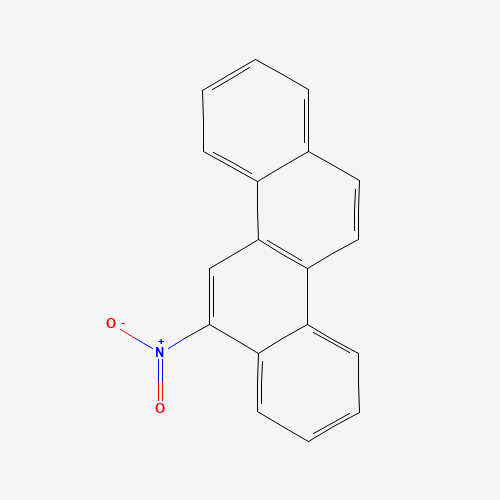
CAS7496-02-8
分子式C18H11NO2
分子量273.29 g/mol
非危品
6-Nitrochrysene can cause cancer according to The World Health Organization's International Agency for Research on Cancer (IARC).
科学粮草官-词典编辑部,修订于:2026-07-06
Toxicity
ToxicityFate Summary
ATMOSPHERIC FATE: According to a model of gas/particle partitioning of semivolatile organic compounds in the atmosphere(1), 6-nitrochrysene, which has an estimated vapor pressure of 7.6X10⁻⁹ mm Hg at 25 °C(SRC), determined from a fragment constant method(2), is expected to exist solely in the particulate phase in the ambient atmosphere. Particulate-phase 6-nitrochrysene may be removed from the air by wet or dry deposition(SRC). 6-Nitrochrysene does contain chromophores that absorb at wavelengths >290 nm(3) and therefore may be susceptible to direct photolysis by sunlight(SRC).
Soil Adsorption / Mobility
Using a structure estimation method based on molecular connectivity indices(1), the Koc of 6-nitrochyrsene can be estimated to be 2.9X10+5(SRC). According to a classification scheme(2), this estimated Koc value suggests that 6-nitrochrysene is expected to be immobile in soil.
Environmental Biodegradation
PURE CULTURE: 6-Nitrochrysene mineralized 2.0% after 2 weeks of incubation with a sediment Mycobacterium sp. inoculum acclimated to pyrene(1).
Environmental Bioconcentration
An estimated BCF of 1,500 was calculated in fish for 6-nitrochrysene(SRC), using an estimated log Kow of 5.3(1) and a regression-derived equation(2). According to a classification scheme(3), this BCF suggests the potential for bioconcentration in aquatic organisms is very high(SRC), provided the compound is not metabolized by the organism(SRC).
Volatilization from Water / Soil
The Henry's Law constant for 6-nitrochrysene is estimated as 1.5X10⁻⁸ atm-cu m/mole(SRC) using a fragment constant estimation method(1). This Henry's Law constant indicates that 6-nitrochrysene is expected to be essentially nonvolatile from water surfaces(2). 6-Nitrochrysene's Henry's Law constant indicates that volatilization from moist soil surfaces will not occur(SRC). 6-Nitrochrysene is not expected to volatilize from dry soil surfaces(SRC) based upon an estimated vapor pressure of 7.6X10⁻⁹ mm Hg(SRC), determined from a fragment constant method(3).
Environmental Abiotic Degradation
The rate constant for the vapor-phase reaction of 6-nitrochrysene with photochemically-produced hydroxyl radicals has been estimated as 6.3 cu cm/molecule-sec at 25 °C(SRC) using a structure estimation method(1). This corresponds to an atmospheric half-life of about 2.6 days at an atmospheric concentration of 5X10+5 hydroxyl radicals per cu cm(1). 6-Nitrochrysene is not expected to undergo hydrolysis in the environment due to the lack of functional groups that hydrolyze under environmental conditions(2). 6-Nitrochrysene does contain chromophores that absorb at wavelengths >290 nm(2) and therefore may be susceptible to direct photolysis by sunlight(SRC).
Effluent Concentrations
6-Nitrochrysene was detected in 6 out of 6 airborne samples in air and diesel particulate collected from Baltimore, Maryland at concentrations ranging from 2.0-2368 ng/g(1).
Atmospheric Concentrations
URBAN/SUBURBAN: 6-Nitrochrysene was detected in 2 out of 4 airborne samples in the vapor plus particulate phase collected from Houston, Texas between August 26, 1990 - September 5, 1990 (summer) and between September 30, 1990 - November 18, 1990 (fall) at concentrations ranging from 1.5-5.2 pg/cu m(1). 6-Nitrochrysene was detected in an unknown amount of airborne samples in the atmosphere of Baltimore, Maryland in January 2001 at concentrations ranging from 0.27-0.64 pg/cu m and in July 2001 at concentrations ranging from 0.05-0.13 pg/cu m(2). 6-Nitrochrysene was also detected in an unknown amount of airborne samples in the atmosphere of Fort Meade, Maryland in January 2001 at concentrations ranging from 0.20-0.73 pg/cu m and in July 2001 at concentrations ranging from 0.10-0.70 pg/cu m...
Artificial Pollution Sources
6-Nitrochrysene's presence in the atmosphere due to reactions of parent polyaromatic hydrocarbons released in various manufacturing processes(1) will result in its direct release to the environment(SRC).
Probable Routes of Human Exposure
Monitoring data indicate that the general population may be exposed to 6-nitrochrysene via inhalation of ambient air and dermal contact with this compound. (SRC)
Other Environmental Concentrations
6-Nitrochrysene was found in carbon black samples known to be used in photocopy machines prior to 1980(1).
Environmental Fate / Exposure Summary
6-Nitrochrysene's presence in the atmosphere due to reactions of parent polyaromatic hydrocarbons will result in its direct release to the environment. If released to air, an estimated vapor pressure of 7.6X10⁻⁹ mm Hg at 25 °C indicates 6-nitrochrysene will exist solely in the particulate phase in the atmosphere. Particulate-phase 6-Nitrochrysene will be removed from the atmosphere by wet or dry deposition. 6-Nitrochrysene does contain chromophores that absorb at wavelengths >290 nm and therefore may be susceptible to direct photolysis by sunlight. If released to soil, 6-nitrochrysene is expected to have no mobility based upon an estimated Koc of 2.9X10+5. Volatilization from moist soil surfaces is not expected to be an important fate process based upon an estimated Henry's Law constant...
Adverse Effects
NTP Carcinogen - Reasonably anticipated to be a human carcinogen.
RAIS Toxicity Values
Oral Slope Factor Reference: CALEPA
Human Toxicity Excerpts
/OTHER TOXICITY INFORMATION/ ... Treatment of HepG2 cells with 6-nitrochrysene (6-NC) increased the activities of microsomal benzo[a]pyrene hydroxylase, 7-ethoxycoumarin and 7-ethoxyresorufin O-deethylases, cytosolic glutathione S-transferase and N-acetyltransferase, and S9 metabolic activation of 6-NC in the Ames mutagenicity test. Immunoblot and RNA blot analyses revealed that 6-NC induced CYP1A1 protein and mRNA levels in the hepatoma cells. Nuclear transcription assay demonstrated that 6-NC increased the transcription rate of CYP1A1 gene in HepG2 cells. Treatment of human lung carcinoma NCI-H322 cells with 6-NC increased benzo[a]pyrene hydroxylase activity and CYP1A1 protein and mRNA levels. These results demonstrate that 6-NC is an inducer of human CYP1A1 and the induction occurs a...
Carcinogen Classification
Additional information: NB Overall evaluation upgraded to Group 2A with supporting evidence from other relevant data
Evidence for Carcinogenicity
6-Nitrochrysene is reasonably anticipated to be a human carcinogen based on sufficient evidence of carcinogenicity at multiple sites in multiple species of experimental animals.
Antidote and Emergency Treatment
/SRP:/ Advanced treatment: Consider orotracheal or nasotracheal intubation for airway control in the patient who is unconscious or is in severe respiratory distress. Monitor cardiac rhythm and treat arrhythmias if necessary. Start IV administration of D5W /SRP: "To keep open", minimal flow rate/. Use 0.9% saline (NS) or lactated Ringer's (LR) if signs of hypovolemia are present. For hypotension with signs of hypovolemia, administer fluid cautiously. If unresponsive to these measures, vasopressors may be helpful. Watch for signs of fluid overload ... . Treat seizures with diazepam or lorazepam ... . Administer 1% solution methylene blue if patient is symptomatic with severe hypoxia, cyanosis, and cardiac compromise not responding to oxygen. DIRECT PHYSICIAN ORDER ONLY ... . Use proparaca...









