

 一键配货
一键配货
化合物详情
CAS693-21-0
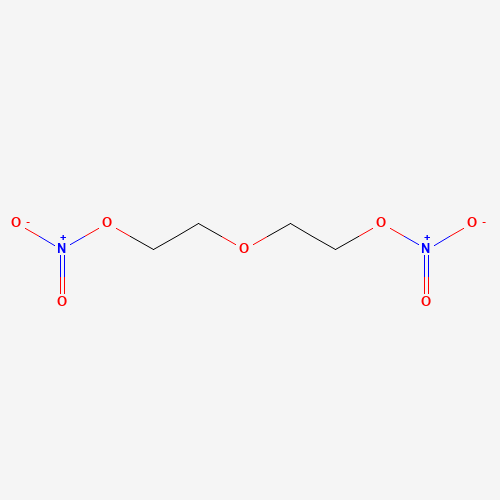
分子式C4H8N2O7
分子量196.14 g/mol
危化品
Physical Description | Diethylene glycol dinitrate appears as a liquid. Extremely sensitive explosive if not properly desensitized with a phlegmatizer. Slightly soluble in alcohol and soluble in ether. Slightly toxic by ingestion. May explode under prolonged exposure to heat or fire or from sudden shock. The primary hazard is the blast effect of an instantaneous explosion and not flying projectiles and fragments. Used as a rocket propellant.
科学粮草官-词典编辑部,修订于:2026-07-06
Toxicity
ToxicityFate Summary
ATMOSPHERIC FATE: According to a model of gas/particle partitioning of semivolatile organic compounds in the atmosphere(1), diethylene glycol dinitrate, which has a vapor pressure of 5.9X10⁻³ mm Hg at 25 °C(2), is expected to exist solely as a vapor in the ambient atmosphere. Vapor-phase diethylene glycol dinitrate is degraded in the atmosphere by reaction with photochemically-produced hydroxyl radicals(SRC); the half-life for this reaction in air is estimated to be 4.9 days(SRC), calculated from its rate constant of 3.3X10⁻¹² cu cm/molecule-sec at 25 °C(SRC) that was derived using a structure estimation method(3). Diethylene glycol dinitrate contains chromophores that absorb at wavelengths >290 nm(4) and therefore may be susceptible to direct photolysis by sunlight(SRC). Photolysis hal...
Soil Adsorption / Mobility
The Koc of diethylene glycol dinitrate is estimated as 32(SRC), using a log Kow of 0.98(1) and a regression-derived equation(2). According to a classification scheme(3), this estimated Koc value suggests that diethylene glycol dinitrate is expected to have very high mobility in soil. The sorption partition coefficients, Kp, were calculated as 2.3 and 0.8 g/mL for EPA-5 sediment (33.6% sand, 31.0% clay, and 35.4% silt at pH 7.44) and EPA-18 sediment (34.6% sand, 39.5% clay, and 25.8% silt at pH 7.76), respectively; these correspond to Koc values of 100 and 120 g/mL, respectively(1).
Environmental Biodegradation
ANAEROBIC: Using diethylene glycol dinitrate-contaminated water maintained under anaerobic conditions and enhanced with yeast, 100 ppm diethylene glycol dintrate was completely degraded in 35 days, with half-lives of 5 to 40 days reported, depending on the amount of organic nutrients or microbes present(1).
Environmental Bioconcentration
An estimated BCF of 3.2 was calculated in fish for diethylene glycol dinitrate(SRC), using a log Kow of 0.98(1) and a regression-derived equation(2). According to a classification scheme(3), this BCF suggests the potential for bioconcentration in aquatic organisms is low(SRC).
Volatilization from Water / Soil
The Henry's Law constant for diethylene glycol dinitrate is estimated as 3.9X10⁻⁷ atm-cu m/mole(SRC) derived from its vapor pressure, 5.9X10⁻³ mm Hg(1), and water solubility, 3.9X10+3 mg/L(1). This Henry's Law constant indicates that diethylene glycol dinitrate is expected to be essentially nonvolatile from water surfaces(2). No loss (less than 5%) of diethylene glycol dinitrate from the aqueous phase was observed after 10 days of purging, indicating that volatilization will be extremely slow in the environment(1). Diethylene glycol dinitrate is not expected to volatilize from dry soil surfaces(SRC) based upon its vapor pressure(1).
Environmental Abiotic Degradation
The photolysis half-lives of diethylene glycol dinitrate in surface waters under cloudless conditions at 40 deg N latitude for spring, summer, fall and winter were 19, 15, 33 and 59 days, respectively; average photolysis rates will decrease at depths below the surface. Photolysis products include nitrite, nitrate, and 2-hydroxyethyl nitratoacetate, with nitrate being the major inorganic degradation product of diethylene glycol dinitrate photolysis(1).
ICSC Environmental Data
The substance is harmful to aquatic organisms.
Artificial Pollution Sources
Diethylene glycol dinitrate's production and use as plasticizer in solid rocket propellants(1), in low-freezing dynamites and some permissible explosives(2), and in low sensitivity gun propellants(3) may result in its release to the environment through various waste streams(SRC).
Probable Routes of Human Exposure
Occupational exposure to diethylene glycol dinitrate may occur through dermal contact with this compound at workplaces where diethylene glycol dinitrate is produced or used. Limited exposure to general population to diethylene glycol dinitrate may occur via inhalation. (SRC)
Environmental Fate / Exposure Summary
Diethylene glycol dinitrate's production and use as plasticizer in solid rocket propellants, in low-freezing dynamites and some permissible explosives, and in low sensitivity gun propellants may result in its release to the environment through various waste streams. If released to air, a vapor pressure of 5.9X10⁻³ mm Hg at 25 °C indicates diethylene glycol dinitrate will exist solely as a vapor in the atmosphere. Vapor-phase diethylene glycol dinitrate will be degraded in the atmosphere by reaction with photochemically-produced hydroxyl radicals; the half-life for this reaction in air is estimated to be 4.9 days. Diethylene glycol dinitrate contains chromophores that absorb at wavelengths >290 nm and therefore may be susceptible to direct photolysis by sunlight. Photolysis half-lives ra...
Symptoms
Ingestion Exposure: See Inhalation.
Adverse Effects
Methemoglobinemia - The presence of increased methemoglobin in the blood; the compound is classified as secondary toxic effect
Exposure Routes
The substance can be absorbed into the body by inhalation of its aerosol, through the skin and by ingestion.
Human Toxicity Excerpts
/SIGNS AND SYMPTOMS/ Short term exposure: the substance may cause effects on the cardiovascular system, central nervous system and blood, resulting in impaired functions and the formation of methemoglobin. The effects may be delayed. Long term or repeated exposure: The substance may have effects on the cardiovascular system, resulting in cardiac disorders .
Non-Human Toxicity Values
LD50 Mouse male oral gavage 1394 mg/kg
Non-Human Toxicity Excerpts
/LABORATORY ANIMALS: Acute Exposure/ A dose of 0.5 mL /diethylene gylcol dintrate/ (DEGDN) was applied to the clipped backs of New Zealand rabbits. After a 4 hr exposure, material was removed and the sites scored for irritation by the method of Draize. All animals showed a negative response during the 72 hr observation period. DEGDN was classified as nonirritating to skin.
Evidence for Carcinogenicity
Classification - D; not classifiable as to human carcinogenicity Basis - No human or animal carcinogenic studies found in the available literature. /Based on former classification system/
Antidote and Emergency Treatment
/SRP:/ Immediate first aid: Ensure that adequate decontamination has been carried out. If patient is not breathing, start artificial respiration, preferably with a demand-valve resuscitator, bag-valve-mask device, or pocket mask, as trained. Perform CPR as necessary. Immediately flush contaminated eyes with gently flowing water. Do not induce vomiting. If vomiting occurs, lean patient forward or place on left side (head-down position, if possible) to maintain an open airway and prevent aspiration. Keep patient quiet and maintain normal body temperature. Obtain medical attention. /Nitrates, nitrites, and related compounds/