


 一键配货
一键配货
化合物详情
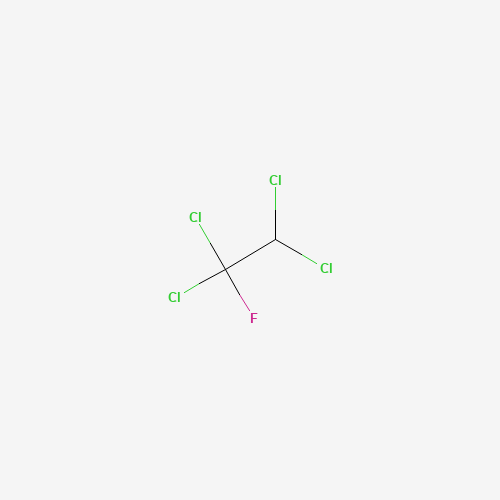
CAS354-14-3
分子式C2HCl4F
分子量185.84 g/mol
非危品
科学粮草官-词典编辑部,修订于:2026-07-06
Toxicity
ToxicityFate Summary
ATMOSPHERIC FATE: According to a model of gas/particle partitioning of semivolatile organic compounds in the atmosphere(1), 1,1,2,2-tetrachloro-1-fluoroethane, which has an estimated vapor pressure of 19 mm Hg at 25 °C(SRC), determined from a fragment constant method(2), is expected to exist solely as a vapor in the ambient atmosphere. Vapor-phase 1,1,2,2-tetrachloro-1-fluoroethane is degraded in the atmosphere by reaction with photochemically-produced hydroxyl radicals(SRC); the half-life for this reaction in air is estimated to be 1300 days(SRC), calculated from its rate constant of 1.2X10⁻¹⁴ cu cm/molecule-sec at 25 °C(SRC) determined using a structure estimation method(3). Stratospheric photolysis of 1,1,2,2-tetrachloro-1-fluoroethane frees chlorine radicals which can participate in...
Soil Adsorption / Mobility
Using a structure estimation method based on molecular connectivity indices(1), the Koc for 1,1,2,2-tetrachloro-1-fluoroethane can be estimated to be 150(SRC). According to a classification scheme(2), this estimated Koc value suggests that 1,1,2,2-tetrachloro-1-fluoroethane is expected to have moderate mobility in soil.
Environmental Bioconcentration
An estimated BCF of 29 was calculated for 1,1,2,2-tetrachloro-1-fluoroethane(SRC), using an estimated log Kow of 2.8(1) and a regression-derived equation(2). According to a classification scheme(3), this BCF suggests the potential for bioconcentration in aquatic organisms is low(SRC).
Volatilization from Water / Soil
The Henry's Law constant for 1,1,2,2-tetrachloro-1-fluoroethane is estimated as 0.003 atm-cu m/mole(SRC) using a fragment constant estimation method(1). This Henry's Law constant indicates that 1,1,2,2-tetrachloro-1-fluoroethane is expected to volatilize from water surfaces(2). Based on this estimated Henry's Law constant, the volatilization half-life from a model river (1 m deep, flowing 1 m/sec, wind velocity of 3 m/sec)(2) is estimated as 4 hours(SRC). The volatilization half-life from a model lake (1 m deep, flowing 0.05 m/sec, wind velocity of 0.5 m/sec)(2) is estimated as 5.5 days(SRC). 1,1,2,2-Tetrachloro-1-fluoroethane's estimated Henry's Law constant(1) indicates that volatilization from moist soil surfaces may occur(SRC). The potential for volatilization of 1,1,2,2-tetrachloro...
Environmental Abiotic Degradation
The rate constant for the vapor-phase reaction of 1,1,2,2-tetrachloro-1-fluoroethane with photochemically-produced hydroxyl radicals has been estimated as 1.2X10⁻¹⁴ cu cm/molecule-sec at 25 °C(SRC) using a structure estimation method(1). This corresponds to an atmospheric half-life of about 1300 days at an atmospheric concentration of 5X10+5 hydroxyl radicals per cu cm(1). 1,1,2,2-Tetrachloro-1-fluoroethane is unreactive in neutral and alkaline solution(2) and is not expected to directly photolyze due to the lack of absorption in the environmental UV spectrum (>290 nm). However, stratospheric photolysis of ozone depleting chemicals such as 1,1,2,2-tetrachloro-1-fluoroethane frees chlorine radicals which can participate in ozone-destroying reactions(3). The ozone-depletion potential for...
Artificial Pollution Sources
No production or use information was located for 1,1,2,2-tetrachloro-1-fluoroethane(SRC). However, the HCFCs are one class of chemicals being used to replace the CFCs which are commonly used as refrigerants, solvents, and foam blowing agents(1).
Probable Routes of Human Exposure
Occupational exposure to 1,1,2,2-tetrachloro-1-fluoroethane may occur through inhalation and dermal contact with this compound at workplaces where 1,1,2,2-tetrachloro-1-fluoroethane is produced or used. (SRC)
Environmental Fate / Exposure Summary
No production or use information was located for 1,1,2,2-tetrachloro-1-fluoroethane. If released to air, an estimated vapor pressure of 19 mm Hg at 25 °C indicates 1,1,2,2-tetrachloro-1-fluoroethane will exist in both the vapor and particulate phases. Vapor-phase 1,1,2,2-tetrachloro-1-fluoroethane will be degraded in the atmosphere by reaction with photochemically-produced hydroxyl radicals; the half-life for this reaction in air is estimated to be 1300 days. Stratospheric photolysis involving 1,1,2,2-tetrachloro-1-fluoroethane frees chlorine radicals which can participate in ozone-destroying reactions. If released to soil, 1,1,2,2-tetrachloro-1-fluoroethane is expected to have moderate mobility based upon an estimated Koc of 150. Volatilization from moist soil surfaces is expected to b...
Adverse Effects
Neurotoxin - Acute solvent syndrome









