


 一键配货
一键配货
化合物详情
CAS511-08-0
分子式C35H39N5O5
分子量609.71 g/mol
非危品
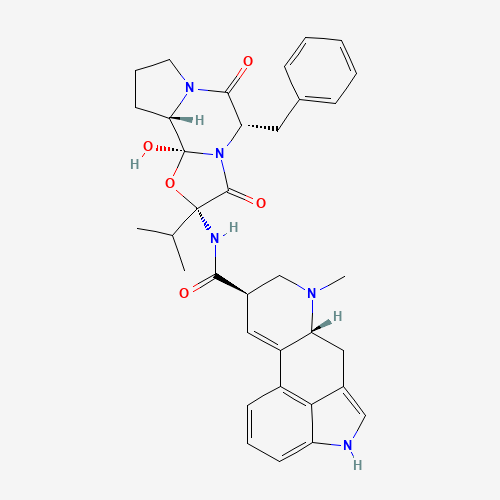
Ergocristine is ergotaman bearing benzyl, hydroxy, and isopropyl groups at the 5', 12' and 2' positions, respectively, and oxo groups at positions 3', 6', and 18. It is a natural ergot alkaloid. It derives from a hydride of an ergotaman.
科学粮草官-词典编辑部,修订于:2026-07-06
Toxicity
ToxicityFate Summary
ATMOSPHERIC FATE: According to a model of gas/particle partitioning of semivolatile organic compounds in the atmosphere(1), ergocristine, which has an estimated vapor pressure of 9X10-27 mm Hg at 25 °C(SRC), determined from a fragment constant method(2), is expected to exist solely in the particulate phase in the ambient atmosphere. Particulate-phase ergocristine may be removed from the air by wet and dry deposition(SRC). Ergocristine contains chromophores that absorb at wavelengths >290 nm(3) and, therefore, may be susceptible to direct photolysis by sunlight(SRC).
Soil Adsorption / Mobility
Using a structure estimation method based on molecular connectivity indices(1), the Koc of ergocristine can be estimated to be 840,000(SRC). According to a classification scheme(2), this estimated Koc value suggests that ergocristine is expected to be immobile in soil. Ergocristine will exist almost entirely in the cation form at pH values of 5 to 9 based on an estimated pKa of 8.75 for similarly structured ergotamine(3) and cations generally adsorb more strongly to soils containing organic carbon and clay than their neutral counterparts(4).
Environmental Bioconcentration
An estimated BCF of 87 was calculated in fish for ergocristine(SRC), using an estimated log Kow of 3.44(1) and a regression-derived equation(1). According to a classification scheme(2), this BCF suggests the potential for bioconcentration in aquatic organisms is moderate.
Volatilization from Water / Soil
Ergocristine will exist almost entirely in the cation form at pH values of 5 to 9 based on an estimated pKa of 8.75 for structurally similar ergotamine(1) and, therefore, volatilization from water and moist soil surfaces is not expected to be an important fate process(SRC). Ergocristine is not expected to volatilize from dry soil surfaces(SRC) based upon an estimated vapor pressure of 9X10-27 mm Hg(SRC), determined from a fragment constant method(2).
Environmental Abiotic Degradation
Ergocristine is not expected to undergo hydrolysis in the environment due to the lack of functional groups that hydrolyze under environmental conditions(1). Ergocristine contains chromophores that absorb at wavelengths >290 nm(1) and, therefore, may be susceptible to direct photolysis by sunlight(SRC).
Natural Pollution Sources
Ergocristine is one of many ergot alkaloids produced by the parasitic fungus Claviceps, mainly C purpurea, that infests grains such as rye, wheat, rice, corn, millet and oat(1).
Artificial Pollution Sources
Ergocristine use as a chemical precursor in the illicit manufacture of lysergic acid diethylamide (LSD)(1), may result in its release to the environment through various waste streams(SRC).
Probable Routes of Human Exposure
Occupational exposure to ergocristine may occur through inhalation and dermal contact with this compound where grains contaminated with ergocristine are processed and used. Monitoring data indicate that the general population may be exposed to ergocristine via consumption of grain products containing ergocristine. (SRC)
Other Environmental Concentrations
Silage fed to 1500 steers in Lethbridge, Alberta, Canada was contaminated with C. purpurea and contained 1299 ppb of ergocristine. Pellets were contaminated with 8016 ppb of ergocristine on a farm in Oregon(1).
Environmental Fate / Exposure Summary
Ergocristine is one of many ergot alkaloids produced by the parasitic fungus Claviceps, mainly C purpurea, that infests grains such as rye, wheat, rice, corn, millet and oat. It's use as a chemical precursor in the illicit manufacture of lysergic acid diethylamide (LSD), may result in its release to the environment through various waste streams. If released to air, an estimated vapor pressure of 9X10-27 mm Hg at 25 °C indicates ergocristine will exist solely in the particulate phase in the atmosphere. Particulate-phase ergocristine will be removed from the atmosphere by wet and dry deposition. Ergocristine contains chromophores that absorb at wavelengths >290 nm and, therefore, may be susceptible to direct photolysis by sunlight. If released to soil, ergocristine is expected to have no...
Symptoms
Convulsive ergotism can cause painful seizures and spasms, diarrhea, paresthesias, itching, headaches, nausea and vomiting. Usually the gastrointestinal effects precede the central nervous system effects. As well as seizures there can be hallucinations and mental effects including mania or psychosis. Gangrenous ergotism causes dry gangrene as a result of vasoconstriction induced in the more poorly vascularized distal structures, such as the fingers and toes. Symptoms include desquamation, weak periphery pulse, loss of peripheral sensation, edema and ultimately the death and loss of affected tissues. (L1920)
Treatment
Treatment for ergotism consists of vasodilators, anticoagulants and low molecular weight dextrans. If necessary, a sympathetic nerve blockade may be carried out, such as brachial plexus blockade. Temporary sedation (e.g. haloperidol) will be necessary in hallucination and diazepam is used for convulsions. There is no specific antidote. (L1921)
Health Effects
Ingestion of ergoline alkaloids is known to cause the disease ergotism. Ergotism occurs in two forms, gangrenous and convulsive, likely depending on the different kinds and amounts of ergoline alkaloids present. (A2913)
Exposure Routes
Oral, dermal, inhalation, and parenteral (contaminated drugs). (A3101)
Toxicity Summary
Ergoline alkaloids tend to act as a group, producing complex and variable effects of partial agonism or antagonism at adrenergic, dopaminergic, and serotonergic receptors. Variables relating to these effects are influenced by the agent, dosage, species, tissue, physiological, and endocrinological state, and experimental conditions. In particular, ergoline alkaloids have been shown to have the significant affinity towards the 5-HT1 and 5-HT2 serotonin receptors, D1 and D2 dopamine receptors, and alpha-adrenergic receptors. This can result in a number of different effects, including vasoconstriction, convulsions, and hallucinations. Ergometrine is also known to have a non-receptor specific oxytocic activity. (A2914, A2915, A2916)
Human Toxicity Excerpts
/ALTERNATIVE and IN VITRO TESTS/ Ergot alkaloids are secondary metabolites produced by fungi of the species Claviceps. Toxic effects after consumption of contaminated grains are described since Medieval times. Of the more than 40 known ergot alkaloids six are found predominantly. These are ergotamine, ergocornine, ergocryptine, ergocristine, ergosine and ergometrine, along with their corresponding isomeric forms (-inine-forms). Toxic effects are known to be induced by an interaction of the ergot alkaloids as neurotransmitters, like dopamine or serotonin. Nevertheless data concerning cytotoxic effects are missing and therefore a screening of the six main ergot alkaloids was performed in human primary cells in order to evaluate the toxic potential. As it is well known that ergot alkaloids...
Carcinogen Classification
No indication of carcinogenicity to humans (not listed by IARC).









