


 一键配货
一键配货
化合物详情
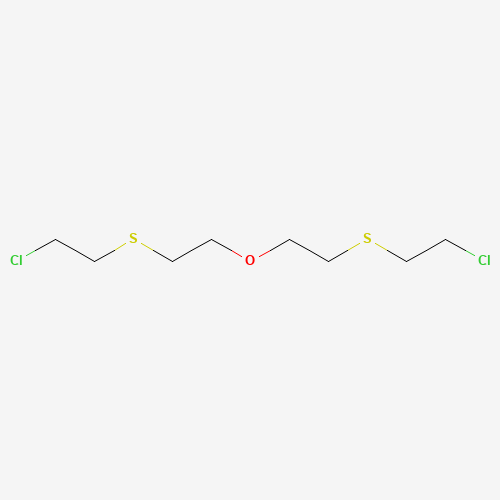
CAS63918-89-8
分子式C8H16Cl2OS2
分子量263.25 g/mol
非危品
Physical Description | This is a chemical weapon related to sulfur mustard (mustard gas) and is expected to react in a similar fashion. See the chemical datasheet for sulfur mustard for more information.
科学粮草官-词典编辑部,修订于:2026-07-06
Toxicity
ToxicityFate Summary
ATMOSPHERIC FATE: According to a model of gas/particle partitioning of semivolatile organic compounds in the atmosphere(1), O-Mustard, which has a vapor pressure of 3X10⁻⁶ mm Hg at 25 °C(2), will exist in both the vapor and particulate phases in the ambient atmosphere. Vapor-phase O-Mustard is degraded in the atmosphere by reaction with photochemically-produced hydroxyl radicals(SRC); the half-life for this reaction in air is estimated to be 5.2 hours(SRC), calculated from its rate constant of 7.5X10⁻¹¹ cu cm/molecule-sec at 25 °C(SRC) that was derived using a structure estimation method(3). Particulate-phase O-Mustard may be removed from the air by wet and dry deposition(SRC).
Soil Adsorption / Mobility
Using a structure estimation method based on molecular connectivity indices(1), the Koc of O-Mustard can be estimated to be 1180(SRC). According to a classification scheme(2), this estimated Koc value suggests that O-Mustard is expected to have low mobility in soil.
Environmental Bioconcentration
An estimated BCF of 28 was calculated in fish for O-Mustard(SRC), using an estimated log Kow of 2.71(1) and a regression-derived equation(1). According to a classification scheme(2), this BCF suggests the potential for bioconcentration in aquatic organisms is low(SRC).
Volatilization from Water / Soil
The Henry's Law constant for O-Mustard is estimated as 3.8X10⁻⁸ atm-cu m/mole(SRC) using a fragment constant estimation method(1). This Henry's Law constant indicates that O-Mustard is expected to be essentially nonvolatile from water surfaces(2). In addition, any O-Mustard that dissolves into water will be reactive with the water(3). O-Mustard's Henry's Law constant indicates that volatilization from moist soil surfaces is not expected to occur(SRC). O-Mustard is not expected to volatilize from dry soil surfaces(SRC) based upon a vapor pressure of 3X10⁻⁶ mm Hg at 25 °C(4).
Environmental Abiotic Degradation
The rate constant for the vapor-phase reaction of O-Mustard with photochemically-produced hydroxyl radicals has been estimated as 7.5X10⁻¹¹ cu cm/molecule-sec at 25 °C(SRC) using a structure estimation method(1). This corresponds to an atmospheric half-life of about 5.2 hours at an atmospheric concentration of 5X10+5 hydroxyl radicals per cu cm(1). The apparent hydrolysis half-life of O-Mustard at 25 °C was determined to be 2.8 minutes in an aqueous solution containing 5% ethanol at pH of 5-8(1).
Artificial Pollution Sources
O-Mustard's limited production for research may result in its release to the environment through various waste streams; its illegal use as a chemical warfare agent(1,2) will result in its direct release to the environment(SRC). Destruction of US stockpiles of chemical agents, including sulfur mustards, was mandated by the Chemical Weapons Convention to take place before April 2007(2).
Sediment/Soil Concentrations
In August 1988, chemical weapons were reported used against Kurdish populations in the mountainous region of northern Iraq close to the borders of Turkey and Iran(1). In November of that year, soil samples (and other samples) were collected from a hillside site of an impacted bomb(1). Analysis of the soil samples identified degradation products of sulfur mustard and O-mustard(1).
Probable Routes of Human Exposure
Occupational exposure to O-Mustard may occur through inhalation and dermal contact with this compound at workplaces where O-Mustard is produced or used. (SRC)
Other Environmental Concentrations
O-Mustard decontamination derivatives were detected in decontamination waste from chemical weapons (CW) agents stored in containers on Johnston Atoll (US territory located in the Pacific Ocean) since 1971(1).
Environmental Fate / Exposure Summary
O-Mustard's limited production for research may result in its release to the environment through various waste streams; its illegal use as a chemical warfare agent will result in its direct release to the environment. Destruction of US stockpiles of chemical agents, including sulfur mustards, was mandated by the Chemical Weapons Convention to take place before April 2007. If released to air, a vapor pressure of 3X10⁻⁶ mm Hg at 25 °C indicates O-Mustard will exist in both the vapor and particulate phases in the atmosphere. Vapor-phase O-Mustard will be degraded in the atmosphere by reaction with photochemically-produced hydroxyl radicals; the half-life for this reaction in air is estimated to be 5.2 hours. Particulate-phase O-Mustard will be removed from the atmosphere by wet and dry dep...
Toxicity Summary
IDENTIFICATION AND USE: O-Mustard is colorless when pure but is typically a yellow to brown oily substance with a slight garlic or mustard odor. This is a warfare and terrorism agent. HUMAN STUDIES: High doses of sulfur mustards can cause hyperexcitability, convulsions, and insomnia. The eye is the most sensitive tissue to sulfur mustard effects. Sulfur mustard vapor or liquid may cause intense conjunctival and scleral pain, swelling, lacrimation, blepharospasm, and photophobia; however, these effects do not appear for an hour or more. Miosis due to cholinergic effects may occur. High concentrations of vapor or liquid can cause corneal edema, perforation, blindness, and later scarring. Direct skin exposure to sulfur mustards causes erythema and blistering. Generally, a pruritic rash wil...
Human Toxicity Values
The lethal dose is about 100 mg/kg or 1 to 1.5 teaspoons of liquid. /Sulfur mustard/
Human Toxicity Excerpts
/SIGNS AND SYMPTOMS/ The eye is the most sensitive tissue to sulfur mustard effects. Sulfur mustard vapor or liquid may cause intense conjunctival and scleral pain, swelling, lacrimation, blepharospasm, and photophobia; however, these effects do not appear for an hour or more. Miosis due to cholinergic effects may occur. High concentrations of vapor or liquid can cause corneal edema, perforation, blindness, and later scarring. /Sulfur mustards/
Non-Human Toxicity Values
LC50 Mice inhalation 1650 mg/cu m/ 10 min
Antidote and Emergency Treatment
Because signs and symptoms of exposure do not occur for several hours postexposure, patients should be observed for at least 6 hours or sent home with instructions to return immediately if symptoms develop. Patients whose clinical effects and time of onset indicate moderate or severe exposure and patients who have ingested sulfur mustard should be transported to a medical facility for evaluation. /Sulfur mustard/









