

 一键配货
一键配货
化合物详情
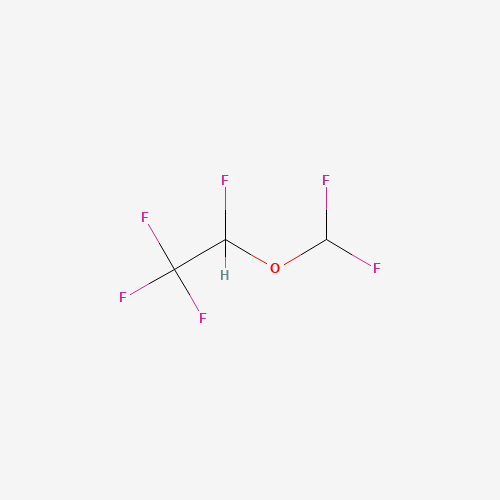
CAS57041-67-5
分子式C3H2F6O
分子量168.04 g/mol
非危品
Desflurane is an organofluorine compound. It has a role as an inhalation anaesthetic. It is functionally related to a methoxyethane.
科学粮草官-词典编辑部,修订于:2026-07-06
Toxicity
ToxicityFate Summary
ATMOSPHERIC FATE: According to a model of gas/particle partitioning of semivolatile organic compounds in the atmosphere(1), desflurane, which has a vapor pressure of 664 mm Hg at 20 °C(2), is expected to exist solely as a vapor in the ambient atmosphere. Vapor-phase desflurane is degraded in the atmosphere by reaction with photochemically-produced hydroxyl radicals(SRC); the half-life for this reaction in air is estimated to be 5 years(SRC), calculated from its rate constant of 4.40X10⁻¹⁵ cu cm/molecule-sec at 25 °C(3). Desflurane does not contain chromophores that absorb at wavelengths >290 nm(4) and, therefore, is not expected to be susceptible to direct photolysis by sunlight(SRC).
Soil Adsorption / Mobility
Using a structure estimation method based on molecular connectivity indices(1), the Koc of desflurane can be estimated to be 98(SRC). According to a classification scheme(2), this estimated Koc value suggests that desflurane is expected to have high mobility in soil.
Environmental Bioconcentration
An estimated BCF of 2.8 was calculated in fish for desflurane(SRC), using an estimated log Kow of 1.20(1) and a regression-derived equation(2). According to a classification scheme(3), this BCF suggests the potential for bioconcentration in aquatic organisms is low(SRC).
Volatilization from Water / Soil
The Henry's Law constant for desflurane is estimated as 7.1X10⁻² atm-cu m/mole(SRC) using a fragment constant estimation method(1). This Henry's Law constant indicates that desflurane is expected to volatilize rapidly from water surfaces(2). Based on this Henry's Law constant, the volatilization half-life from a model river (1 m deep, flowing 1 m/sec, wind velocity of 3 m/sec)(2) is estimated as 1.3 hours(SRC). The volatilization half-life from a model lake (1 m deep, flowing 0.05 m/sec, wind velocity of 0.5 m/sec)(2) is estimated as 5 days(SRC). Desflurane is expected to volatilize from dry soil surfaces(SRC) based upon a vapor pressure of 664 mm Hg(3).
Environmental Abiotic Degradation
The rate constant for the vapor-phase reaction of desflurane with photochemically-produced hydroxyl radicals is 4.40X10⁻¹⁵ cu cm/molecule-sec at 25 °C(1). This corresponds to an atmospheric half-life of about 5 years at an atmospheric concentration of 5X10+5 hydroxyl radicals per cu cm(1). A tropospheric half-life of 10 years has been calculated(2). The compound has a Global Warming Potential of 0.14 relative to CFC-12 and potential ozone depletion efficiency of 0.0 (an efficiency of Br relative to Cl of alpha=50 was used)(1). Desflurane is not expected to undergo hydrolysis in the environment due to the lack of functional groups that hydrolyze under environmental conditions(3). Desflurane does not contain chromophores that absorb at wavelengths >290 nm(3) and, therefore, is not expecte...
Artificial Pollution Sources
Desflurane's production and use as an anaesthetic(1) may result in its release to the environment through various waste streams(SRC).
Probable Routes of Human Exposure
Occupational exposure to desflurane may occur through inhalation and dermal contact with this compound at workplaces where desflurane is produced or administered(1). Exposure to desflurane among the general population will be limited to those administered the drug, an anaesthetic(SRC).
Environmental Fate / Exposure Summary
Desflurane's production may result in its release to the environment through various waste streams; its administration as an anaesthetic will result in its direct release to the environment. If released to air, a vapor pressure of 664 mm Hg at 20 °C indicates desflurane will exist solely as a vapor phase in the atmosphere. Vapor-phase desflurane will be degraded in the atmosphere by reaction with photochemically-produced hydroxyl radicals; the half-life for this reaction in air is estimated to be 5 years. Desflurane does not contain chromophores that absorb at wavelengths >290 nm and, therefore, is not expected to be susceptible to direct photolysis by sunlight. If released to soil, desflurane is expected to have very high mobility based upon an estimated Koc of 98. Volatilization from...
Symptoms
Ingestion Exposure: See Inhalation.
Treatment
In the event of overdosage, or suspected overdosage, take the following actions: discontinue administration of Desflurane, maintain a patent airway, initiate assisted or controlled ventilation with oxygen, and maintain adequate cardiovascular function. (L1712)
Interactions
We investigated effects of vitamin C and E (VCE) administration on desflurane-induced oxidative toxicity and element changes in the blood of operative patients under desflurane general anesthesia. Forty American Society of Anesthesiologists I or II Physical Status adult patients were scheduled for elective surgery. The patients were randomly divided into two groups. Control and VCE group was introduced to anesthesia with desflurane. VCE was administreted to patients in the control and VCE group before 1 hour of anesthesia with desflurane. Baseline (preoperative) and postoperative (at the 1(st), the 24(th), and 72(th) hr), blood samples were taken from the first and second groups. Erythrocyte and plasma lipid peroxidation levels at the 1(st), 24(th), and 72(th) hours were higher in the c...
Toxicity Data
LD50: 312.0 mg.kg-1 (i.v,swiss rate) (A698)
Health Effects
It may cause tachycardia and airway irritability when administered at concentrations greater than 10 vol%. [Wikipedia]
Hepatotoxicity
Likelihood score: C (probable rare cause of clinically apparent liver injury).
Adverse Effects
Rapid increases in desflurane concentration can cause a transient but clinically significant elevation in heart rate and blood pressure. These effects are secondary to catecholamine release, which is more pronounced with desflurane than isoflurane or sevoflurane. This resulting sympathetic response is controllable by concurrent administration of esmolol, clonidine, or the use of an opioid. Slowing the rate of increase in the concentration of desflurane can also decrease the catecholamine release. Volatile anesthetics promote skeletal muscle relaxation and enhance the effects of neuromuscular blocking agents. Desflurane enhances the effects of rocuronium greater than sevoflurane, isoflurane, or IV anesthetics. As with all inhaled anesthetics, a decrease in the ventilatory response to CO2...
Exposure Routes
Rapidly absorbed into the circulation via the lungs following inhalation.
Toxicity Summary
Desflurane induces a reduction in junctional conductance by decreasing gap junction channel opening times and increasing gap junction channel closing times. Desflurane also activates calcium dependent ATPase in the sarcoplasmic reticulum by increasing the fluidity of the lipid membrane. It also appears to bind the D subunit of ATP synthase and NADH dehydogenase. Desflurane also binds to and agonizes the GABA receptor, the large conductance Ca<sup>2+</sup> activated potassium channel, the glycine receptors, and antagonizes the glutamate receptors.
Human Toxicity Excerpts
/HUMAN EXPOSURE STUDIES/In an open-labelled clinical trial, the effect of desflurane anesthesia on liver function markers in pediatric patients was monitored. Fifty infants and children, 37 male, scheduled for elective cleft plate surgery were included in the study. Median age was 0.57 (0.25-5.45) years (range), mean desflurane exposure was 2.29 +/- 0.75 MAC-hr. Function markers were determined within 24 hr prior to and within 24-48 hr after anaesthesia. Complete data sets were available for total bilirubin 29, aspartate aminotransferase (ASAT) 36, alanine aminotransferase (ALAT) 35, and for alkaline phosphatase (AP) 28. Pre- and postanesthetic function tests were compared by means of Wilcoxon's matched-pairs test. Only for AP could a statistically significant reduction of the postanest...
Carcinogen Classification
No indication of carcinogenicity to humans (not listed by IARC).
Drug Induced Liver Injury
References: DOI:10.1016/j.drudis.2019.09.022
Non-Human Toxicity Excerpts
/GENOTOXICITY/ In vitro and in vivo genotoxicity studies did not demonstrate mutagenicity or chromosomal damage by SUPRANE. Tests for genotoxicity included the Ames mutation assay...and the mouse micronucleus assay.
Antidote and Emergency Treatment
/SRP:/ Advanced treatment: Consider orotracheal or nasotracheal intubation for airway control in the patient who is unconscious, has severe pulmonary edema, or is in severe respiratory distress. Positive-pressure ventilation techniques with a bag valve mask device may be beneficial. Consider drug therapy for pulmonary edema ... . Consider administering a beta agonist such as albuterol for severe bronchospasm ... . Monitor cardiac rhythm and treat arrhythmias as necessary ... . Start IV administration of D5W /SRP: "To keep open", minimal flow rate/. Use 0.9% saline (NS) or lactated Ringer's if signs of hypovolemia are present. For hypotension with signs of hypovolemia, administer fluid cautiously. Watch for signs of fluid overload ... . Treat seizures with diazepam or lorazepam ... . Use...
Effects During Pregnancy and Lactation
A retrospective study of women in a Turkish hospital who underwent elective cesarean section deliveries compared women who received bupivacaine spinal anesthesia (n = 170) to women who received general anesthesia (n = 78) with propofol for induction, sevoflurane for maintenance and fentanyl after delivery. No differences in breastfeeding rates were seen between the groups at 1 hour and 24 hours postpartum. However, at 6 months postpartum, 67% of women in the general anesthesia group were still breastfeeding compared to 81% in the spinal anesthesia group, which was a statistically significant difference.