


 一键配货
一键配货
化合物详情
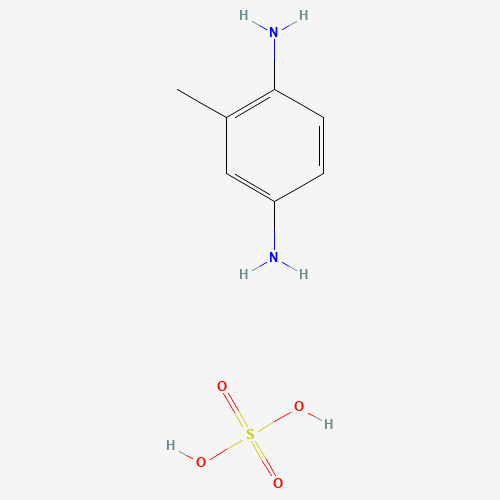
CAS615-50-9
分子式CH3C6H3(NH2)2·H2SO4
分子量220.25 g/mol g/mol
危化品
Physical Description | 2,5-toluenediamine sulfate is a light tan to light purple powder. (NTP, 1992)
科学粮草官-词典编辑部,修订于:2026-07-06
Toxicity
ToxicityEcotoxicity Excerpts
/OTHER TERRESTRIAL SPECIES/ ...The toxicity of 10 benzamines was tested by the well diffusion assay technique against 18 common bacterial species including the nitrogen-fixing bacterium Azotobacter vinelandii. ... 2,5-Diaminotoluene was inhibitory to the growth of P. fluorescens and Streptococcus mitis. The growth of A. vinelandii was inhibited by p-phenylenediamine and 2,5-diaminotoluene in the well diffusion assay. ... The nitrogenase activity of A. vinelandii was inhibited by p-phenylenediamine, 2,5-diaminotoluene, p-nitroaniline, 2-nitro-p-phenylenediamine, 3-nitro-o-phenylenediamine, and 4-nitro-o-phenylenediamine. Because many of these organisms are common soil and aquatic bacteria, the accumulation of these benzamine compounds in the environment may have an adverse impact on soil...
ICSC Environmental Data
Environmental effects from the substance have not been investigated adequately.
Probable Routes of Human Exposure
NIOSH (NOES Survey 1981-1983) has statistically estimated that 39,400 workers (32,217 of these were female) were potentially exposed to 2,5-diaminotoluene sulfate in the US(1). Occupational exposure to 2,5-diaminotoluene sulfate may occur through inhalation and dermal contact with this compound at workplaces where 2,5-diaminotoluene sulfate is produced or used. Use data indicate that the general population may be exposed to 2,5-diaminotoluene sulfate via dermal contact with consumer products containing 2,5-diaminotoluene sulfate(SRC).
Symptoms
Eye Exposure: Redness.
Adverse Effects
Skin Sensitizer - An agent that can induce an allergic reaction in the skin.
Exposure Routes
The substance can be absorbed into the body through the skin and by ingestion.
Toxicity Summary
Cosmetic Ingredient Review Finding(s): Safe for use in cosmetics, with qualifications
RAIS Toxicity Values
Oral Slope Factor Reference: SCREEN Current
Carcinogen Classification
Summary: Under the conditions of this bioassay, sufficient evidence was not obtained to demostrate the carcinogenicity of 2,5-toluenediamine sulfate in either Fischer 344 rats or B6C3F1 mice.
Non-Human Toxicity Values
LD50 Rat ip 49 mg/kg /in dimethylsulfoxide/
1 or Cancer Risk Level 1E-06
Fraction of Contaminant Absorbed Dermally from Soil: 0.1
Evidence for Carcinogenicity
Classification of carcinogenicity: 1) evidence in humans: No data; 2) evidence in animals: insufficient. Overall summary evaluation of carcinogenic risk to humans is Group 3: The agent is not classifiable as to its carcinogenicity to humans. /2,5-Diaminotoluene/
Antidote and Emergency Treatment
/SRP:/ Advanced treatment: Consider orotracheal or nasotracheal intubation for airway control in the patient who is unconscious, has severe pulmonary edema, or is in severe respiratory distress. Positive-pressure ventilation techniques with a bag-valve-mask device may be beneficial. Consider drug therapy for pulmonary edema ... . Monitor cardiac rhythm and treat arrhythmias as necessary ... . Start IV administration of D5W /SRP: "To keep open", minimal flow rate/. Use 0.9% saline (NS) or lactated Ringer's (LR) if signs of hypovolemia are present. For hypotension with signs of hypovolemia, administer fluid cautiously. If patient is unresponsive to these measures, vasopressors may be helpful. Watch for signs of fluid overload ... . Administer 1% solution methylene blue if patient is sympt...
Hazard Quotient Level 3 or Cancer Risk Level 1E-04
Fraction of Contaminant Absorbed Dermally from Soil: 0.1









