


 一键配货
一键配货
化合物详情
CAS33629-47-9
分子式C14H21N3O4
分子量295.33 g/mol
非危品
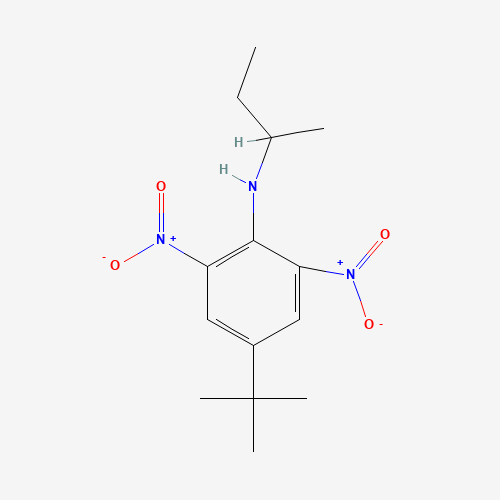
Butralin is a C-nitro compound.
科学粮草官-词典编辑部,修订于:2026-07-06
Toxicity
ToxicityEPA Ecotoxicity
Pesticide Ecotoxicity Data from EPA: 46
Fate Summary
ATMOSPHERIC FATE: According to a model of gas/particle partitioning of semivolatile organic compounds in the atmosphere(1), butralin, which has a vapor pressure of 1.3X10⁻⁵ mm Hg at 25 °C(2), will exist in both the vapor and particulate phases in the ambient atmosphere. Vapor-phase butralin is degraded in the atmosphere by reaction with photochemically-produced hydroxyl radicals(SRC); the half-life for this reaction in air is estimated to be 5.3 hours(SRC), calculated from its rate constant of 24.2X10⁻¹² cu cm/molecule-sec at 25 °C(SRC) that was derived using a structure estimation method(3). Particulate-phase butralin may be removed from the air by wet and dry deposition(SRC). Butralin has been reported as stable to photochemical reactions(4).
Soil Adsorption / Mobility
The Koc of butralin has been reported as 3,400(1). According to a classification scheme(2), this Koc value suggests that butralin is expected to have slight mobility in soil. Butralin was strongly adsorbed by organic matter, as shown by 77, 82, and 78% adsorption of addition of 2.5, 5.0, and 10X10-6 M concentrations, respectively(3). The same concentrations added to montmorillonite resulted in 21, 13, and 9% adsorption, respectively(3). Subsequent desorption studies showed very little desorption from organic matter by either water or 1 N CaCl solution, results being 13.2 and 11.1%, respectively; 91.7 and 68.4% desorption, respectively, was desorbed from montmorillonite(3). Metapeake loam, treated 7 months earlier with 10 ppm butralin, contained 27% nonextractable radioactivity(1).
Environmental Biodegradation
ANAEROBIC: In general, greater degradation in soil has been noted for the dinitroaniline compounds under anaerobic conditions than under aerobic(1). 550 grams of soil (Sharkey clay (4% sand, 25% silt, 71% clay, 4.2% organic matter) and Bosket clay loam (20% sand, 60% silt, 20% clay, 1.5% organic matter)) were flooded following application of a commercial formulation of butralin at 0.5 ppmw and maintained in a greenhouse at 20-42 °C temperature range(2). A half-life of 24 days was reported when the soil was subjected to flooding conditions while a half-life of 36 days was reported when soil moisture content was maintained at field capacity(2).
Environmental Bioconcentration
An estimated BCF of 1248 was calculated for butralin(SRC), using a log Kow of 4.93(1) and a regression-derived equation(2). According to a classification scheme(3), this BCF suggests the potential for bioconcentration in aquatic organisms is very high(SRC), provided the compound is not metabolized by the organism(SRC).
Volatilization from Water / Soil
The Henry's Law constant for butralin is estimated as 4.9X10⁻⁶ atm-cu m/mole(SRC) derived from its vapor pressure, 1.3X10⁻⁵ mm Hg(1), and water solubility, 1 mg/L(2). This Henry's Law constant indicates that butralin is expected to volatilize from water surfaces(3). Based on this Henry's Law constant, the volatilization half-life from a model river (1 m deep, flowing 1 m/sec, wind velocity of 3 m/sec)(3) is estimated as 13 days(SRC). The volatilization half-life from a model lake (1 m deep, flowing 0.05 m/sec, wind velocity of 0.5 m/sec)(3) is estimated as 99 days(SRC). Butralin's estimated Henry's Law constant indicates that volatilization from moist soil surfaces may occur(SRC). Butralin is not expected to volatilize from dry soil surfaces(SRC) based upon its vapor pressure(1).
Environmental Abiotic Degradation
The rate constant for the vapor-phase reaction of butralin with photochemically-produced hydroxyl radicals has been estimated as 24.2X10⁻¹² cu cm/molecule-sec at 25 °C(SRC) using a structure estimation method(1). This corresponds to an atmospheric half-life of about 5.3 hours at an atmospheric concentration of 5X10+5 hydroxyl radicals per cu cm(1). Butralin is not expected to undergo hydrolysis in the environment due to the lack of hydrolyzable functional groups(2). Following 7 days exposure to unfiltered solar radiation in July, 9.0% photodecomposition of 14C-labeled butralin was reported from a starting concentration 1 kg/ha applied to dry soil thin layer plates(4). The soil characteristics were a Hagerstown clay loam (28% sand, 44% silt, 28% clay, 1.9% organic matter, pH 6.3, and cat...
Ecotoxicity Excerpts
/BIRDS and MAMMALS/ Technical butralin (purity not identified) did not impair the reproductive ability of mallard ducks, with the exception of increased eggshell cracks, at 80 ppm. Technical butralin, fed to bobwhite quail for a total of 15 weeks, did not impair the reproductive ability at either the 4 or 80 ppm levels. However, these studies are inadequate and the highest tested level (80 ppm) does not adequately represent avian exposure levels expected in the environment... .
Artificial Pollution Sources
Butralin's production may result in its release to the environment through various waste streams; it's use as an herbicide(1) will result in its direct release to the environment(SRC).
Probable Routes of Human Exposure
Occupational exposure to butralin may occur through dermal contact with this compound at workplaces where butralin is produced or used. The greatest potential for dermal and inhalation exposure to butralin is expected at the manufacturing site and in the field during is application as an herbicide. (SRC)
Environmental Fate / Exposure Summary
Butralin's production may result in its release to the environment through various waste streams; it's use as an herbicide will result in its direct release to the environment. If released to air, a vapor pressure of 1.3X10⁻⁵ mm Hg at 25 °C indicates butralin will exist in both the vapor and particulate phases. Vapor-phase butralin will be degraded in the atmosphere by reaction with photochemically-produced hydroxyl radicals; the half-life for this reaction in air is estimated to be 5.3 hours. Particulate-phase butralin will be removed from the atmosphere by wet and dry deposition. Butralin has been reported to be photochemically stable. If released to soil, butralin is expected to have slight mobility based upon an estimated Koc of 3,400. Volatilization from moist soil surfaces is expe...
Toxicity Data
LC50 (rat) = 50,000 mg/m3/4h
Adverse Effects
Occupational hepatotoxin - Secondary hepatotoxins: the potential for toxic effect in the occupational setting is based on cases of poisoning by human ingestion or animal experimentation.
RAIS Toxicity Values
Oral Chronic Reference Dose Reference: OPP
Human Toxicity Excerpts
/EPIDEMIOLOGY STUDIES/ ... Median sensory nerve conduction velocity (SCV) (finger-wrist) in farmers using Delsen (mancozeb, dithiocarbamate fungicide), who showed significant decrease of serum cholinesterase activities, were significantly lower compared with the controls. Sural SCV in farmers using Fastac (alpha-cypermethrin, pyrethroid insecticide) and median motor nerve conduction velocity (MCV) (elbow-wrist) in farmers using Tamex (butralin, dinitroaniline herbicide) were significantly slowed compared with their respective controls. In Delsen (mancozeb, dithiocarbamate) users, the power of postural sway of 0-1 Hz was significantly larger than that in the controls both in the anterior-posterior direction with eyes open and in the right-left direction with eyes closed. The former type...
Carcinogen Classification
No indication of carcinogenicity to humans (not listed by IARC).
Antidote and Emergency Treatment
Supportive measures are ordinarily sufficient for successful management of excessive exposures to these herbicides ... . If the patient's condition deteriorates in spite of good supportive care, the operation of an alternative or additional toxicant should be suspected. /Other herbicides/
USGS Health-Based Screening Levels for Evaluating Water-Quality
Reference: Smith, C.D. and Nowell, L.H., 2024. Health-Based Screening Levels for evaluating water-quality data (3rd ed.). DOI:10.5066/F71C1TWP









