


 一键配货
一键配货
化合物详情
CAS122320-73-4
分子式C18H19N3O3S
分子量357.43 g/mol g/mol
危化品
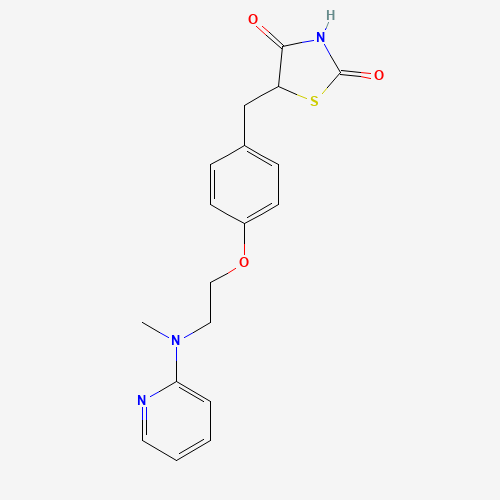
Rosiglitazone is an aminopyridine and a member of thiazolidinediones. It has a role as a ferroptosis inhibitor, an insulin-sensitizing drug and an EC 6.2.1.3 (long-chain-fatty-acid--CoA ligase) inhibitor. It is a conjugate acid of a rosiglitazone(1-).
科学粮草官-词典编辑部,修订于:2026-07-06
Toxicity
ToxicityFate Summary
ATMOSPHERIC FATE: According to a model of gas/particle partitioning of semivolatile organic compounds in the atmosphere(1), rosiglitazone, which has an estimated vapor pressure of 3.0X-14 mm Hg at 25 °C(SRC), determined from a fragment constant method(2), is expected to exist solely in the particulate phase in the ambient atmosphere. Particulate-phase rosiglitazone may be removed from the air by wet or dry deposition(SRC). Rosiglitazone does not contain chromophores that absorb at wavelengths >290 nm(3) and, therefore, is not expected to be susceptible to direct photolysis by sunlight(SRC).
Soil Adsorption / Mobility
Using a structure estimation method based on molecular connectivity indices(1), the Koc of rosiglitazone can be estimated to be 3,600(SRC). According to a classification scheme(2), this estimated Koc value suggests that rosiglitazone is expected to have slight mobility in soil. The pKa1, pKa2 values of rosiglitazone maleate are 6.1, 6.8(3), suggesting that this compound will exist partially in the cation form in the environment and cations generally adsorb more strongly to soils containing organic carbon and clay than their neutral counterparts(4).
Environmental Bioconcentration
An estimated BCF of 58 was calculated for rosiglitazone(SRC), using an estimated log Kow of 3.2(1) and a regression-derived equation(1). According to a classification scheme(3), this BCF suggests the potential for bioconcentration in aquatic organisms is moderate(SRC).
Volatilization from Water / Soil
The Henry's Law constant for rosiglitazone is estimated as 1.7X10⁻¹⁴ atm-cu m/mole(SRC) using a fragment constant estimation method(1). This Henry's Law constant indicates that rosiglitazone is expected to be essentially nonvolatile from water surfaces(2). Rosiglitazone is not expected to volatilize from dry soil surfaces(SRC) based upon an estimated vapor pressure of 3.0X10⁻¹⁴ mm Hg(SRC), determined from a fragment constant method(1).
Environmental Abiotic Degradation
Rosiglitazone is not expected to undergo hydrolysis in the environment due to the lack of functional groups that hydrolyze under environmental conditions(1). Rosiglitazone does not contain chromophores that absorb at wavelengths >290 nm(1) and, therefore, is not expected to be susceptible to direct photolysis by sunlight(SRC).
Environmental Water Concentrations
While data specific to rosiglitazone were not located(SRC, 2018), the literature suggests that some pharmaceutically active compounds originating from human and veterinary therapy are not eliminated completely in municipal sewage treatment plants and are therefore discharged into receiving waters(1). Wastewater treatment processes often were not designed to remove them from the effluent(2). Selected organic waste compounds may be degrading to new and more persistent compounds that may be released instead of or in addition to the parent compound(2). Studies have indicated that several polar pharmaceutically active compounds can leach through soil(1).
Artificial Pollution Sources
Rosiglitazone's production and administration as a medication(1) may result in its release to the environment through various waste streams(SRC).
Probable Routes of Human Exposure
Occupational exposure to rosiglitazone may occur through inhalation of dust and dermal contact with this compound at workplaces where rosiglitazone is produced or used. The general public is not likely to be exposed to rosiglitazone unless by direct medical treatment. (SRC)
Environmental Fate / Exposure Summary
Rosiglitazone's production and administration as a medication may result in its release to the environment through various waste streams. If released to air, an estimated vapor pressure of 3.0X10⁻¹⁴ mm Hg at 25 °C indicates rosiglitazone will exist solely in the particulate phase in the atmosphere. Particulate-phase rosiglitazone will be removed from the atmosphere by wet or dry deposition. Rosiglitazone does not contain chromophores that absorb at wavelengths >290 nm and, therefore, is not expected to be susceptible to direct photolysis by sunlight. If released to soil, rosiglitazone is expected to have slight mobility based upon an estimated Koc of 3,600. The pKa1, pKa2 values of rosiglitazone maleate are 6.1, 6.8, suggesting that rosiglitazone will exist partially in the cation form...
Interactions
Rifampin administration (600 mg once a day), an inducer of CYP2C8, for 6 days is reported to decrease rosiglitazone AUC by 66%, compared with the administration of rosiglitazone (8 mg) alone.
Hepatotoxicity
Likelihood score: C (probable rare cause of clinically apparent liver injury).
Adverse Effects
There are case reports of macular edema that have been reported in the literature, as well as cases of ovulation in anovulatory women.
Toxicity Summary
For patients with impaired liver function test who reports ALT greater than three times the normal upper limit, it is recommended to stop the treatment. In cases of ALT showing 1.5 to 3 times the upper normal limit, it is recommended to re-test every week until normalization of liver function test.
Human Toxicity Excerpts
/SIGNS AND SYMPTOMS/ No evidence of hepatotoxicity has been noted with rosiglitazone in clinical studies to date, including a long-term (4-6 years) study (ADOPT) in patients with recently diagnosed type 2 diabetes mellitus. In the ADOPT study, the incidence of ALT elevation exceeding 3 times the upper limit of normal was similar in patients receiving rosiglitazone or active comparators (i.e., glyburide or metformin). However, hepatitis, elevations in hepatic enzymes to at least 3 times the upper limit of normal, and liver failure with or without fatalities have been reported during postmarketing experience with rosiglitazone.
Carcinogen Classification
Evaluation Year: 2013
Drug Induced Liver Injury
References: DOI:10.1016/j.drudis.2019.09.022
Non-Human Toxicity Excerpts
/LABORATORY ANIMALS: Subchronic or Prechronic Exposure/ The pleiotropic effects of glitazones may favorably affect atrial remodeling. We sought to investigate the effects of peroxisome proliferator-activated receptor-gamma (PPAR-gamma) activator rosiglitazone on atrial structural remodeling and atrial fibrillation (AF) promotion in alloxan-induced diabetic rabbits. Twenty alloxan-induced diabetic rabbits were randomly divided into two groups (10 animals in each group), namely the diabetic rosiglitazone group (treated with rosiglitazone 2 mg/day/kg for 4 weeks) and the nontreated diabetic group, while 10 additional healthy rabbits served as controls. Moreover, isolated Langendorff-perfused rabbit hearts were used to evaluate atrial electrophysiological parameters and vulnerability to AF,...
Populations at Special Risk
Initiation of therapy with rosiglitazone is contraindicated in patients with New York Heart Association (NYHA) class III or IV heart failure.
Evidence for Carcinogenicity
Cancer in humans: There is inadequate evidence in humans for the carcinogenicity of rosiglitazone. Cancer in experimental animals: There is limited evidence in experimental animals for the carcinogenicity of rosiglitazone. Overall evaluation: Rosiglitazone is not classifiable as to its carcinogenicity to humans (Group 3).
Antidote and Emergency Treatment
/SRP:/ Immediate first aid: Ensure that adequate decontamination has been carried out. If patient is not breathing, start artificial respiration, preferably with a demand valve resuscitator, bag-valve-mask device, or pocket mask, as trained. Perform CPR if necessary. Immediately flush contaminated eyes with gently flowing water. Do not induce vomiting. If vomiting occurs, lean patient forward or place on the left side (head-down position, if possible) to maintain an open airway and prevent aspiration. Keep patient quiet and maintain normal body temperature. Obtain medical attention. /Poisons A and B/
Effects During Pregnancy and Lactation
◉ Effects on Lactation and Breastmilk









