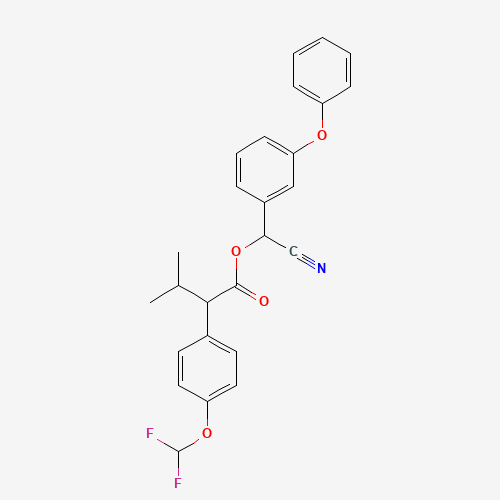
EPA Ecotoxicity
Pesticide Ecotoxicity Data from EPA: 25
Ecotoxicity Values
LC50 /Colinus virginianus/ (Bobwhite quail) dietary 3443 mg/kg diet/8 day
Fate Summary
ATMOSPHERIC FATE: According to a model of gas/particle partitioning of semivolatile organic compounds in the atmosphere(1), flucythrinate, which has a vapor pressure of 8.7X10⁻⁹ mm Hg at 25 °C(SRC), determined from a fragment constant method(2), is expected to exist solely in the particulate phase in the ambient atmosphere. Particulate-phase flucythrinate may be removed from the air by wet or dry deposition(SRC). Flucythrinate absorbs light strongly at wavelengths >290 nm(3) and therefore may be susceptible to direct photolysis by sunlight(SRC).
Soil Adsorption / Mobility
The Koc of flucythrinate is estimated as 56,000(SRC), using a log Kow of 6.20(1) and a regression-derived equation(2). According to a classification scheme(3), this estimated Koc value suggests that flucythrinate is expected to be immobile in soil. In a field study conducted in New Delhi, India (farm soil, pH 8.1 organic content 0.3%) flucythrinate did not leach below a 7.5 cm depth after a 40-day observation period(4).
Environmental Biodegradation
AEROBIC: Flucythrinate exhibited degradations of 28.6 and 45.6% in 6 weeks under dry conditions using unamended and amended (mixed with cotton plant residue) commerce silt loam soil, respectively(1). When applied in combination with methyl parathion to unamended and amended soils, flucythrinate degraded 27.9% and 47.0%, respectively(1). In a laboratory study using sediment and seawater collected from a salt marsh near Escambia County, FL, flucythrinate was observed to have a half-life of about 16 days(2) with no appreciable degradation after 28 days using sterilized media(2). An agricultural water-sediment persistence study found that flucythrinate disappeared entirely within 15 days in the water(3); however, it persisted beyond 20 days in the sediment(3).
Environmental Bioconcentration
An estimated BCF of 12,000 was calculated in fish for flucythrinate(SRC), using a log Kow of 6.2(1) and a regression-derived equation(2). According to a classification scheme(3), this BCF suggests the potential for bioconcentration in aquatic organisms is very high, provided the compound is not metabolized by the organism(SRC). In a 28-day laboratory study, a steady-state BCF of 2300 was measured in eastern oysters (Crassostrea virginica)(4).
Volatilization from Water / Soil
The Henry's Law constant for flucythrinate is estimated as 8.6X10⁻⁸ atm-cu m/mole(SRC) derived from its vapor pressure, 8.7X10⁻⁸ mm Hg(1), and water solubility, 0.06 mg/L(1). This Henry's Law constant indicates that flucythrinate is expected to be essentially nonvolatile from water surfaces(2). Flucythrinate is not expected to volatilize from dry soil surfaces(SRC) based upon its vapor pressure(1).
Environmental Abiotic Degradation
Flucythrinate is rapidly hydrolyzed in water under alkaline conditions, but more slowly under neutral or acidic conditions(1). Reported hydrolysis half-lives at 27 °C are about 40 days at pH 3, 52 days at pH 5, and 6.3 days at pH 9(1). Flucythrinate was degraded on soil plates by simulated sunlight and in aqueous solutions with half-lives of about 21 and 4 days, respectively(1), and therefore it may be susceptible to direct photolysis by sunlight(SRC). Flucythrinate absorbs light strongly in the environmental spectra (>290 nm)(2); when exposed to sunlight, thin films of flucythrinate on glass surfaces were observed to have a half-life of about 8 days(2); on bean leaves, the photodegradation half-life was about 3 days(2); only minor degradation occurred on dark control glass and leaf sur...
Food Survey Values
Flucythrinate was not detected as part of the Danish National Pesticide Monitoring Program for January 1995 through December 1996 sampling of 4,182 food samples(1). It was not detected in brown rice, potato, cabbage, lettuce, carrot, cucumber, shiitake, apple, strawberry, and banana samples in Japan, detection limit 0.01 ppm(2). Flucythrinate was not detected on 710 domestic and 949 imported pears nor 1219 domestic and 114 imported tomatoes sampled in 1992-1993, as part of the US Food and Drug Administration Pesticide Program(3).
Ecotoxicity Excerpts
/AQUATIC SPECIES/ Data on the acute and chronic toxicities of permethrin, fenvalerate, cypermethrin and flucythrinate to marine invertebrates and fish are reviewed. Generally, crustaceans are more sensitive than fish; oysters are comparatively insensitive. The mysid Mysidopsis bahia consistently is among the most sensitive crustaceans tested, with 96-hr LC50s of <0.02 ug/L for permethrin and of <0.01 ug/L for fenvalerate, cypermethrin and flucythrinate. The potential for chronic toxicity to fish is minimal for permethrin, moderate for fenvalerate and relatively great for flucythrinate.
Artificial Pollution Sources
Flucythrinate's former production in the US may have resulted in its release to the environment through various waste streams; its use as an insecticide(1) resulted in its direct release to the environment(SRC).
Probable Routes of Human Exposure
Occupational exposure and general population exposure should be low or non-existent since flucythrinate is no longer produced or used in the US (Sept, 1995). In the past, flucythrinate was applied directly to crops as a spray and exposure to this compound was primarily by inhalation and dermal routes in the field where it was applied. (SRC)
Environmental Fate / Exposure Summary
Flucythrinate's former production in the US may have resulted in its release to the environment through various waste streams; its use as an insecticide resulted in its direct release to the environment. If released to air, a vapor pressure of 8.7X10⁻⁹ mm Hg at 25 °C indicates flucythrinate will exist solely in the particulate phase in the atmosphere. Particulate-phase flucythrinate will be removed from the atmosphere by wet or dry deposition. Flucythrinate absorbs light strongly at wavelengths >290 nm and therefore may be susceptible to direct photolysis by sunlight. If released to soil, flucythrinate is expected to be immobile based upon an estimated Koc of 56,000. Volatilization from moist soil surfaces is not expected to be an important fate process based upon an estimated Henry's L...
Symptoms
Following dermal exposure to flucythrinate, feelings of numbness, itching, burning, stinging, tingling, or warmth may occur, that could last for a few hours. Dizziness, headache, nausea, muscle twitching, reduced energy, and changes in awareness can result from inhalation or ingestion of large amounts of flucythrinate. Paralysis can occur after exposure. (L857)
Treatment
Following oral exposure, the treatment is symptomatic and supportive and includes monitoring for the development of hypersensitivity reactions with respiratory distress. Provide adequate airway management when needed. Gastric decontamination is usually not required unless the pyrethrin product is combined with a hydrocarbon. Following inhalation exposure, move patient to fresh air. monitor for respiratory distress. If cough or difficulty breathing develops, evaluate for respiratory tract irritation, bronchitis, or pneumonitis. Administer oxygen and assist ventilation as required. Treat bronchospasm with inhaled beta2 agonist and oral or parenteral corticosteroids. In case of eye exposure, irrigate exposed eyes with copious amounts of room temperature water for at least 15 minutes. If ir...
Interactions
Male Sprague-Dawley rats dosed with N-nitrosodiethylamine (NDEA) 24 hr after two-thirds partial hepatectomy were treated with t... flucythrinate ... in the diet for 20 weeks. Altered hepatic foci were analyzed by quantitative stereology from paraffin-embedded sections stained for gamma-glutamyltranspeptidase (GGT) or glutathione S-transferase P (GST-P)... /and flucythrinate enhanced/ ...the development of NDEA-initiated, GGT-positive foci in rat liver at non-hepatotoxic doses. On the contrary, the volume fractions of GST-P-positive foci were not elevated as compared to the control group. /Flucythrinate/ ... inhibited the transfer of Lucifer Yellow CH between WB-F344 rat liver epithelial cells in culture, supporting the increase of GGT-positive foci and suggesting that these substances c...
Toxicity Data
LD50: >5000 mg/kg (Dermal, Rabbit) (L883) LD50: 81 mg/kg (Oral, Rat) (L883) LC50: 4.85 mg/L over 4 hours (Inhalation, Rat) (L883)
Health Effects
At high doses, signs of poisoning attributable to flucythrinate include profuse salivation and pulmonary edema, clonic seizures, opisthotonos (i.e., the spine is bent forward such that a supine body rests on its head and heels), coma, and death. At lower doses, commonly observed effects include paresthesia and erythema. (L863)
Adverse Effects
Neurotoxin - Other CNS neurotoxin
Exposure Routes
Inhalation (L857); oral (L857); dermal (L857); eye contact (L857).
Toxicity Summary
Pyrethroids exert their effect by prolonging the open phase of the sodium channel gates when a nerve cell is excited. They appear to bind to the membrane lipid phase in the immediate vicinity of the sodium channel, thus modifying the channel kinetics. This blocks the closing of the sodium gates in the nerves, and thus prolongs the return of the membrane potential to its resting state. The repetitive (sensory, motor) neuronal discharge and a prolonged negative afterpotential produces effects quite similar to those produced by DDT, leading to hyperactivity of the nervous system which can result in paralysis and/or death. Other mechanisms of action of pyrethroids include antagonism of gamma-aminobutyric acid (GABA)-mediated inhibition, modulation of nicotinic cholinergic transmission, enha...
Human Toxicity Excerpts
/SIGNS AND SYMPTOMS/ The allergenic properties of pyrethroids /with early pyrethrum preparations/ are marked in comparison with other pesticides. Many cases of contact dermatitis and respiratory allergy have been reported. Persons sensitive to ragweed pollen are particularly prone to such reactions. Preparations containing synthetic pyrethroids are less likely to cause allergic reactions than are the preparations made from pyrethrum powder. /Pyrethroids/
Acceptable Daily Intakes
FAO/WHO ADI: 0.02 mg/kg
Carcinogen Classification
No indication of carcinogenicity to humans (not listed by IARC).
Non-Human Toxicity Values
LD50 Mice oral 76 mg/kg
Non-Human Toxicity Excerpts
/LABORATORY ANIMALS: Subchronic or Prechronic Exposure/ Rats fed 300 ppm for 28 days showed severe motor symptoms, and rats fed 150 ppm showed moderate motor symptoms. In both cases these disappeared within 48 hr of reverting to normal diet. ...
Antidote and Emergency Treatment
Skin decontamination. Wash skin promptly with soap and water ... . If irritant or paresthetic effects occur, obtain treatment by a physician. Because volatilization of pyrethroids apparently accounts for paresthesia affecting the face, strenuous measures should be taken (ventilation, protective face mask and hood) to avoid vapor contact with the face and eyes. Vitamin E oil preparations (dL-alpha tocopheryl acetate) are uniquely effective in preventing and stopping the paresthetic reaction. They are safe for application to the skin under field conditions. Corn oil is somewhat effective, but possible side effects with continuing use make it less suitable. Vaseline is less effective than corn oil. Zinc oxide actually worsens the reaction. /Pyrethroids/



 一键配货
一键配货