


 一键配货
一键配货
化合物详情
CAS7788-98-9
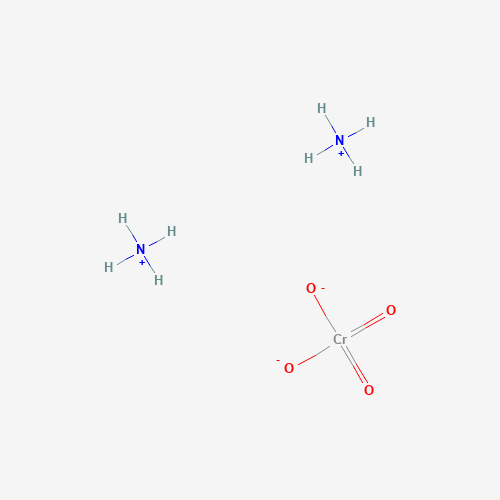
分子式CrH8N2O4
分子量152.07 g/mol
非危品
Physical Description | Ammonium chromate appears as a yellow crystalline solid. Density 1.866 g / cm3. Soluble in water. Toxic by inhalation (of dust). A strong irritant. The primary hazard is the threat to the environment. Immediate steps should be taken to limit its spread to the environment. Used in dyeing, photography, chemical analysis, and as a corrosion inhibitor.
科学粮草官-词典编辑部,修订于:2026-07-06
Toxicity
ToxicityProbable Routes of Human Exposure
NIOSH (NOES Survey 1981-1983) has statistically estimated that 2,769 workers (349 of these are female) were potentially exposed to ammonium chromate in the US(1).
Symptoms
Breathing hexavalent chromium can cause irritation to the lining of the nose, nose ulcers, runny nose, and breathing problems, such as asthma, cough, shortness of breath, or wheezing. Ingestion of hexavalent chromium causes irritation and ulcers in the stomach and small intestine, as well as anemia. Skin contact can cause skin ulcers. (L16)
Treatment
There is no know antidote for chromium poisoning. Exposure is usually handled with symptomatic treatment. (L16)
Health Effects
Hexavalent chromium is a known carcinogen. Chronic inhalation especially has been linked to lung cancer. Hexavalent chromium has also been know to cause reproductive and developmental defects. (A12)
Adverse Effects
ACGIH Carcinogen - Confirmed Human.
Exposure Routes
Inhalation (L16); oral (L16); dermal (L16)
Toxicity Summary
Hexavalent chromium's carcinogenic effects are caused by its metabolites, pentavalent and trivalent chromium. The DNA damage may be caused by hydroxyl radicals produced during reoxidation of pentavalent chromium by hydrogen peroxide molecules present in the cell. Trivalent chromium may also form complexes with peptides, proteins, and DNA, resulting in DNA-protein crosslinks, DNA strand breaks, DNA-DNA interstrand crosslinks, chromium-DNA adducts, chromosomal aberrations and alterations in cellular signaling pathways. It has been shown to induce carcinogenesis by overstimulating cellular regulatory pathways and increasing peroxide levels by activating certain mitogen-activated protein kinases. It can also cause transcriptional repression by cross-linking histone deacetylase 1-DNA methylt...
Minimum Risk Level
Intermediate Oral: 0.005 mg/kg/day (L134) Chronic Oral: 0.001 mg/kg/day (L134)
Carcinogen Classification
1, carcinogenic to humans. (L135)
Non-Human Toxicity Excerpts
/GENOTOXICITY/ Ammonium chromate Cr(VI) was tested using Escherichia coli strains WP2, WP67 and CM871 in the Escherichia coli DNA-repair test and using Salmonella typhimurium strains TA1535, TA100, TA1538, TA98, TA1537 and TA97 in the Ames reversion test. The test was performed both with and without S9 mix. The MIC (minimal inhibitory concentration) for ammonium chromate was 100 mug for E coli strains WP2 and WP67 without S9, 50 mug for CM871 (without S9) and with S9 mix the MIC was 150 ug for WP2, 120 ug for WP67, and 75 mug for CM871. The overall potency was a 0.003 change in MICs/nmole. The compound was positive in the spot test and also in the 2 hr preincubation assay. In the Ames test the compound was positive in strains TA100 and TA97, weakly positive in strains TA1538, TA98, and...
Evidence for Carcinogenicity
A1; Confirmed human carcinogen. /Insoluble Cr(VI) inorganic compounds/
Antidote and Emergency Treatment
Advanced treatment: Consider orotracheal or nasotracheal intubation for airway control if signs of upper airway obstruction are present or if the patient who is unconscious, has severe pulmonary edema, or is in severe respiratory distress. Positive-pressure ventilation techniques with a bag-valve-mask device may be beneficial. Consider drug therapy for pulmonary edema ... . Consider administering a beta agonist such as albuterol for severe bronchospasm ... . Monitor cardiac rhythm and treat arrhythmias if necessary ... . Start IV administration of D5W TKO. Use 0.9% saline (NS) or lactated Ringer's (LR) if signs of hypovolemia are present. For hypotension with signs of hypovolemia, administer fluid cautiously. Consider vasopressors if patient is hypotensive with a normal fluid colume. Wa...









