

 一键配货
一键配货
化合物详情
CAS1222-05-5
分子式C18H26O
分子量258.4 g/mol g/mol
危化品
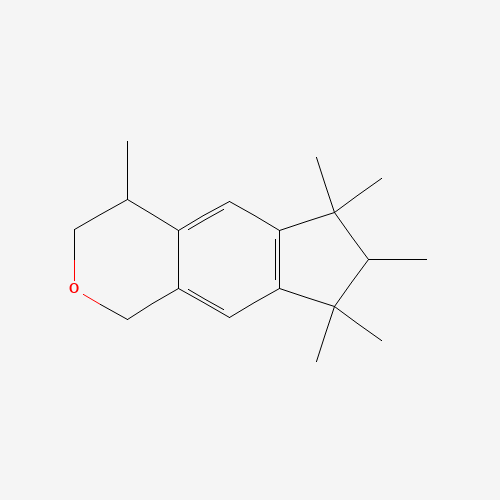
Galaxolide is an organic heterotricyclic compound that is 1,3,4,6,7,8-hexahydrocyclopenta[g]isochromene substituted by methyl groups at positions 4, 6, 6, 7, 8 and 8 respectively. It is a synthetic musk used as a fragrance in cosmetics. It has a role as a fragrance. It is an organic heterotricyclic compound and a member of isochromenes.
科学粮草官-词典编辑部,修订于:2026-07-06
Toxicity
ToxicityBody Burden
Concentrations of HHCB and AHTN in human adipose fat collected from New York City were measured. Concentrations of HHCB and AHTN in human adipose fat samples ranged from 12 to 798 and from <5 to 134 ng/g, on a lipid weight basis, respectively. A significant correlation existed between the concentrations of HHCB and AHTN in human adipose fat. Concentrations of HHCB and AHTN were not positively correlated with age or gender of the donors.
Ecotoxicity Values
LC50; Species: Daphnia magna (Water Flea) age 6-24 hr, parthenogenetic; Conditions: freshwater, static, no suspended solids, pH 7.0, dissolved oxygen 7.0 mg/L; Concentration: 568 ug/L for 24 hr (95% confidence interval: 440-754 ug/L) /77.45% purity/
Fate Summary
ATMOSPHERIC FATE: According to a model of gas/particle partitioning of semivolatile organic compounds in the atmosphere(1), galaxolide, which has a vapor pressure of 5.45X10⁻⁴ mm Hg at 25 °C((SRC), determined from a fragment constant method(2)), will exist in both the vapor and particulate phases in the ambient atmosphere. Vapor-phase galaxolide is degraded in the atmosphere by reaction with photochemically-produced hydroxyl radicals(SRC); the half-life for this reaction in air is estimated to be approximately 10 hrs(SRC), calculated from its rate constant of 2.60X10⁻¹¹ cu cm/molecule-sec at 25 °C(3). Particulate-phase galaxolide may be removed from the air by wet and dry deposition(SRC). Galaxolide does not contain chromophores that absorb at wavelengths >290 nm(4) and, therefore, is n...
Soil Adsorption / Mobility
Using a structure estimation method based on molecular connectivity indices(1), the Koc of galaxolide can be estimated to be 2.9X10+4(SRC). A log Koc of 4.86 has also been reported, test conditions not available(2). According to a classification scheme(3), these Koc values suggest that galaxolide is expected to be immobile in soil(SRC). In soil column experiments, galaxolide was added at 0.330 ug/L to a 2.4 m soil column employing a Mohall-Laveen sandy loam soil from northwest of Phoenix, AZ(4). After percolating through the soil column over 23 days, the concentration in the column effluent was below the detection limit of 0.500 ug/L(4). Galaxolide has been found in association with suspended particulate matter collected from the Elbe River at Magdeburg, Germany during June 1996-May 199...
Environmental Biodegradation
AEROBIC: Galaxolide, present at 10 and 20 mg/L, released 0% CO2 in four weeks using a sewage inoculum at 1 drop/L and the Modified Sturm test(1). Galaxolide, present at 10.97 mg C/L, released 0% CO2 in four weeks using an effluent from a semi-continuous activated sludge (SCAS) test after 8 weeks acclimation and the OECD 302 test(1). C14-Labeled galaxolide was added at 25 ug/L to freshly collected activated sludge resulting in 18% 14-CO2 recovered after 200 days; products identified were galaxolide-lactone and a galaxolide-hydroxy acid(1). Using sludge-amended farm, forest, and agricultural soils sampled from New Jersey, and river sediment from the Delaware River, it was concluded that galaxolide half-life in soil is approximately 4 months(1). Galaxolide, present at 10-20 mg/L, was not b...
Environmental Bioconcentration
A BCF of 1,584 was measured in fish for galaxolide(SRC), using bluegill sunfish (Lepomis macrochirus) which were exposed to concentrations of 1 and 10 mg/L over an 28-day period(1). According to a classification scheme(2), this BCF suggests the potential for bioconcentration in aquatic organisms is very high(SRC). A polar metabolite accounting for 9-24% of the total radioactivity in tissue was detected(1).
Volatilization from Water / Soil
The Henry's Law constant for galaxolide is estimated as 1.1X10⁻⁴ atm-cu m/mole(SRC) derived from its vapor pressure, 5.45X10⁻⁴ mm Hg(1), and water solubility, 1.75 mg/L(1). This Henry's Law constant indicates that galaxolide is expected to volatilize from water surfaces(2). Based on this Henry's Law constant, the volatilization half-life from a model river (1 m deep, flowing 1 m/sec, wind velocity of 3 m/sec)(2) is estimated as 18 hours(SRC). The volatilization half-life from a model lake (1 m deep, flowing 0.05 m/sec, wind velocity of 0.5 m/sec)(2) is estimated as 10 days(SRC). However, volatilization from water surfaces is expected to be attenuated by adsorption to suspended solids and sediment in the water column. The estimated volatilization half-life from a model pond is 18 months...
Environmental Abiotic Degradation
The rate constant for the vapor-phase reaction of galaxolide with photochemically-produced hydroxyl radicals is 2.6X10⁻¹¹ cu cm/molecule-sec at 25 °C(1). This corresponds to an atmospheric half-life of about 3.7 hours at an atmospheric concentration of 5X10+5 hydroxyl radicals per cu cm(1). A half-life of 3.7 hrs has also been reported at an atmospheric concentration of 2.0X10+5 hydroxyl radicals per cu cm(1). Galaxolide is not expected to undergo hydrolysis in the environment due to the lack of functional groups that hydrolyze under environmental conditions(2). Galaxolide does not contain chromophores that absorb at wavelengths >290 nm(2) and, therefore, is not expected to be susceptible to direct photolysis by sunlight(SRC).
Environmental Water Concentrations
SURFACE WATER: Galaxolide was reported at a concentration range of 3.5-32.0 ng/L in water samples from the Haihe River in North China collected from Dec 29-30, 2008(1). Mean concentrations in surface water have been reported as follows (ng/L, location): 15-57, Denmark; <84, France; <3-1590, Germany; 172.1-313.7, Romania; 100-13.920, Korea; 3.1-2184, Spain; <2-564, Switzerland; 6-28, UK; not detected-4.7, USA(2). A median concentration of 463 ng/L has been reported in surface water from the Molgora River (Lombardia Region, Northern Italy), sampled in 2010/2011. Concentrations in other European rivers are as follows (river, country, year, ng/L): Elbe, Germany, 1997, 118; Mulde Saale, Germany, 1996-1997, 116; Ruhr, Germany, 1995/1996, 275; Glatt, Switzerland, 1994, 136(3). Mean concentrati...
Milk Concentrations
Samples from 40 healthy breast feeding mothers were analyzed under carefully controlled conditions avoiding secondary contamination. ... Among the polycyclic musks HHCB was found in most samples (median 64 ng/kg fat)...
Ecotoxicity Excerpts
/AQUATIC SPECIES/ In the current study, the bioconcentration behavior and acute toxicity of ... galaxolide 1,3,4,6,7,8-hexahydro-4,6,6,7,8,8-hexa-methylcyclopenta[gamma]-2-benzopyran (HHCB), was studied in two benthic organisms ... Chironomus riparius exhibited bioconcentration factors (BCFs) for ... HHCB substantially lower than predicted for nontransformed organics. The BCF ... increased after coexposure of the organism to the cytochrome P450 inhibitor piperonyl butoxide. Thus, the low BCF values were the result of rapid biotransformation of HHCB in the midge larvae. Bioconcentration kinetics indicated that /HHCB/ induced its own cytochrome P450-mediated metabolism. Acute toxicity of /HHCB/ to midge larvae was reduced compared to predicted baseline toxicity. Bioconcentration of HHCB ....
Animal Concentrations
[Table#7195]: IlNwZWNpZXMiLCJHZW51cyBzcGVjaWVzIiwiVGlzc3VlIiwiTG9jYXRpb24sIHllYXIiLCJDb25jbiAobmcvZyB3ZXQgd3QpIgoiRmlubGVzcyBwb3Jwb2lzZSIsIk5lb3Bob2NhZW5hIHBob2NhZW5vaWRlcyIsImJsdWJiZXIiLCIiLCIyNiIKIk1hbGxhcmQiLCJBbmFzIHBsYXR5cmh5bmNob3MiLCJsaXZlciIsIlNoYWxsb3cgd2F0ZXIiLCIxLjAiCiJCbGFjay1oZWFkZWQgZ3VsbCIsIkxhcnVzIHJpZGlidW5kdXMiLCJsaXZlciIsIiIsIjEuMSIKIkNhbGlmb3JuaWEgc2VhbGlvbiIsIiIsImJsdWJiZXIiLCJDQSwgMTk5MS0xOTk1IiwiNi4wIgoiQm90dGxlbm9zZSBkb2xwaGluIiwiIiwiYmx1YmJlciIsIkZMLCAyMDA0IiwiMi4xIgoiU3RyaXBlZCBkb2xwaGluIiwiIiwiYmx1YmJlciIsIkl0YWx5LCBNZWRpdGVycmFuZWFuIFNlYSwgMjAwMy0yMDA0IiwiMS41IgoiQ29ybW9yYW50IiwiIiwibGl2ZXIiLCJJdGFseSwgTWVkaXRlcnJhbmVhbiBTZWEsIDIwMDMtMjAwNCIsIjEuMCIKIlJpbmdlZCBzZWFsIiwiIiwibGl2ZXIiLCJCYWx0aWMgU2VhLCBGaW5sYW5kLCAxOTk4IiwiPDAuOCIKIkdyYXkgc2VhbCIsIiIsImxpdmVyIiw...
Effluent Concentrations
Galaxolide was studied for its presence in Bavarian sewage treatment plants (STP) influents and effluents. Galaxolide was found in the receiving surface waters of the STP at a maximum concentration of 108,000 ng/L(1,2). It was reported that galaxolide concentration in the effluent (1.08 ug/L) was larger than in the influent concentration of 0.79 ug/L the following analysis of the Kallby sewage treat plant situated on the Hoje River in Sweden. Donwstream concentrations were (ug/L, distance from outflow): 0.23, 283 m; 0.15, 4012 m; 0.13, 7543 m. The upstream concentration was 0.03 ug/L(3).
Atmospheric Concentrations
RURAL/REMOTE: Galaxolide was present in the gas-phase over Lake Michigan at a concentration of 1.1 ng/cu m, sampled during June 1999 and May 2000(1).
Fish/Seafood Concentrations
[Table#7197]: IlNhbXBsaW5nIHNpdGUiLCJSZXNpZGVudCBzcGVjaWVzIiwibWVhbiBjb25jbiAobmcvZykiCiJDaGljYWdvLCBJTCIsImxhcmdlbW91dGggYmFzcyIsIjEsMzAwIgoiRGFsbGFzLCBUWCIsInNtYWxsbW91dGggYnVmZmFsbyIsIjgwMCIKIk9ybGFuZG8sIEZMIiwiYm93ZmluIiwiMTAwIgoiUGhvZW5peCwgQVoiLCJjb21tb24gY2FycCIsIjEsODAwIgoiV2VzdCBDaGVzdGVyLCBQQSIsIndoaXRlIHN1Y2tlciIsIjEsODAwIgoiR2lsYSBXaWxkZXJuZXNzIGFyZWEsIE5NIiwiU29ub3JhIHN1Y2tlciIsIjxNREwiCg==
Artificial Pollution Sources
Galaxolide's production may result in its release to the environment through various waste streams. Its use in a fragrance ingredient in perfumes, soaps, cosmetics and detergents(1) will result in its direct release to the environment(SRC).
Sediment/Soil Concentrations
SEDIMENT: Human activity in estuarine areas has resulted in pollution of the aquatic environment, but little is known about the levels of synthetic musks (SMs) in river water and sediments in estuarine areas. This study investigated the concentrations and distribution of SMs in the Jiaozhou Bay wetland, including celestolide, phantolide, traseolide, galaxolide (HHCB), tonalide (AHTN), musk xylene and musk ketone (MK). The SMs HHCB, AHTN and MK were detected at concentrations of 10.7-208, not detected (ND)-59.2 and ND-13.6 ng/L, respectively, in surface water samples and 13.1-27.3, 3.06-14.5 and 1.33-18.8 ng/g (dry weight; dw), respectively, in sediment samples. Based on the calculated total organic carbon (TOC) concentrations, there was no significant correlation between SMs and TOC in...
Probable Routes of Human Exposure
[Table#7206]: IkF2ZyB0aW1lIChtaW4pIiwiQWR1bHQgYnJlYXRoaW5nIHpvbmUgKHVnL2N1IG0pIiwiQ2hpbGQgYnJlYXRoaW5nIHpvbmUgKHVnL2N1IG0pIgoiMC41IiwiMTA4IiwiMTI4IgoiMi41IiwiNTUiLCIxNTEiCiI1LjUiLCI2NSIsIjIzMCIKIjMwIiwiMzAiLCIxNCIKIjU1IiwiMTgiLCI1IgoiMTEwIiwiNSIsIjMiCg==
Other Environmental Concentrations
[Table#7203]: IlByb2R1Y3QiLCIlIHByb2R1Y3RzIGNvbnRhaW5pbmcgZ2FsYXhvbGlkZSIsIkF2ZyBjb25jbiAobmcvZyBzYW1wbGUpIiwiUmFuZ2UgKG5nL2cgc2FtcGxlKSIKIlBlcmZ1bWVzIiwiODYiLCIxLDI4MCwwMDAiLCI8NS00LDk5MCwwMDAiCiJCb2R5IGxvdGlvbi9jcmVhbSIsIjg2IiwiMSwyMjksMDAwIiwiPDUtMyw3NDAsMDAwIgoiRGVvZG9yYW50cy9hbnRpcGVyc3BpcmFudHMiLCIxMDAiLCIyMjgsMDAwIiwiPDUtMiwyNTAsMDAwIgoiU2hvd2VyIGdlbHMvc2hhdmluZyBjcmVhbSIsIjY0IiwiMjI4LDAwMCIsIjw1LTEsMjMwLDAwMCIKIlNoYW1wb28vY29uZGl0aW9uZXIvaGFpciBwcm9kdWN0cyIsIjkyIiwiMTE1LDAwMCIsIjw1LTg1NSwwMDAiCg==
Environmental Fate / Exposure Summary
Galaxolide's production may result in its release to the environment through various waste streams. Its use in a fragrance ingredient in perfumes, soaps, cosmetics and detergents will result in its direct release to the environment. If released to air, a vapor pressure of 5.45X10⁻⁴ mm Hg at 25 °C indicates galaxolide will exist in both the vapor and particulate phases in the atmosphere. Vapor-phase galaxolide will be degraded in the atmosphere by reaction with photochemically-produced hydroxyl radicals; the half-life for this reaction in air is estimated to be 10 hrs. Particulate-phase galaxolide will be removed from the atmosphere by wet or dry deposition. Galaxolide does not contain chromophores that absorb at wavelengths >290 nm and, therefore, is not expected to be susceptible to di...
Effect Level
collection=toxvaldb&kind=^EL$
Interactions
Single and joint toxic effects of polycyclic musks including 1,3,4,6,7,8-hexahydro-4,6,6,6,7,8,8-hexamethylcyclopenta[g]-2-benzopyran (HHCB) and 7-acetyl-1,1,3,4,4,6-hexamethyl-l,2,3,4-tetrahydronapthalene (AHTN) and cadmium (Cd) on seed germination and seedling growth of wheat (Triticum aestivum) were investigated. The results showed that the toxicity sequence of HHCB toxic to wheat seed germination and seedling growth was similar to that of AHTN, that is, germination rate > shoot elongation > root elongation, while the toxicity of Cd was in the sequence of root elongation > shoot elongation > germination rate, according to the LC50 and EC50 values. It is suggested that polycyclic musks and Cd had different toxicological mechanisms. Root and shoot elongation of wheat might be good bioi...
Lethal Dose
collection=toxvaldb&kind=^LD$
Adverse Effects
Skin Sensitizer - An agent that can induce an allergic reaction in the skin.
Toxicity Summary
IDENTIFICATION AND USE: Galaxolide (HHCB) is an almost colorless viscous liquid. It is a synthetic, artificial musk fragrance, which is used as a laundry detergent fragrance, as well as an ingredient in perfumes, soaps, and cosmetics. HUMAN STUDIES: No irritation was observed in any of the 42 subjects tested in human repeated insult patch test even after repeated occlusive applications of undiluted material. High concentrations of HHCB can affect steroidogenesis in vitro using the H295R cell line. HHCB was not genotoxic in the micronucleus test with human lymphocytes in vitro in the presence and absence of metabolic activation. ANIMAL STUDIES: HHCB was added to the diet of rats at levels calculated to result in mean daily doses of 5, 15, 50 or 150 mg HHCB/kg. On completion of the 90-day...
Average Daily Intake
The occurrence of ten synthetic musks in samples of 10 widely consumed fish and shellfish species from Tarragona (Catalonia, Spain) was determined. The most used nitro and polycyclic musks, as well as a well-known transformation product in tissues, were analyzed. Furthermore, the human health risks derived from the musk exposure through seafood consumption were characterized. None of the nitro musks were detected in any of the analyzed samples. In contrast, most of the polycyclic musks were found, being galaxolide (HHCB) and tonalide (AHTN) present in all the samples. HHCB was the greatest contributor, with maximum levels in sardine and mackerel (367 and 304 ng g(-1) (d.w.) (dry weight), respectively). The highest exposure to individual musks was estimated for HHCB and HHCB-Lactone, wit...
Lethal Concentration
collection=toxvaldb&kind=^LC$
Human Toxicity Excerpts
/BIOMONITORING/ Personal care products (PCPs), such as soaps, perfumes, cosmetics, lotions, etc., contain a variety of chemicals that have been described as potentially hormone disrupting chemicals. Therefore, it is important to assess the internal exposure of these chemicals in humans. Within the 2nd Flemish Environment and Health Study (FLEHS II, 2007-2011), the human exposure to three classes of pollutants that are present in a wide variety of PCPs i.e. polycyclic musks (galaxolide, HHCB and tonalide, AHTN in blood), parabens (urinary para-hydroxybenzoic acid, HBA) and triclosan (urinary TCS) was assessed in 210 Flemish adolescents (14-15 years) and in 204 adults (20-40 years) randomly selected from the general population according to a stratified two stage clustered study design. Th...
Non-Human Toxicity Values
LD50 Rat oral 4640 mg/kg bw[ECHA; 1,3,4,6,7,8-hexahydro-4,6,6,7,8,8-hexamethylindeno
Reference and Risk Values
collection=toxvaldb&kind=^RRV$
Non-Human Toxicity Excerpts
/LABORATORY ANIMALS: Acute Exposure/ Groups of five female rats (Charles River Sprague Dawley weighing 106 - 155 g) were dosed with Galaxolide 50 (65% HHCB in diethyl phthalate) by intraperitoneal injection at doses of 0.1, 0.215, 1.0 or 4.64 g/kg bw, (equivalent to 0.065, 0.14, 0.65 or 3.0 g/kg bw HHCB) and observed for 7 days. At 1.0 g/kg, 3 animals were observed to be in a depressed condition within two hr of dosing but returned to normal at 24 hr. There were no deaths at this dose. Lethargy and depression were observed in 4/5 animals at the high dose within 2 hr and all were found dead at 24 hr. The remaining animal was prostate at 24 hr and found dead the next day. Based on these observations an IP LD50 of 3.16 g/kg bw (equivalent to 2.1 g/kg bw HHCB) was calculated.
Antidote and Emergency Treatment
/SRP:/ Advanced treatment: Consider orotracheal or nasotracheal intubation for airway control in the patient who is unconscious, has severe pulmonary edema, or is in severe respiratory distress. Positive-pressure ventilation techniques with a bag valve mask device may be beneficial. Consider drug therapy for pulmonary edema ... . Consider administering a beta agonist such as albuterol for severe bronchospasm ... . Monitor cardiac rhythm and treat arrhythmias as necessary ... . Start IV administration of D5W TKO /SRP: "To keep open", minimal flow rate/. Use 0.9% saline (NS) or lactated Ringer's (LR) if signs of hypovolemia are present. For hypotension with signs of hypovolemia, administer fluid cautiously. Watch for signs of fluid overload ... . Treat seizures with diazepam (Valium) or l...
USGS Health-Based Screening Levels for Evaluating Water-Quality
Reference: Smith, C.D. and Nowell, L.H., 2024. Health-Based Screening Levels for evaluating water-quality data (3rd ed.). DOI:10.5066/F71C1TWP