


 一键配货
一键配货
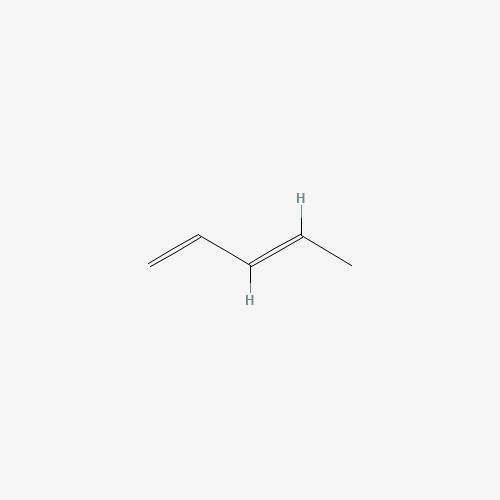
化合物详情
CAS504-60-9
分子式C5H8
分子量68.12 g/mol
危化品
Physical Description | 1,3-pentadiene appears as a clear colorless liquid with an acrid odor. A dangerous fire risk. Vapors are irritating to the eyes and respiratory system. Subject to polymerization if heated or contaminated. If the polymerization takes place inside a container, the container may violently rupture. Insoluble in water. Used to make intermediates and polymers.
科学粮草官-词典编辑部,修订于:2026-07-06
Toxicity
ToxicityFate Summary
ATMOSPHERIC FATE: According to a model of gas/particle partitioning of semivolatile organic compounds in the atmosphere(1), trans-1,3-pentadiene, which has a vapor pressure of 411 mm Hg at 25 °C(2), is expected to exist solely as a vapor in the ambient atmosphere(SRC). Vapor-phase trans-1,3-pentadiene is degraded in the atmosphere by reaction with photochemically-produced hydroxyl radicals(SRC); the half-life for this reaction in air is estimated to be 3.7 hours(SRC), calculated from its rate constant of 1.05X10⁻¹⁰ cu cm/molecule-sec at 25 °C(SRC) determined using a structure estimation method(3). Vapor-phase trans-1,3-pentadiene is also degraded in the atmosphere by reaction with photochemically-produced ozone(SRC); the half-life for this reaction in air is estimated to be 5.2 hours(SR...
Soil Adsorption / Mobility
The Koc of trans-1,3-pentadiene is estimated as 500(SRC), using a measured log Kow of 2.44(1) and a regression-derived equation(2). According to a classification scheme(3), this estimated Koc value suggests that trans-1,3-pentadiene is expected to have low mobility in soil(SRC).
Environmental Biodegradation
No biodegradation data regarding 1,3-pentadiene were located(SRC), however data on a similar compound, 1,3-butadiene are available(1-4). Laboratory studies employing pure bacterial cultures isolated from lake and soil samples were shown to degrade 1,3-butadiene to 1,2-epoxybutene, however it is not clear what the rate of degradation will be under environmental conditions(1-3). The biodegradation half-life of 1,3-butadiene in aerobic waters has been reported as 7 days and the half-life in anaerobic waters was reported as 28 days(4). These data suggest that 1,3-pentadiene will also undergo biodegradation under similar conditions(SRC).
Environmental Bioconcentration
An estimated BCF of 15 was calculated for trans-1,3-pentadiene(SRC), using a log Kow of 2.44(1) and a regression-derived equation(2). According to a classification scheme(3), this BCF suggests the potential for bioconcentration in aquatic organisms is low(SRC).
Volatilization from Water / Soil
The Henry's Law constant for trans-1,3-pentadiene is estimated as 0.12 atm-cu m/mole(SRC) using a fragment constant estimation method(1). This Henry's Law constant indicates that trans-1,3-pentadiene is expected to volatilize rapidly from water surfaces(2). Based on this Henry's Law constant, the volatilization half-life from a model river (1 m deep, flowing 1 m/sec, wind velocity of 3 m/sec)(2) is estimated as 51 min(SRC). The volatilization half-life from a model lake (1 m deep, flowing 0.05 m/sec, wind velocity of 0.5 m/sec)(2) is estimated as 3.3 days(SRC). trans-1,3-Pentadiene's Henry's Law constant(1) indicates that volatilization from moist soil surfaces may occur(SRC). The potential for volatilization of trans-1,3-pentadiene from dry soil surfaces may exist based upon a vapor pr...
Environmental Abiotic Degradation
The rate constant for the vapor-phase reaction of trans-1,3-pentadiene with photochemically-produced hydroxyl radicals has been estimated as 1.05X10⁻¹⁰ cu cm/molecule-sec at 25 °C(SRC) using a structure estimation method(1). This corresponds to an atmospheric half-life of about 3.7 hours at an atmospheric concentration of 5X10+5 hydroxyl radicals per cu cm(1). The rate constant for the vapor-phase reaction of trans-1,3-pentadiene with photochemically-produced ozone has been estimated as 5.26X10⁻¹⁷ cu cm/molecule-sec at 25 °C(SRC) using a structure estimation method(1). This corresponds to an atmospheric half-life of about 5.2 hours at an atmospheric concentration of 7X10+11 ozone per cu cm(1). In general, the night time degradation of conjugated diolefins by the gas-phase reaction with...
Effluent Concentrations
trans-1,3-Pentadiene has been qualitatively detected in the exhaust of gasoline and diesel engines(1).
Natural Pollution Sources
trans-1,3-Pentadiene may be released to the atmosphere during the combustion of biomass during fires caused by lightning, volcanoes, or other natural phenomena(1).
Fish/Seafood Concentrations
1,3-Pentadiene was detected in clams and oysters taken from Lake Pontchartrain, LA, 1980, at a concentration of 3.2 and 1.4 ppb wet weight, respectively(1).
Artificial Pollution Sources
trans-1,3-Pentadiene's production and use in polymers, maleic anhydride adducts, and as an intermediate(1) may result in its release to the environment through various waste streams(SRC). trans-1,3-Pentadiene may also be released to the atmosphere in the exhaust of motor vehicles(2).
Probable Routes of Human Exposure
Occupational exposure to trans-1,3-pentadiene may occur through inhalation and dermal contact with this compound at workplaces where trans-1,3-pentadiene is produced or used(SRC). Inhalation of the exhaust of motor vehicles may also lead to trans-1,3-pentadiene exposure by the general population(1).
Environmental Fate / Exposure Summary
trans-1,3-Pentadiene's production and use in polymers, maleic anhydride adducts, and as an intermediate may result in its release to the environment through various waste streams. If released to air, a vapor pressure of 411 mm Hg at 25 °C indicates trans-1,3-pentadiene will exist solely as a vapor in the ambient atmosphere. Vapor-phase trans-1,3-pentadiene will be degraded in the atmosphere by reaction with photochemically-produced hydroxyl radicals and ozone; the half-life for these reactions in air are estimated to be 3.7 hours and 5.2 hours, respectively. If released to soil, trans-1,3-pentadiene is expected to have low mobility based upon an estimated Koc of 500. Volatilization from moist soil surfaces is expected to be an important fate process based upon an estimated Henry's Law c...
Symptoms
Ingestion Exposure: Nausea. Vomiting. Aspiration hazard!
Toxicity Data
LC50 (rat) = 2692 mg/m3/2H
Adverse Effects
Neurotoxin - Acute solvent syndrome
Exposure Routes
The substance can be absorbed into the body by inhalation.
Non-Human Toxicity Values
LD50 Mouse iv 18 mg/kg
Non-Human Toxicity Excerpts
1,3-Pentadiene ... was tested for mutagenicity using variations of the Salmonella/mammalian microsome assay. The chemical was incorporated into the test system (with and without S9 mix) by 3 methods: (a) the standard plate incorporation assay, (b) a liquid preincubation procedure and (c) exposure of test bacteria in the soft agar overlay to gaseous 1,3-pentadiene. The chemical was extremely toxic to the test bacteria with amounts as low as 2 ug/plate causing cellular death. None of the nonlethal concentrations tested by any of the methods was mutagenic to Salmonella typhimurium strains TA97, TA98, TA100, TA1535, TA1537 or TA1538.
Antidote and Emergency Treatment
Advanced treatment: Consider orotracheal or nasotracheal intubation for airway control in the patient who is unconscious or in respiratory rest. Positive pressure ventilation techniques with a bag-valve-mask device may be beneficial. Monitor cardiac rhythm and treat arrhythmias as necessary ... . Start an IV with D5W /SRP: "To keep open", minimal flow rate/. Use lactated Ringer's if signs of hypovolemia are present. Watch for signs of fluid overload. Consider drug therapy for pulmonary edema ... . Treat seizures with diazepam (Valium) ... . Use proparacaine hydrochloride to assist eye irrigation ... . /Aliphatic hydrocarbons and related compounds/









