


 一键配货
一键配货
化合物详情
CAS13171-21-6
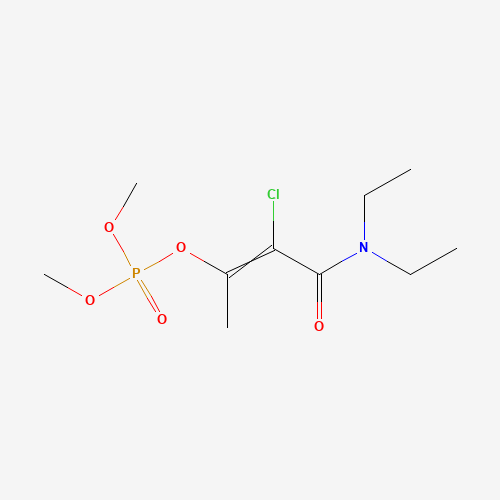
分子式C10H19ClNO5P
分子量299.69 g/mol
危化品
Physical Description | Phosphamidon is a pale yellow oily liquid with a faint odor. Used as an insecticide for citrus, cotton, and deciduous fruit and nuts. and as an acaricide. (EPA, 1998)
科学粮草官-词典编辑部,修订于:2026-07-06
Toxicity
ToxicityEPA Ecotoxicity
Pesticide Ecotoxicity Data from EPA: 41
Ecotoxicity Values
USDA APHIS Chemical Effects: collection=usda_chemeffect&query_type=synonym&query='^297-99-4$'
Fate Summary
ATMOSPHERIC FATE: According to a model of gas/particle partitioning of semivolatile organic compounds in the atmosphere(1), phosphamidon, which has a vapor pressure of 1.65X10⁻⁵ mm Hg at 25 °C(2), will exist in both the vapor and particulate phases in the ambient atmosphere. Vapor-phase phosphamidon is degraded in the atmosphere by reaction with photochemically-produced hydroxyl radicals(SRC); the half-life for this reaction in air is estimated to be 10.5 hrs(SRC), calculated from its rate constant of 3.7X10⁻¹¹ cu cm/molecule-sec at 25 °C(SRC) that was derived using a structure estimation method(3). Particulate-phase phosphamidon may be removed from the air by wet and dry deposition(SRC). The rate constant for the vapor-phase reaction of phosphamidon with ozone has been estimated as 1.6...
Soil Adsorption / Mobility
The leaching behavior of phosphamidon in sand, loamy sand, loam, and silt soil in a 15 cm column was studied after 150 cm of rain applied(2). All the added phosphamidon leached through the sand and sandy loam soil, while most of the residue was in the lower third of the column(2). With the silt soil, residues were rather evenly distributed throughout the column and in the leachate, although the greatest fraction of residue was in the upper third of the column. In contrast with the good total recoveries in the other cases, recovery with the silt column was only 39%(2). According to a soil thin layer chromatography study with four soils, phosphamidon was very mobile (retardation factor (Rf) 0.91-0.92) in a silt loam (0.83% organic matter, pH 7.9), silt loam (0.72% organic matter, pH 6.6),...
Environmental Biodegradation
AEROBIC: When applied at 5 ppm, the half-lives of phosphamidon in loam, loamy sand, and sand was approximately 6, 3, and <3 days, respectively(1,2). At an application rate of 1 ppm, the half-life in loam and silt was three to four weeks(1,2). No data on sterile controls were presented, and the pH of the soils studied were not reported.
Environmental Bioconcentration
BCFs of <1 were measured for phosphamidon in zebrafish (Brachydanio rerio) using OECD test guideline 305 in a continuous flow-through system operated for 168 hrs with test concns of 995.4 and 198.3 ug/l(1). According to a classification scheme(2), this BCF suggests the potential for bioconcentration in aquatic organisms is low(SRC). Bioconcentration of phosphamidon is unlikely due to its high water solubility(1), very low lipophilicity(1) and very rapid depuration(1,3).
Volatilization from Water / Soil
The Henry's Law constant for phosphamidon is estimated as 1.5X10⁻¹² atm-cu m/mole(SRC) using a fragment constant estimation method(1). This Henry's Law constant indicates that phosphamidon is expected to be essentially nonvolatile from water surfaces(2). Phosphamidon is not expected to volatilize from dry soil surfaces(SRC) based upon a vapor pressure of 1.65X10⁻⁵ mm Hg(3).
Environmental Abiotic Degradation
Phosphamidon is stable in neutral and weakly acid solutions but is rapidly hydrolyzed in alkaline solutions(2). The half-lives at 23 °C are 74 days, 13.8 days, and 2.2 days at pH 4, 7, and 10; at 45 °C the respective half-lives are 6.6 days, 2.1 days, and 3.3 hrs(3). The hydrolysis products are dimethyl phosphate and alpha-chloroacetoacetic acid diethylamide(3). Stability studies with seawater, freshwater, and in water-sediment systems in which the sediment was additionally washed to remove exchangeable ions indicate that exchangeable ions in the sediment facilitate hydrolysis and a higher ionic strength reduces this rate(1).
Food Survey Values
In a pesticide screening study of 81 varieties of domestic and imported produce (6970 samples), no residues of phosphamidon were found above the detection limit of 0.50 ppm(1). According to FDAs Total Diet Study, April 1982-April 1984, the dietary intake of phosphamidon for each of seven population groups of different sex and age ranging from toddlers to seniors was <0.1 ng/kg body weight/day(2). According to FDA's Total Diet Study, phosphamidon residues are not present in food items consumed by infants(2). Phosphamidon is destroyed by heat >160 °C(3). After 1 hr of cooking, residue levels in apples and pears decreased by 80%(3). In a 1992-1993 FDA survey of domestic and imported pears and tomatoes, phosphamidon was not detected in any of the 710 domestic and 949 imported pear samples t...
Milk Concentrations
Many of the organophosphorus insecticides are excreted in the milk ... /Organophosphorus insecticides/
Plant Concentrations
The concn of phosphamidon on treated foliage 18-24 hr after spraying in an apple orchard was 20 ppm(1). Foliage in a grapefruit orchard contained 150 ppm phosphamidon 23 hours after spraying(1). Phosphamidon is rapidly absorbed and metabolized in plants(3). Reported initial half-lives are of the order of 1-2 days(1,2,3). Degradation then proceeds more slowly with residues decreasing to the 0.5 ppm level or less in about 1 week in leafy plants and 2-3 weeks in fruit after normal application(1,2,3).
Animal Concentrations
Phosphamidon is rapidly metabolized in animals(1) and therefore residues should not be present in animals unless recently exposed.
ICSC Environmental Data
The substance is very toxic to aquatic organisms. This substance may be hazardous to the environment. Special attention should be given to birds and bees. This substance does enter the environment under normal use. Great care, however, should be taken to avoid any additional release, for example through inappropriate disposal.
Atmospheric Concentrations
The concn of phosphamidon in air 18-24 hr after spraying in an apple orchard was <0.005 mg/cu m in calm weather and not detectable with a 1-2 m/sec wind(1). Temperatures were high in both cases. Similarly, 23 hr after phosphamidon was sprayed in a grapefruit orchard under clear, calm, and warm weather conditions, the phosphamidon concn 1.5 m above ground was <0.01 mg/cu m(1).
Artificial Pollution Sources
Phosphamidon's former(1) production and use as an insecticide and acaricide(2) may have resulted in its direct release to the environment(SRC).
Probable Routes of Human Exposure
Secondary exposure of children through contact with their parents' contaminated clothing can also occur. /Organophosphorus pesticides/
Environmental Fate / Exposure Summary
Phosphamidon's former production and use as an insecticide and acaricide may have resulted in its direct release to the environment. If released to air, a vapor pressure of 1.65X10⁻⁵ mm Hg at 25 °C indicates phosphamidon will exist in both the vapor and particulate phases in the ambient atmosphere. Vapor-phase phosphamidon will be degraded in the atmosphere by reaction with photochemically-produced hydroxyl radicals; the half-life for this reaction in air is estimated to be 10.5 hrs. Phosphamidon will react with ozone, exhibiting an atmospheric half-life of about 7 days. Particulate-phase phosphamidon will be removed from the atmosphere by wet and dry deposition. If released to soil, phosphamidon is expected to have very high mobility based upon retardation factors (Rf) of 0.91-0.92 in...
Symptoms
Ingestion Exposure: Abdominal cramps. Further see Inhalation.
Interactions
/When citiolone was administered with phosphamidon/... significant depletion was observed in the glutathione-S-transferase activity as well as in the level of total and non-protein bound sulfhydryl groups in various CNS regions of phosphamidon intoxicated rats. When citiolone was administered alone, there was a remarkable elevation in glutathione-S-transferase activity. However, significant protection against glutathione-S-transferase inhibition was observed when phosphamidon and citiolone were administered simultaneously.
Toxicity Data
LC50 (rat) = 135 mg/m3/4h
Adverse Effects
Other Poison - Organophosphate
Exposure Routes
The substance can be absorbed into the body by inhalation of its aerosol, through the skin and by ingestion.
Human Toxicity Values
The probable fatal dose of phosphamidon for an adult by ingestion is 5-50 mg/kg bw. The estimated fatal dose in humans (~70 kg) is 490 mg by oral ingestion.
Carcinogen Classification
Summary: It is concluded that under the conditions of this bioassay, technical-grade phosphamidon was not carcinogenic for B6C3F1 mice. The data obtained in this bioassay with Osborne-Mendel rats are insufficient to allow the interpretation that technical-grade phosphamidon is carcinogenic in this species.









