

 一键配货
一键配货
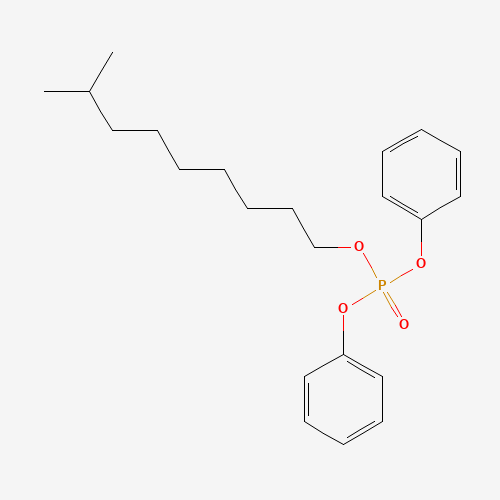
化合物详情
CAS29761-21-5
分子式C22H31O4P
分子量390.45 g/mol
非危品
Physical Description | Isodecyl diphenyl phosphate is a viscous clear colorless liquid. (NTP, 1992)
科学粮草官-词典编辑部,修订于:2026-07-06
Toxicity
ToxicityEcotoxicity Values
LC50 Menidia beryllina 1400 ppm/96 hr, static bioassay in synthetic seawater at 23 °C, mild aeration applied after 24 hr.
Fate Summary
ATMOSPHERIC FATE: Based on an estimated vapor pressure of 1.6X10⁻⁵ mm Hg at 25 °C(2), isodecyl diphenyl phosphate should exist in the particulate- and vapor-phases in the ambient atmosphere(3). Vapor-phase isodecyl diphenyl phosphate is rapidly degraded in the ambient atmosphere by reaction with photochemically formed hydroxyl radicals; the half-life for this reaction in air can be estimated to be about 8.8 hrs(1,SRC). Particulate-phase isodecyl diphenyl phosphate may be susceptible to wet and dry deposition(SRC).
Soil Adsorption / Mobility
Based upon a measured log Kow of 5.44(1), the Koc for isodecyl diphenyl phosphate can be estimated to be about 21,695 from a regression derived equation(2). According to a suggested classification scheme(3), isodecyl diphenyl phosphate should be immobile in soil and sediment. The low water solubility of 0.75 mg/l at 25 °C(1) and high Koc value suggest that adsorption to soil and sediment may be an important fate process for isodecyl diphenyl phosphate(4,SRC).
Environmental Biodegradation
The ultimate biodegradation of isodecyl diphenyl phosphate, initial concn of 19 ppm, was observed to be 13.5, 63.3, and 68.4% of theoretical CO2 evolution in a CO2-evolution screening study using acclimated seed (14 day acclimation period) over an incubation period of 7, 28, and 35 days, respectively. Isodecyl diphenyl phosphate biodegraded 20 to 54% with an addition rate of 13 to 3 1/ppm-hr, respectively, in semicontinuous activated sludge (SCAS) tests and a half-life of about 11 days was observed in a river die-away test for isodecyl diphenyl phosphate at an initial concn of 1 ppm(1).
Environmental Bioconcentration
Calculated BCFs of 1,100(1) and 7,500(2) indicate that isodecyl diphenyl phosphate has a moderate potential to bioconcentrate in aquatic organisms(1,SRC).
Volatilization from Water / Soil
The Henry's Law constant for isodecyl diphenyl phosphate can be estimated to be 4.36X10⁻⁷ atm-cu m/mole at 25 °C using a chemical structure estimation method(2,SRC). According to a suggested classification scheme(1), this Henry's Law constant indicates that isodecyl diphenyl phosphate volatilizes slowly from water. The volatilization half-life of isodecyl diphenyl phosphate from a model river 1 m deep flowing 1 m/sec with a wind velocity of 3 m/sec can be estimated to be approximately 166 days based on the Henry's Law constant(1,SRC).
Environmental Abiotic Degradation
The rate constant for the vapor-phase reaction of isodecyl diphenyl phosphate with photochemically produced hydroxyl radicals has been estimated to be 4.38X10⁻¹¹ cu cm/molecule-sec at 25 °C which corresponds to an atmospheric half-life of about 8.8 hrs at an atmospheric concn of 5X10+5 hydroxyl radicals per cu cm(1,SRC). Phosphate esters are generally resistant to hydrolysis in neutral or acid waters (pH 5-7)(3). Aqueous hydrolysis may be an important degradative pathway of isodecyl diphenyl phosphate in the environment under mildly alkaline conditions (pH 9)(2). By analogy, half-lives of the first hydrolysis step for triphenyl phosphate have been measured to range from 0.23 to 7.5 days at pH 9.5 to pH 8.2, respectively(2-3).
Artificial Pollution Sources
Isodecyl diphenyl phosphate and other aryl phosphates are released during production to soil via land disposal of solid or semi-solid wastes(1). Isodecyl diphenyl phosphate may also be released to the environment through processing and use applications; furthermore, release via use applications are expected to be more than from production(1). Isodecyl diphenyl phosphate may volatilize from plastic items where it is used as a plasticizer, it may leak from hydraulic fluids, and it may be released from lubricants where it is used as an additive(1-2). Isodecyl diphenyl phosphate may be released from plastics that are exposed to water in piping, it may leach from landfills, and it may be released in waste water effluents resulting from production and use(1-2).
Probable Routes of Human Exposure
NIOSH (NOES Survey 1981-1983) has statistically estimated that 13,976 workers are potentially exposed to isodecyl diphenyl phosphate in the USA(1).
Environmental Fate / Exposure Summary
Isodecyl diphenyl phosphate may be released to the environment from its production, processing, and use. The major sources of release are expected to be volatilization from plastic items where it may be used as a plasticizer and leakage from hydraulic fluids. During production, primary releases are to soil via land disposal of solid or semi-solid waste. If released to water, isodecyl diphenyl phosphate will readily biodegrade under aerobic conditions (half-life of 11 days or less in river water). However, biodegradation in benthic sediments is unclear. Aqueous hydrolysis may become increasingly important with increasing alkalinity but no rate data were located. Isodecyl diphenyl phosphate will partition from the water column to sediment and suspended material; also, it is expected to bi...
Non-Human Toxicity Excerpts
The signs of poisoning due to organophosphorus cmpd are those due to accumulation of acetylcholine & hence overstimulation of parasympathetic nervous system. It is usual to divide them under 3 headings: muscarinic, nicotinic & central. Muscarinic signs ... consist of hypersalivation, lacrimation, sweating & nasal discharge. Miosis, dyspnea, vomiting, diarrhea & frequency of urination ... Nicotinic effects consist of fasciculation of muscles, weakness & paralysis. Central nervous system effects include nervousness, apprehension, ataxia, convulsions & coma. Death is due to resp failure, or sometimes cardiac arrest. There is little difference between signs produced by different organophosphorus compounds, but route of absorption may influence one system more than another. /Organophosphorus...
Antidote and Emergency Treatment
A comatose patient who is diaphoretic, has pinpoint pupils and the odor of an insecticide on clothing or breath, and is noted to have muscle fasciculations represents the classic presentation of organophosphate poisoning. ... Specific steps in management include the following. 1. Decontamination. ... 2 Airway. Establish an airway if necessary. ... 3. Respiratory Status. Respiratory distress, in fact, is commonly found in these patients from multiple causes. ... 4. Cardiac Monitoring. ... 5. Cholinesterase Level. ... 6. Pralidoxime. Pralidoxime is the treatment of choice for organophosphate poisoning and should be used for nearly all patients with clinically significant orgnophosphate poisoning,particularly whose patients with muscular fasciculations and weakness. ... 7. Atropine. Atropi...