


 一键配货
一键配货
化合物详情
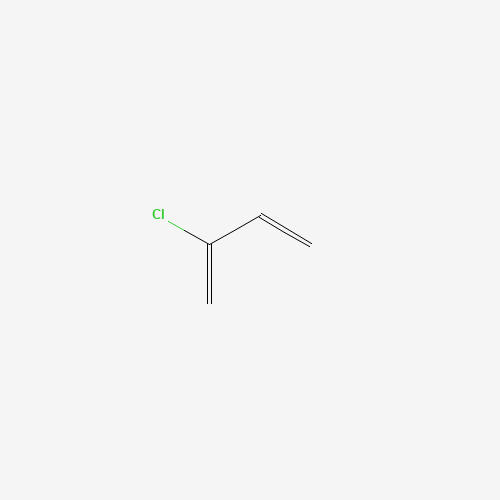
CAS126-99-8
分子式C4H5Cl
分子量88.54 g/mol
危化品
科学粮草官-词典编辑部,修订于:2026-07-06
Toxicity
ToxicityFate Summary
ATMOSPHERIC FATE: According to a model of gas/particle partitioning of semivolatile organic compounds in the atmosphere(1), 2-chloro-1,3-butadiene, which has a vapor pressure of 2.15X10+2 mm Hg at 25 °C, is expected to exist solely as a vapor in the ambient atmosphere. Vapor-phase 2-chloro-1,3-butadiene is degraded in the atmosphere by reaction with photochemically-produced hydroxyl radicals, ozone molecules and nitrate radicals(SRC). The half-life for the reaction in air with hydroxyl radicals is estimated to be 18 hours(SRC), calculated from its rate constant of 22X10-12 cu cm/molecule-sec at 25 °C(SRC), determined using a structure estimation method(2). The rate constant for the vapor-phase reaction of 2-chloro-1,3-butadiene with ozone has been estimated as 0.12X10⁻¹⁷ cu cm/molecule-...
Soil Adsorption / Mobility
Using a structure estimation method based on molecular connectivity indices(1), the Koc for 2-chloro-1,3-butadiene can be estimated to be 68(SRC). According to a classification scheme(2), this estimated Koc value suggests that 2-chloro-1,3-butadiene is expected to have high mobility in soil.
Environmental Bioconcentration
An estimated BCF of 18 was calculated for 2-chloro-1,3-butadiene(SRC), using an estimated log Kow of 2.53(1) and a regression-derived equation(2). According to a classification scheme(3), this BCF suggests the potential for bioconcentration in aquatic organisms is low (SRC).
Volatilization from Water / Soil
The Henry's Law constant for 2-chloro-1,3-butadiene is estimated as 0.056 atm-cu m/mole(SRC) using a fragment constant estimation method(1). This Henry's Law constant indicates that 2-chloro-1,3-butadiene is expected to volatilize rapidly from water surfaces(2). Based on this Henry's Law constant, the volatilization half-life from a model river (1 m deep, flowing 1 m/sec, wind velocity of 3 m/sec)(2) is estimated as 3 hours(SRC). The volatilization half-life from a model lake (1 m deep, flowing 0.05 m/sec, wind velocity of 0.5 m/sec)(2) is estimated as 4 days(SRC). 2-Chloro-1,3-butadiene's Henry's Law constant(1) indicates that volatilization from moist soil surfaces may occur(SRC). The potential for volatilization of 2-chloro-1,3-butadiene from dry soil surfaces may exist(SRC) based up...
Environmental Abiotic Degradation
The rate constant for the vapor-phase reaction of 2-chloro-1,3-butadiene with photochemically-produced hydroxyl radicals has been estimated as 22X10-12 cu cm/molecule-sec at 25 °C(SRC) using a structure estimation method(1). This corresponds to an atmospheric half-life of about 18 hours at an atmospheric concentration of 5X10+5 hydroxyl radicals per cu cm(1). The rate constant for the vapor-phase reaction of 2-chloro-1,3-butadiene with ozone has been estimated as 0.12X10⁻¹⁷ cu cm/molecule-sec at 25 °C(SRC) using a structure estimation method(1). This corresponds to an atmospheric half-life of about 10 days at an atmospheric concentration of 7X10+11 ozone molecules per cu cm(2). In general, the night time degradation of conjugated diolefins by the gas-phase reaction with nitrate radicals...
Environmental Water Concentrations
SURFACE WATER: 2-Chloro-1,3-butadiene was detected in 1 out of 204 samples of surface water collected from sites near heavily industrialized areas across the US during 1975/76(1).
Effluent Concentrations
2-Chloro-1,3-butadiene was identified in 1 out of 33 industrial effluents at a concentration greater than 100 ug/l, detection limit of 10 ug/l(1).
Natural Pollution Sources
2-Chloro-1,3-butadiene is not known to occur as a natural product(1).
Atmospheric Concentrations
SOURCE DOMINATED: The compound was not detected in air above 6 abandoned hazardous wastes sites and one active sanitary landfill in NJ during 1983/84, at a detection limit of 0.01 ppb(1).
Artificial Pollution Sources
2-Chloro-1,3-butadiene's manufacture and use in the production of polychloroprene elastomers, such as neoprene(1), may result in its release to the environment through various waste streams(SRC).
Probable Routes of Human Exposure
NIOSH (NOES Survey 1981-1983) has statistically estimated that 17,750 workers (654 of these are female) are potentially exposed to 2-chloro-1,3-butadiene in the US(1). During 1977, airborne concentrations of 2-chloro-1,3-butadiene of up to 0.2 ppm were reported in a roll building area in a metal fabricating plant where polychloroprene was applied extensively to metal cylinders prior to vulcanization(2). During 1973, at a US 2-chloro-1,3-butadiene polymerization plant, airborne concentrations of 2-chloro-1,3-butadiene were found to range from 14-1,420 ppm in the make-up area, from 130-6,760 ppm in the reactor area, from 6-440 in the monomer recovery area and from 113-252 ppm in the latex area(2). Occupational exposure to 2-chloro-1,3-butadiene may occur through inhalation of this compoun...
Environmental Fate / Exposure Summary
2-Chloro-1,3-butadiene's manufacture and use in the production of polychloroprene elastomers, such as neoprene, may result in its release to the environment through various waste streams. If released to air, a vapor pressure of 215 mm Hg at 25 °C indicates 2-chloro-1,3-butadiene will exist solely as a vapor in the ambient atmosphere. Vapor-phase 2-chloro-1,3-butadiene will be degraded in the atmosphere by reaction with photochemically-produced hydroxyl radicals and ozone molecules. The half-life for this reaction in air with hydroxyl radicals is estimated to be 18 hours. The half-life for the reaction in air with ozone is estimated to be 10 days. The gas-phase reaction of 2-chloro-1,3-butadiene with nitrate radicals may also be an important atmospheric removal process in urban areas at...
Symptoms
irritation eyes, skin, respiratory system; anxiety, irritability; dermatitis; alopecia; reproductive effects; [potential occupational carcinogen]
Cancer Sites
[lung & skin cancer]
Interactions
The brain ATP levels in rats were decreased at 7-30 days after the ip injection of chloroprene (600 umol/100 g body weight). However, the simultaneous administration of alpha-tocopherol acetate (0.1 mg/100 g body weight) counteracted this effect of chloroprene. The toxicity of chloroprene depletes the endogenous alpha-tocopherol supply. Administration of exogenous alpha-tocopherol can then counteract this toxic effect of chloroprene.
Target Organs
Eyes, skin, respiratory system, reproductive system
Toxicity Data
LC50 (rat) = 3,270 ppm/4 hr
Adverse Effects
ACGIH Carcinogen - Suspected Human.
Exposure Routes
inhalation, skin absorption, ingestion, skin and/or eye contact
RAIS Toxicity Values
Oral Subchronic Chronic Reference Dose Reference: HEAST Current
Carcinogen Classification
Summary: Exposure of male and female rats to chloroprene was associated with increased incidences of alveolar epithelial hyperplasia in the lung; nephropathy; and several nonneoplastic effects in the nose including olfactory epithelial atrophy, fibrosis, adenomatous hyperplasia, basal cell hyperplasia, chronic inflammation, respiratory metaplasia, and necrosis. Exposure of male and female mice to chloroprene was associated with increased incidences of bronchiolar hyperplasia and histiocytic cell infiltration in the lung; epithelial hyperplasia in the forestomach; renal tubule hyperplasia (males only); several effects in the nose including olfactory epithelial atrophy, respiratory metaplasia, and adenomatous hyperplasia; and hematopoietic cell proliferation in the spleen.
Non-Human Toxicity Values
LC50 Mouse inhalation 2300 mg/cu m
1 or Cancer Risk Level 1E-06
Soil Saturation Concentration (mg/kg): 7.86e+02
Antidote and Emergency Treatment
Advanced treatment: Consider orotracheal or nasotracheal intubation for airway control in the patient who is unconscious or in respiratory rest. Positive pressure ventilation techniques with a bag-valve-mask device may be beneficial. Monitor cardiac rhythm and treat arrhythmias as necessary ... . Start an IV with D5W /SRP: "To keep open", minimal flow rate/. Use lactated Ringer's if signs of hypovolemia are present. Watch for signs of fluid overload. Consider drug therapy for pulmonary edema ... . Treat seizures with diazepam (Valium) ... . Use proparacaine hydrochloride to assist eye irrigation ... . /Aliphatic hydrocarbons and related compounds/
Hazard Quotient Level 3 or Cancer Risk Level 1E-04
Soil Saturation Concentration (mg/kg): 7.86e+02









