


 一键配货
一键配货
化合物详情
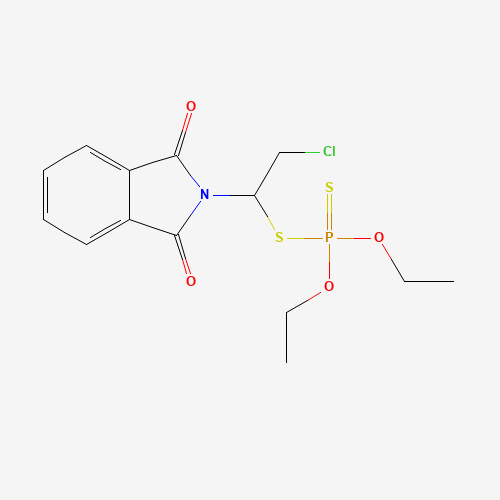
CAS10311-84-9
分子式C14H17ClNO4PS2
分子量393.85 g/mol
危化品
Physical Description | Dialifor is a white crystalline solid, also reported as a colorless oil, colorless. Used as an insecticide and acaricide (kills beetles, ticks, mites, etc.). (EPA, 1998)
科学粮草官-词典编辑部,修订于:2026-07-06
Toxicity
ToxicityEPA Ecotoxicity
Pesticide Ecotoxicity Data from EPA: 6
Fate Summary
ATMOSPHERIC FATE: According to a model of gas/particle partitioning of semivolatile organic compounds in the atmosphere(1), dialifor, which has a vapor pressure of 6.2X10⁻⁸ mm Hg at 25 °C(2), will exist in both the vapor and particulate phases in the ambient atmosphere. Vapor-phase dialifor is degraded in the atmosphere by reaction with photochemically-produced hydroxyl radicals(SRC); the half-life for this reaction in air is estimated to be 2.5 hours(SRC), calculated from its rate constant of 1.5X10⁻¹⁰ cu cm/molecule-sec at 25 °C(SRC) that was derived using a structure estimation method(3). Particulate-phase dialifor may be removed from the air by wet or dry deposition(SRC). Dialifor does not contain chromophores that absorb at wavelengths >290 nm and therefore is not expected to be su...
Soil Adsorption / Mobility
The Koc of dialifor is estimated as 8500(SRC), using a log Kow of 4.69(1)and a regression-derived equation(2). According to a classification scheme(3), this estimated Koc value suggests that dialifor is expected to be immobile in soil.
Environmental Bioconcentration
An estimated BCF of 820 was calculated for dialifor(SRC), using a log Kow of 4.69(1) and a regression-derived equation(2). According to a classification scheme(3), this BCF suggests the potential for bioconcentration in aquatic organisms is high(SRC), but dialifor's rapid hydrolysis(4) probably prevents bioconcentration, especially under basic conditions(SRC).
Volatilization from Water / Soil
The Henry's Law constant for dialifor is estimated as 1.8X10⁻⁷ atm-cu m/mole(SRC) derived from its vapor pressure, 6.2X10⁻⁸ mm Hg(1), and water solubility, 0.18 mg/L(1). This Henry's Law constant indicates that dialifor is expected to be essentially nonvolatile from water surfaces(2). Dialifor's estimated Henry's Law constant indicates that volatilization from moist soil surfaces may occur(SRC). Dialifor is not expected to volatilize from dry soil surfaces(SRC) based upon its vapor pressure(1).
Environmental Abiotic Degradation
The rate constant for the vapor-phase reaction of dialifor with photochemically-produced hydroxyl radicals has been estimated as 1.5X10⁻¹⁰ cu cm/molecule-sec at 25 °C(SRC) using a structure estimation method(1). This corresponds to an atmospheric half-life of about 2.5 hours at an atmospheric concentration of 5X10+5 hydroxyl radicals per cu cm(1). At room temperature and pH 8, dialifor is hydrolyzed 50 percent in 2.5 hours(2). Aqueous hydrolysis half-lives at pH 7.4 were experimentally determined to be 1.8 and 14 hr at 37.5 and 20 °C, respectively(3). At pH 6.1 and 20 °C the half-life of dialifor in water was determined to be 15 days(3). Dialifor does not contain chromophores that absorb at wavelengths >290 nm and therefore is not expected to be susceptible to direct photolysis by sunli...
Food Survey Values
ON ORANGES & LEMONS, RESIDUE HALF-LIFE OF TORAK WAS 40-60 DAYS & 60-80 DAYS. THERE WAS NO EVIDENCE OF PRESENCE OF THE OXYGEN ANALOG ... .
Artificial Pollution Sources
Dialifor's production may result in its release to the environment through various waste streams; its former use in the US as an acaricide and insecticide(1) resulted in its direct release to the environment.
Probable Routes of Human Exposure
IN VINEYARD TREATED WITH DIALIFOR @ 2.2 KG/ACRE IN 113.5 L OF WATER, INITIAL DISLODGEABLE RESIDUES WERE AS HIGH AS 2.3 MUG/SQ CM. AT LEAST 65 DAYS ARE REQUIRED BEFORE A POSSIBLY SAFE LEVEL OF LESS THAN O.66 MUG/SQ CM IS REACHED. A REPORT WAS MADE TO THE CALIFORNIA DEPARTMENT OF FOOD AND AGRICULTURAL ON SEPTEMBER 8-10, 1976 THAT 118 OF 120 FIELD WORKERS HAD BECOME ILL HARVESTING GRAPES IN VINEYARD, WHICH HAD BEEN TREATED WITH TORAK AND ZOLONE.
Environmental Fate / Exposure Summary
Dialifor's production may result in its release to the environment through various waste streams; its former use in the US as an acaricide and insecticide(1) resulted in its direct release to the environment. If released to air, a vapor pressure of 6.2X10⁻⁸ mm Hg at 25 °C indicates dialifor will exist in both the vapor and particulate phases in the atmosphere. Vapor-phase dialifor will be degraded in the atmosphere by reaction with photochemically-produced hydroxyl radicals; the half-life for this reaction in air is estimated to be 2.5 hours. Particulate-phase dialifor will be removed from the atmosphere by wet or dry deposition. Dialifor does not contain chromophores that absorb at wavelengths >290 nm and therefore is not expected to be susceptible to direct photolysis by sunlight. If...
Adverse Effects
Other Poison - Organophosphate
Human Toxicity Excerpts
/SURVEILLANCE/ Among a crew of 120 grape pickers (110 men and 10 women), 15 became sick one day, 100 additional workers became sick the next day, and three more became sick the 3rd day. Some were only dizzy or mildly weak. Others also had headaches, blurred vision, and tightness in the chest. Most plasma and red cell values were depressed more than 60%. Eighty-five of the workers received medical attention. Most were treated with atropine and some with 2-PAM. Three workers were hospitalized. Recovery was uneventful. The vineyard had been treated with dialifos and a less toxic compound, phosalone. On the basis of measurements made soon after the illnesses, it was concluded that the leaf residues of dialifos and of its oxon that caused poisoning were 100 and 2 ppm, respectively. Because o...
Non-Human Toxicity Excerpts
/OTHER TOXICITY INFORMATION/ Lethal amounts of organophosphates cause death by combination of effects of muscarinic, nicotinic, and central cholinergic overstimulation and/or receptor paralysis/ Organophosphate Pesticides/









