


 一键配货
一键配货
化合物详情
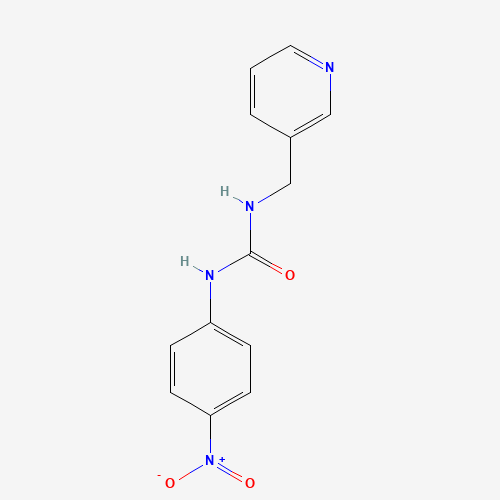
CAS53558-25-1
分子式C13H12N4O3
分子量272.26 g/mol
危化品
Physical Description | Pyriminil is a yellow, resembling corn meal. Used as a single-dose, acute rodenticide. Not registered as a pesticide in the U.S. (EPA, 1998)
科学粮草官-词典编辑部,修订于:2026-07-06
Toxicity
ToxicityEcotoxicity Values
USDA APHIS Chemical Effects: collection=usda_chemeffect&query_type=synonym&query='^53558-25-1$'
Fate Summary
ATMOSPHERIC FATE: According to a model of gas/particle partitioning of semivolatile organic compounds in the atmosphere(1), pyriminil, which has an estimated vapor pressure of 3.39X10⁻⁹ mm Hg at 25 °C(SRC), determined from a fragment constant method(2), is expected to exist solely in the particulate phase in the ambient atmosphere. Particulate-phase pyriminil may be removed from the air by wet and dry deposition(SRC).
Soil Adsorption / Mobility
Using a structure estimation method based on molecular connectivity indices(1), the Koc for pyriminil can be estimated to be 1,990(SRC). According to a classification scheme(2), this estimated Koc value suggests that pyriminil is expected to have low mobility in soil. The estimated pKa values of pyriminil are 3.5 for the conjugate acid of the pyriding ring nitrogen and 7.6 for the benzyl amide acting as an acid(3). The pKa of 3.5 indicates that the pyridine nitrogen will not be ionized at environmental pHs(4). However, the pKa of 7.6 indicates that the benzyl amide group will partially exist in anion form in the environment and anions generally do not adsorb more strongly to organic carbon and clay than their neutral counterparts(4).
Environmental Bioconcentration
An estimated BCF of 8 was calculated for pyriminil(SRC), using an estimated log Kow of 2.09(1) and a regression-derived equation(2). According to a classification scheme(3), this BCF suggests the potential for bioconcentration in aquatic organisms is low(SRC).
Volatilization from Water / Soil
The Henry's Law constant for pyriminil is estimated as 1.84X10⁻¹⁶ atm-cu m/mole(SRC) using a fragment constant estimation method(1). This Henry's Law constant indicates that pyriminil is expected to be essentially nonvolatile from moist soil or water surfaces(2). Pyriminil is not expected to volatilize from dry soil surfaces(SRC) based upon an estimated vapor pressure of 3.39X10⁻⁹ mm Hg(SRC), determined from a fragment constant method(3).
Environmental Abiotic Degradation
The rate constant for the vapor-phase reaction of pyriminil with photochemically-produced hydroxyl radicals has been estimated as 1.11X10⁻¹¹ cu cm/molecule-sec at 25 °C(SRC) using a structure estimation method(1). This corresponds to an atmospheric half-life of about 3.5 hours at an atmospheric concentration of 5X10+5 hydroxyl radicals per cu cm(1). Pyriminil is not expected to undergo hydrolysis in the environment due to the lack of functional groups that will hydrolyze under environmental conditions(2) nor to directly photolyze due to the lack of absorption in the environmental UV spectrum (>290 nm).
Ecotoxicity Excerpts
/BIRDS and MAMMALS/ The toxicity of the rodenticidal product Pyriminyl (Vacor) was tested in 4 dogs, 9 cats, 11 coypus, and 16 ducks . In the tested dogs the 1000mg dose per kg l. w. was lethal only in 17% of cases. The results demonstrate that the LD50 for the dog is higher than stated in the literature (1000 mg/kg l. w.). Dogs show a high variability in their sensitivity to the product, since some of them died at lower doses. It can be assumed that 1 to 2% field bait will not induce any lethal intoxication in dogs. Doses of 300 mg/kg l. w. and higher were lethal for cats. The dose of 200 mg/kg killed 66% of the cats tested. There is a high possibility of poisoning cats in field deratization campaigns with Vacor. Coypus show clinical symptoms of intoxication after ingesting a Vacor bai...
Artificial Pollution Sources
Pyriminil's former production and use as a rodenticide(1) may have resulted in its direct release to the environment(SRC).
Probable Routes of Human Exposure
Occupational exposure and general population exposure should be low or non-existent since pyriminil is no longer produced or used. (SRC)
Environmental Fate / Exposure Summary
Pyriminil's former production and use as rodenticide may have resulted in its direct release to the environment. If released to air, an estimated vapor pressure of 3.39X10⁻⁹ mm Hg at 25 °C indicates pyriminil will exist solely in the particulate phase in the ambient atmosphere. Particulate-phase pyriminil will be removed from the atmosphere by wet and dry deposition. If released to soil, pyriminil is expected to have low mobility based upon an estimated Koc of 1,990. Volatilization from moist soil surfaces is not expected to be an important fate process based upon an estimated Henry's Law constant of 1.84X10⁻¹⁶ atm-cu m/mole. The estimated pKa values of pyriminil are 3.5 for the conjugate acid of the pyriding ring nitrogen and 7.6 for the benzyl amide acting as an acid. The pKa of 3.5 i...
Interactions
... The antidotal efficacy of nicotinamide (p.o. or i.p.) was greatest when administered within 1 hr of Vacor, or when pre-fed in diet. Nicotinic acid was less effective. Rats fed high levels of L-tryptophan or acutely pretreated were protected against Vacor, while D-tryp. and other amino acids were less effective. Agents such as atropine, PAM or nikethamide delayed but did not prevent death. Vacor or 2,4-DNP caused similar symptoms, suggesting interference with mitochondrial respiration. While mild Vacor-induced hyperglycemia was seen in rats and reversed by insulin, its role in ultimate toxicity is unclear. Vacor biotransformation appears to be more significant in detoxication, but prior bioactivation was not necessarily excluded. Cyt. P-448 induction by 3-MC pretreatment decreased Va...
Adverse Effects
Neurotoxin - Other CNS neurotoxin
Antidote and Emergency Treatment
Advanced treatment: Consider orotracheal or nasotracheal intubation for airway control in the patient who is unconscious, has severe pulmonary edema, or is in respiratory arrest. Positive pressure ventilation techniques with a bag valve mask device may be beneficial. Monitor cardiac rhythm and treat arrhythmias as necessary ... . Start an IV with D5W /SRP: "To keep open", minimal flow rate/. Use lactated Ringer's if signs of hypovolemia are present. Watch for signs of fluid overload. Consider drug therapy for pulmonary edema ... . For hypotension with signs of hypovolemia, administer fluid cautiously. Watch for signs of fluid overload ... . Treat seizures with diazepam (Valium) ... . Use proparacaine hydrochloride to assist eye irrigation ... . /Poison A and B/









