


 一键配货
一键配货
化合物详情
CAS8065-48-3
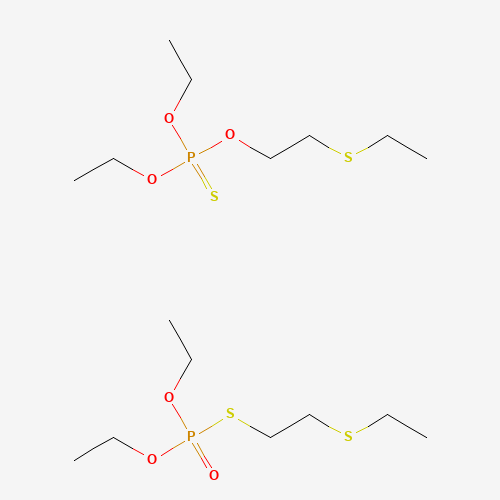
分子式C16H38O6P2S4
分子量516.68 g/mol
危化品
Physical Description | Demeton is an oily liquid with an amber color and an odor of sulfur. Used as an agricultural insecticide. (EPA, 1998)
科学粮草官-词典编辑部,修订于:2026-07-06
Toxicity
ToxicityEPA Ecotoxicity
Pesticide Ecotoxicity Data from EPA: 44
Ecotoxicity Values
USDA APHIS Chemical Effects: collection=usda_chemeffect&query_type=synonym&query='^8065-48-3$'
Fate Summary
ATMOSPHERIC FATE: According to a model of gas/particle partitioning of semivolatile organic compounds in the atmosphere(1), systox, which has a vapor pressure of 3.4X10⁻⁴ mm Hg at 25 °C(2), is expected to exist in both the vapor and particulate phase. Vapor-phase systox is degraded in the atmosphere by reaction with photochemically generated hydroxyl radicals. The half-life for this reaction in air is estimated as 3 to 5 hours from its rate constant of 8X10-11 cm/molec-sec (isosytox) and 1.33X10⁻¹⁰ cu cm/molec-sec (demeton-O)(SRC), derived using a structure estimation method(3). Particulate-phase systox may be removed from the air by wet or dry deposition(SRC). Demeton-S (isosystox) was photodegraded when applied to soil surfaces and exposed to natural sunlight(4), suggesting photolysis...
Soil Adsorption / Mobility
The Koc value for demeton-S (isosystox) and demeton-O, were reported as 70 and 387, respectively, in an unspecified soil(1). According to a classification scheme(2), these Koc values suggests that systox is expected to have high to moderate mobility in soil(SRC).
Environmental Biodegradation
AEROBIC: The half-life of demeton-S-methyl in soil was reported as 26 days(1), suggesting that systox will also biodegrade(SRC).
Environmental Bioconcentration
An estimated BCF of 16 was calculated in fish for systox(SRC), using a water solubility of 666 mg/L(1) and a regression-derived equation(2). According to a classification scheme(3), this BCF suggests the potential for bioconcentration in aquatic organisms is low(SRC).
Volatilization from Water / Soil
The Henry's Law constant for systox is estimated as 1.8X10⁻⁷ atm-cu m/mole(SRC) derived from its vapor pressure, 3.4X10⁻⁴ mm Hg(1), and water solubility, 666 mg/L(2). This Henry's Law constant indicates that isosystox is expected to be essentially nonvolatile from moist soil and water surfaces(3). Isosystox is not expected to volatilize from dry soil surfaces(SRC) based upon its vapor pressure(1).
Environmental Abiotic Degradation
The rate constant for the vapor-phase reaction of demeton-S (isosystox)and demeton-O with photochemically-produced hydroxyl radicals has been estimated as 8X10-11 and 1.33X10⁻¹⁰ cu cm/molec-sec, respectively(SRC), using a structure estimation method(1). This corresponds to an atmospheric half-life of 5 hours (demeton-S) and 3 hours (demeton-O) at a hydroxyl radical concentration of 5X10+5 hydroxyl radicals per cu cm(1). The hydrolysis half-life of demeton-S (isosystox) was reported as 53 days at pH 5.7 and 27 °C, with 1,2-bis(ethylthio)ethane identified as its major hydrolysis byproduct(2). The half-life increased to 347 days at 15 °C(2). Demeton-S (isosystox) was photolyzed 69, 74, and 24% when incorporated into 3 different soils and irradiated in natural sunlight for 8 days(3), sugges...
Food Survey Values
Systox was identified, not quantified, in unspecified food items during the FDA monitoring program in 1993, 1994, 1995, 1996, 1997, 1999, 2000, 2001, and 2002(1).
Ecotoxicity Excerpts
/BIRDS and MAMMALS/ Ducklings hatched from eggs innoculated with demeton at the rate of 0.01 mg/egg on day 13 of incubation had partial to complete loss of voluntary control of one or both hind legs. Some were excitable and ataxic. The difficulties gradually disappeared about 1 week after hatching, but the growth of treated ducklings remained retarded. Histological examination of the skeletal muscles revealed areas of degenerative change and other areas of marked regenerative activity.
ICSC Environmental Data
The substance is very toxic to aquatic organisms. This substance may be hazardous to the environment. Special attention should be given to birds, bees and mammals. This substance does enter the environment under normal use. Great care, however, should be taken to avoid any additional release, for example through inappropriate disposal.
Artificial Pollution Sources
Systox's former production and use as an insecticide(1) resulted in its direct release to the environment(SRC).
Probable Routes of Human Exposure
During aerial spraying of wheat & cotton, the concn of demeton in the air breathed by agricultural workers approached 1 mg/cu m.
Environmental Fate / Exposure Summary
Systox is an insecticide composed of two organophosphate isomers, demeton-S (also called isosystox) and demeton-O. Systox's former production and use as an insecticide resulted in its direct release to the environment. If released to air, a vapor pressure of 3.4X10⁻⁴ mm Hg at 25 °C indicates systox will exist in both the vapor and particulate phases in the atmosphere. Vapor-phase systox will be degraded in the atmosphere by reaction with photochemically-produced hydroxyl radicals; the half-life for this reaction in air is estimated to be 3 to 5 hours. Particulate-phase systox will be removed from the atmosphere by wet or dry deposition. Systox has weak absorption bands greater than 290 nm, suggesting that photolysis in the atmosphere is possible. If released to soil, systox is expected...
Symptoms
irritation eyes, skin; miosis, ache eyes, rhinorrhea (discharge of thin nasal mucus), headache; chest tightness, wheezing, laryngeal spasm, salivation, cyanosis; anorexia, nausea, vomiting, abdominal cramps, diarrhea; localized sweating; muscle fasciculation, lassitude (weakness, exhaustion), paralysis; dizziness, confusion, ataxia; convulsions, coma; low blood pressure; cardiac irreg
Interactions
... ADDITION /OF ARAMITE/ TO DEMETON DELAYS ONSET OF DEMETON RESISTANCE /IN PANONYCHUS CITRI (CITRUS RED MITE)/ TO WHICH THIS SPECIES IS NORMALLY LIABLE.
Target Organs
Eyes, skin, respiratory system, cardiovascular system, central nervous system, blood cholinesterase
Toxicity Data
LCLo (cat) = 15 mg/m3/4hr
Adverse Effects
Other Poison - Organophosphate
Exposure Routes
inhalation, skin absorption, ingestion, skin and/or eye contact
RAIS Toxicity Values
Oral Chronic Reference Dose Reference: IRIS Current
Acceptable Daily Intakes
0.005 mg/kg/day (Withdrawn) /From table/
Populations at Special Risk
Contraindications for work with /organophosphorus pesticides/ are organic diseases of the central nervous system, mental disorders & epilepsy, pronounced endocrine & vegetative disorders, pulmonary tuberculosis, bronchial asthma, chronic respiratory diseases, cardiovascular diseases & circulatory disorders, gastrointestinal diseases (peptic ulcer), gastroenterocolitis, diseases of liver & kidneys, eye diseases (chronic conjunctivitis & keratitis). The blood cholinesterase activity must be determined before work starts. In the event of prolonged work periods, this activity should be determined at intervals of 3-4 days. Persons exhibiting a fall in cholinesterase activity of 25% or more must be transferred to other work where they are not exposed to organophosphorus pesticides until this...
1 or Cancer Risk Level 1E-06
Fraction of Contaminant Absorbed Dermally from Soil: 0.1
Hazard Quotient Level 3 or Cancer Risk Level 1E-04
Fraction of Contaminant Absorbed Dermally from Soil: 0.1









