


 一键配货
一键配货
化合物详情
CAS26644-46-2
分子式C10H14Cl6N4O2
分子量434.96 g/mol g/mol
危化品
Triforine can cause developmental toxicity according to The Environmental Protection Agency (EPA).
科学粮草官-词典编辑部,修订于:2026-07-06
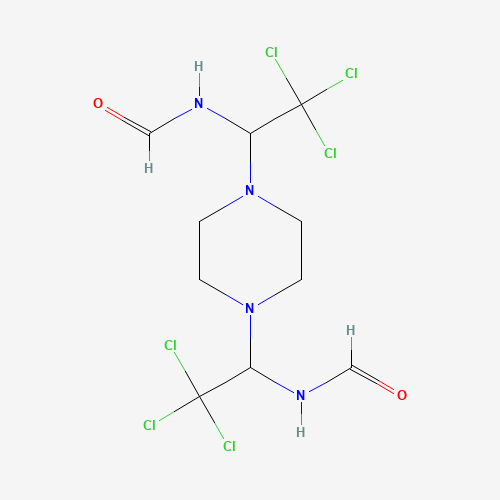
Toxicity
ToxicityEPA Ecotoxicity
Pesticide Ecotoxicity Data from EPA: 27
Fate Summary
ATMOSPHERIC FATE: According to a model of gas/particle partitioning of semivolatile organic compounds in the atmosphere(1), triforine, which has a vapor pressure of 2.0X10⁻⁷ mm Hg at 25 °C(2), will exist in both the vapor and particulate phases in the ambient atmosphere. Vapor-phase triforine is degraded in the atmosphere by reaction with photochemically-produced hydroxyl radicals(SRC); the half-life for this reaction in air is estimated to be 6 hrs(SRC), calculated from its rate constant of 6.6X10⁻¹¹ cu cm/molecule-sec at 25 °C(SRC) that was derived using a structure estimation method(3). Particulate-phase triforine may be removed from the air by wet and dry deposition(SRC).
Soil Adsorption / Mobility
A Koc of 200 has been reported for triforine(1). According to a classification scheme(2), this Koc value suggests that triforine is expected to have moderate mobility in soil.
Environmental Biodegradation
AEROBIC: A half-life of 19 days was reported for triforine in soil, although the exact loss processes were not specified(1).
Environmental Bioconcentration
An estimated BCF of 10 was calculated for triforine(SRC), using a log Kow of 2.20(1) and a regression-derived equation(2). According to a classification scheme(3), this BCF suggests the potential for bioconcentration in aquatic organisms is low(SRC), provided the compound is not altered physically or chemically once released into the environment(SRP).
Volatilization from Water / Soil
The Henry's Law constant for triforine is estimated as 3.8X10⁻⁹ atm-cu m/mole(SRC) derived from its vapor pressure, 2.0X10⁻⁷ mm Hg(1), and water solubility, 30 mg/L(1). This Henry's Law constant indicates that triforine is expected to be essentially nonvolatile from water surfaces(2). Triforine's estimated Henry's Law constant indicates that volatilization from moist soil surfaces may not occur(SRC). Triforine is not expected to volatilize from dry soil surfaces(SRC) based upon its vapor pressure(1).
Environmental Abiotic Degradation
The rate constant for the vapor-phase reaction of triforine with photochemically-produced hydroxyl radicals has been estimated as 6.6X10⁻¹¹ cu cm/molecule-sec at 25 °C(SRC) using a structure estimation method(1). This corresponds to an atmospheric half-life of about 6 hours at an atmospheric concentration of 5X10+5 hydroxyl radicals per cu cm(1). A hydrolysis half-life of 2 to 3 days was reported for triforine(2). The compound decomposes in strongly acidic media to trichloroacetaldehyde and piperazine salts and in strongly alkaline media to chloroform and piperazine(3). Triforine decomposes in aqueous solution exposed to UV or daylight(3).
Artificial Pollution Sources
Triforine's production may result in its release to the environment through various waste streams; it's use as a foliar and postharvest fungicide active against powdery mildew, rust and leaf spot diseases of fruit, ornamentals, vegetables, and cereals(1) will result in its direct release to the environment(SRC).
Probable Routes of Human Exposure
NIOSH (NOES Survey 1981-1983) has statistically estimated that 644 workers (123 of these are female) are potentially exposed to triforine in the US(1). The NOES Survey does not include farm workers. Occupational exposure to triforine may occur through inhalation and dermal contact with this compound at workplaces where triforine is produced or used(SRC). Monitoring data indicate that the general population may be exposed to triforine via ingestion of food and dermal contact with consumer products containing triforine(SRC).
Environmental Fate / Exposure Summary
Triforine's production may result in its release to the environment through various waste streams; it's use as a fungicide on fruit, ornamentals, vegetables, and cereals will result in its direct release to the environment. If released to air, a vapor pressure of 2.0X10⁻⁷ mm Hg at 25 °C indicates triforine will exist in both the vapor and particulate phases in the ambient atmosphere. Vapor-phase triforine will be degraded in the atmosphere by reaction with photochemically-produced hydroxyl radicals; the half-life for this reaction in air is estimated to be 6 hrs. Particulate-phase triforine will be removed from the atmosphere by wet and dry deposition. If released to soil, triforine is expected to have very moderate mobility based upon a Koc of 200. Volatilization from moist soil surfac...
Interactions
Groups of 25 or 50 male and 25 or 50 female Swiss mice were given 0.05% sodium nitrate in drinking-water, triforine suspended in water at 300 mg/kg bw by gavage twice each week, or a combination of the two treatments for up to 180 days. Tumor incidences were compared with those in a control group of 184 males and 117 females. Triforine alone did not increase the number of tumors; however, the combination increased the frequencies of lymphomas (including thymoma) and of epithelial adenomas and carcinomas of the gastrointestinal tract, the lung, and, in males, the liver. Incubation of triforine with 4% acidified sodium nitrite solution for 24 hr formed dinitrosopiperazine, which is known to be carcinogenic and was suspected to be the substance that induced the tumors.
Toxicity Data
LC50 (rat) > 5,120 mg/m3
Adverse Effects
Skin Sensitizer - An agent that can induce an allergic reaction in the skin.
RAIS Toxicity Values
Oral Chronic Reference Dose Reference: OPP
Human Toxicity Excerpts
/HUMAN EXPOSURE STUDIES/ ...In a mass examination of chrysanthemum growers among whom triforine was commonly used, the highest rate of positive patch test reaction was seen to triforine (17%) among the 7 pesticides and chrysanthemum extracts tested. A higher prevalence rate of work-related skin symptoms was seen in subjects with a positive patch test reaction to triforine (44%) than in those with negative reactions to all allergens tested (15%) (p<0.05). 12 subjects (67%) with positive patch test reactions to triforine were also positive to dichlorvos (DDVP), with a high kappa coefficient (0.65). The grading of guinea pig maximization test to triforine was grade IV (66%), defined as "strong". Cross-sensitization between triforine and dichlorvos was also shown. The present results confir...
Antidote and Emergency Treatment
Gastrointestinal decontamination. If a large amount of the fungicide has been ingested in the last few hours, and if copious vomiting has not already occurred, it may be reasonable to consider GI decontamination. Activated charcoal can be used along with the addition of the cathartic sorbitol to the charcoal slurry. If sorbitol is given separately, it should be diluted with an equal volume of water before administration. No more than one dose of sorbitol is recommended and it should be used with caution in children and the elderly. ...If contact with the toxicant has been minimal (for example, oral contamination only, promptly flushed out of the mouth), administration of charcoal without a cathartic, followed by careful observation of the patient, probably represents optimal management....









