


 一键配货
一键配货
化合物详情
CAS7085-85-0
分子式C6H7NO2
分子量125.13 g/mol g/mol
危化品
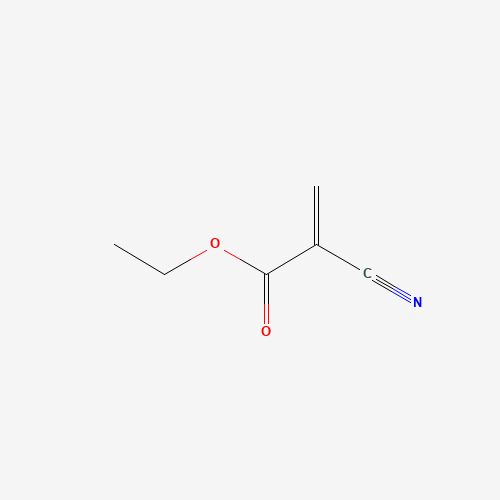
Ethyl cyanoacrylate is a chemical compound of cyanide. It is used as the main component of certain cyanoacrylate glues, such as the well known Super Glue and Krazy Glue. (L605)
科学粮草官-词典编辑部,修订于:2026-07-06
Toxicity
ToxicityFate Summary
ATMOSPHERIC FATE: According to a model of gas/particle partitioning of semivolatile organic compounds in the atmosphere(1), ethyl cyanoacrylate, which has a vapor pressure of 0.31 mm Hg at 20 °C(2), is expected to exist solely as a vapor in the ambient atmosphere. Vapor-phase ethyl cyanoacrylate is degraded in the atmosphere by reaction with photochemically-produced hydroxyl radicals(SRC); the half-life for this reaction in air is estimated to be 3.5 days(SRC), calculated from its rate constant of 4.5X10⁻¹² cu cm/molecule-sec at 25 °C(SRC) that was derived using a structure estimation method(3). Ethyl cyanoacrylate contains chromophores that absorb strongly at wavelengths >290 nm, and therefore may be susceptible to direct photolysis by sunlight(4).
Soil Adsorption / Mobility
Using a structure estimation method based on molecular connectivity indices(1), the Koc of ethyl cyanoacrylate can be estimated to be 6.8(SRC). According to a classification scheme(2), this estimated Koc value suggests that ethyl cyanoacrylate is expected to have very high mobility in soil. However, movement of ethyl cyanoacrylate through soil will be hindered by its rapid polymerization as it comes into contact with moisture or other weakly basic substances(3,4).
Environmental Biodegradation
Ethyl cyanoacrylate polymerizes rapidly on contact with moisture(1,2). Therefore, biodegradation is not a relevant environmental fate process for this substance(SRC).
Environmental Bioconcentration
Ethyl cyanoacrylate polymerizes rapidly on contact with moisture(1,2). Therefore, bioconcentration in aquatic organisms is not a relevant environmental process for this substance(SRC).
Volatilization from Water / Soil
Ethyl cyanoacrylate polymerizes rapidly on contact with moisture (1,2). Therefore, volatilization from moist soil and water surfaces is not a relevant transport process for this substance. Ethyl cyanoacrylate is not expected to volatilize from dry soil surfaces(SRC) based upon a vapor pressure of 0.31 mm Hg at 20 °C(1).
Environmental Abiotic Degradation
The rate constant for the vapor-phase reaction of ethyl cyanoacrylate with photochemically-produced hydroxyl radicals has been estimated as 4.5X10⁻¹² cu cm/molecule-sec at 25 °C(SRC) using a structure estimation method(1). This corresponds to an atmospheric half-life of about 3.5 days at an atmospheric concentration of 5X10+5 hydroxyl radicals per cu cm(1). The 2-cyanoacrylic esters are highly reactive and polymerize nearly instantaneously through an anionic mechanism on contact with moisture or other weakly basic substances(2,3). Therefore, rapid polymerization is expected to be the dominant fate process for ethyl cyanoacrylate in soil and water. Ethyl cyanoacrylate contains chromophores that absorb strongly at wavelengths >290 nm, and therefore may be susceptible to direct photolysis...
Artificial Pollution Sources
Ethyl cyanoacrylate's production and use as an adhesive(1,2) may result in its release to the environment through various waste streams(SRC).
Probable Routes of Human Exposure
NIOSH (NOES Survey 1981-1983) has statistically estimated that 65,862 workers (24,791 of these were female) were potentially exposed to ethyl cyanoacrylate in the US(1). Occupational exposure to ethyl cyanoacrylate may occur through inhalation and dermal contact with this compound at workplaces where ethyl cyanoacrylate is produced or used. Ethyl cyanoacrylate was detected in the workspace air at one out of 22 nail sculpturing salons sampled in south-eastern Norway with a reported concentration of 0.003 ppm(2). Members of the general population may be exposed to ethyl cyanoacrylate via inhalation or dermal contact when using commercial cyanoacrylate adhesives(SRC).
Environmental Fate / Exposure Summary
Ethyl cyanoacrylate's production and use as an adhesive may result in its release to the environment through various waste streams. If released to air, a vapor pressure of 0.31 mm Hg at 20 °C indicates ethyl cyanoacrylate will exist solely as a vapor in the atmosphere. Vapor-phase ethyl cyanoacrylate will be degraded in the atmosphere by reaction with photochemically-produced hydroxyl radicals; the half-life for this reaction in air is estimated to be 3.5 days. Ethyl cyanoacrylate is highly reactive and polymerizes rapidly on contact with moisture or other weakly basic substances; therefore, environmental processes such as volatilization from moist soil and water surfaces, biodegradation, and bioconcentration in aquatic organisms are not relevant for this substance. Ethyl cyanoacrylate...
Symptoms
Cyanide poisoning is identified by rapid, deep breathing and shortness of breath, general weakness, giddiness, headaches, vertigo, confusion, convulsions/seizures and eventually loss of consciousness. (L96, L97)
Treatment
Antidotes to cyanide poisoning include hydroxocobalamin and sodium nitrite, which release the cyanide from the cytochrome system, and rhodanase, which is an enzyme occurring naturally in mammals that combines serum cyanide with thiosulfate, producing comparatively harmless thiocyanate. Oxygen therapy can also be administered. (L97)
Lethal Dose
collection=toxvaldb&kind=^LD$
Health Effects
Exposure to high levels of cyanide for a short time harms the brain and heart and can even cause coma, seizures, apnea, cardiac arrest and death. Chronic inhalation of cyanide causes breathing difficulties, chest pain, vomiting, blood changes, headaches, and enlargement of the thyroid gland. Skin contact with cyanide salts can irritate and produce sores. (L96, L97)
Adverse Effects
Asthma - Reversible bronchoconstriction (narrowing of bronchioles) initiated by the inhalation of irritating or allergenic agents.
Exposure Routes
Oral (L96); inhalation (L96); dermal (L96)
Toxicity Summary
Organic nitriles decompose into cyanide ions both in vivo and in vitro. Consequently the primary mechanism of toxicity for organic nitriles is their production of toxic cyanide ions or hydrogen cyanide. Cyanide is an inhibitor of cytochrome c oxidase in the fourth complex of the electron transport chain (found in the membrane of the mitochondria of eukaryotic cells). It complexes with the ferric iron atom in this enzyme. The binding of cyanide to this cytochrome prevents transport of electrons from cytochrome c oxidase to oxygen. As a result, the electron transport chain is disrupted and the cell can no longer aerobically produce ATP for energy. Tissues that mainly depend on aerobic respiration, such as the central nervous system and the heart, are particularly affected. Cyanide is also...
Lethal Concentration
collection=toxvaldb&kind=^LC$
Human Toxicity Excerpts
/CASE REPORTS/ ... An individual ... showed a skin reaction associated with occupational exposure to an ethyl cyanoacrylate (ECA)-based adhesive (90% ECA), initially on the backs of hands but later progressing to all of the hands, lower arms, and abdomen. The only positive skin reaction in a patch testing series was to ECA. Negative reactions were reported for a group of 20 control subjects patch-tested with 100% adhesive.
Carcinogen Classification
No indication of carcinogenicity to humans (not listed by IARC).
Non-Human Toxicity Values
LC50 Rat (Wistar, male and female) inhalation 21.11 mg/L (1 hr/14days)
Reference and Risk Values
collection=toxvaldb&kind=^RRV$
Non-Human Toxicity Excerpts
/LABORATORY ANIMALS: Acute Exposure/ Groups of five male and five female rats were exposed for 1 hr to 21,000 mg/cu m of ethyl cyanoacrylate (ECA) aerosol (droplet size not stated), resulting in 70% mortality during the first 4 days post-exposure. Macroscopic pathological examination of the seven decedents revealed pulmonary and intestinal hemorrhage in all animals and splenic hemorrhage in six of seven animals.
Antidote and Emergency Treatment
Advanced treatment: Consider orotracheal or nasotracheal intubation for airway control in the patient who is unconscious, has severe pulmonary edema, or is in severe respiratory distress. Positive-pressure ventilation techniques with a bag-valve-mask device may be beneficial. Consider drug therapy for pulmonary edema ... . Monitor cardiac rhythm and treat arrhythmias if necessary ... . Start IV administration of D5W /SRP: "To keep open", minimal flow rate/. Use 0.9% saline (NS) or lactated Ringer's (LR) if signs of hypovolemia are present. For hypotension with signs of hypovolemia, administer fluid cautiously. Consider vasopressors if patient is hypotensive with a normal fluid volume. Watch for signs of fluid overload ... . Use proparacaine hydrochloride to assist eye irrigation ... . /...









