

 一键配货
一键配货
化合物详情
CAS124-10-7
分子式C15H30O2
分子量242.4 g/mol
非危品
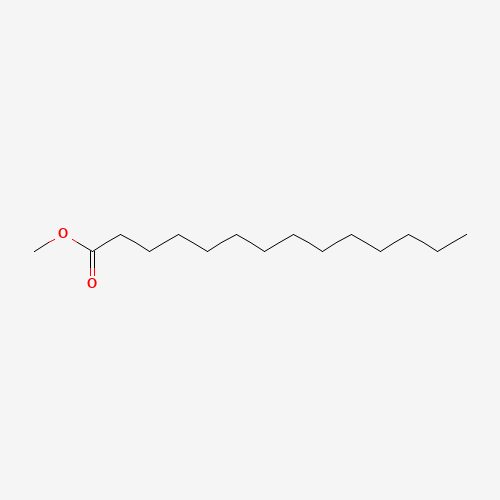
Methyl tetradecanoate is a fatty acid methyl ester resulting from the formal condensation of the carboxy group of tetradecanoic acid (myristic acid) with methanol. It has a role as a flavouring agent, a fragrance and a plant metabolite. It is functionally related to a tetradecanoic acid.
科学粮草官-词典编辑部,修订于:2026-07-06
Toxicity
ToxicityBody Burden
Methyl myristate was detected in thrombogenic coronary plaques in 1 of 2 human aortas samples at 10 ppb(1).
Fate Summary
ATMOSPHERIC FATE: According to a model of gas/particle partitioning of semivolatile organic compounds in the atmosphere(1), methyl myristate, which has a vapor pressure of 0.00049 mm Hg at 25 °C(2), will exist solely in the vapor phase in the ambient atmosphere. Vapor-phase methyl myristate is degraded in the atmosphere by reaction with photochemically-produced hydroxyl radicals(SRC); the half-life for this reaction in air is estimated to be 24 hours(SRC) from its estimated rate constant of 1.6X10⁻¹¹ cu cm/molecule-sec at 25 °C(3).
Soil Adsorption / Mobility
Using a structure estimation method based on molecular connectivity indices(1), the Koc for methyl myristate can be estimated to be about 5400(SRC). According to a classification scheme(2), this estimated Koc value suggests that methyl myristate is expected to be immobile in soil.
Environmental Biodegradation
AEROBIC: By analogy to chemically similar long chain fatty acid esters that were rapidly degraded by in mixed sewage sludge(1-3), methyl myristate is expected to rapidly biodegrade under aerobic conditions(SRC).
Environmental Bioconcentration
An estimated BCF of 1100 was calculated for methyl myristate(SRC) using a log Kow of 6.41(1) and a regression-derived equation(2). According to a classification scheme(3), the estimated BCF suggests the potential for bioconcentration in aquatic organisms is high. However, bioconcentration studies on compounds which are structurally similar(4,5) suggests that bioconcentration may be lower than that indicated by the regression-derived equation due to the ability of aquatic organisms to readily metabolize this class of compounds(SRC).
Volatilization from Water / Soil
The Henry's Law constant for methyl myristate is estimated as 0.0052 atm-cu m/mole(SRC) using a fragment constant estimation method(1). This Henry's Law constant indicates that methyl myristate is expected to volatilize from water surfaces(2). Based on this Henry's Law constant, the volatilization half-life from a model river (1 m deep, flowing 1 m/sec, wind velocity of 3 m/sec)(2) is estimated as approximately 5 hours(SRC). The volatilization half-life from a model lake (1 m deep, flowing 0.05 m/sec, wind velocity of 0.5 m/sec)(2) is estimated as approximately 6.2 days(SRC). The volatilization half-life from a model pond 2 m deep is estimated to be about 57 hours ignoring adsorption; when considering maximum adsorption the volatilization half-life increases to 45 days(3). Methyl myrist...
Environmental Abiotic Degradation
The rate constant for the vapor-phase reaction of methyl myristate with photochemically-produced hydroxyl radicals has been estimated as 1.6X10⁻¹¹ cu cm/molecule-sec at 25 °C(SRC) using a structure estimation method(1). This corresponds to an atmospheric half-life of about 24 hours at an atmospheric concentration of 5X10+5 hydroxyl radicals per cu cm(1). A base-catalyzed second-order hydrolysis rate constant of 0.030 L/mole-sec(SRC) was estimated using a structure estimation method(2); this corresponds to half-lives of 7.3 years and 270 days at pH values of 7 and 8, respectively(2). Methyl myristate is not expected to directly photolyze due to the lack of absorption in the environmental UV spectrum(3).
Environmental Water Concentrations
SURFACE WATER: Methyl myristate was detected in 10% of 30 samples taken from the Delaware Basin (Delaware, Schuylkill, and Lehigh Rivers) in February, 1976, at concentrations > 1 ug/l(1). It was detected, but not quantified, in water samples collected from the Delaware River, Summer 1976; it was not detected in samples taken during the Winter(2). In a survey of 14 heavily industrialized river basins in the United States (240 sites), 1975-76, 47 samples were found to contain methyl myristate, detection limit not provided(3). It was detected in 6 of 13 samples taken from the Lake Michigan basin at concentrations ranging from 1-24 ug/l(4). Methyl myristate was also detected in trace quantities in samples from the River Lee, UK(5).
Food Survey Values
Methyl myristate was identified as a volatile component of clams, short neck clams, and corbicula(1).
Natural Pollution Sources
Methyl myristate has been identified as a component of the rhizome of the decorative perennial iris (Pallida lam)(1). It has also been identified as a component of clams, short neck clams, and corbicula(2).
Atmospheric Concentrations
SOURCE DOMINATED: Methyl myristate was qualitatively detected in samples taken in the Allegheny Mountain Tunnel of the Pennsylvania Turnpike, in 1979(1).
Artificial Pollution Sources
Methyl myristate's production and use as a synthetic intermediate and flavoring(1) may result in its release to the environment through various waste streams.
Sediment/Soil Concentrations
SOIL: Methyl myristate was qualitatively detected in soil samples from Southern Alberta, Canada, in strata associated with the Mazama volcano eruption which occurred approximately 7000 years ago(1). SEDIMENT: Methyl myristate was qualitatively detected in a sediment sample from the Calcasieu River, LA, 1979(2).
Probable Routes of Human Exposure
NIOSH (NOES Survey 1981-1983) has statistically estimated that 27,787 workers (4,243 of these are female) are potentially exposed to methyl myristate in the US(1). Occupational exposure to methyl myristate may occur through inhalation and dermal contact with this compound at workplaces where methyl myristate is produced or used(SRC). The general population may be exposed to methyl myristate via inhalation of ambient air, ingestion of food and drinking water, and dermal contact with this compound and other products containing methyl myristate(SRC). The general population may also be exposed to methyl myristate due to its occurrence in some foods(2,3).
Environmental Fate / Exposure Summary
Methyl myristate's production and use as a synthetic intermediate may result in its release to the environment through various waste streams. Methyl myristate is found naturally as a flavor component of some foods. If released to air, a vapor pressure of 0.00049 mm Hg at 25 °C indicates methyl myristate will exist solely as a vapor in the ambient atmosphere. Vapor-phase methyl myristate will be degraded in the atmosphere by reaction with photochemically-produced hydroxyl radicals; the half-life for this reaction in air is estimated to be 24 hours. If released to soil, methyl myristate is expected to have no mobility based upon an estimated Koc of 5,400. Volatilization from moist soil surfaces is expected to be an important fate process based upon an estimated Henry's Law constant of 0.0...
Interactions
Linear saturated fatty acid methyl esters were comitogenic with lectins for mouse lymphocytes, the degree of comitogenicity being strongly dependent on the length of the acyl group, and maximal for methyl tetradecanoate. Lesser effects were found for analogs with 10, 12, or 16 acyl carbon atoms, whereas those with fewer than 10 or more than 16 were inactive. /Methyl esters/
Toxicity Summary
Cosmetic Ingredient Review Finding(s): Safe in the present practices of use and concentration. Ingredient, concentration, and use information are available in documents discoverable at https://cir-reports.cir-safety.org
Non-Human Toxicity Excerpts
THE INFLUENCE OF HIGHLY PURIFIED SATURATED FATTY ACID ESTERS, INCLUDING METHYL MYRISTATE, & UNSATURATED FATTY ACID ESTERS AS WELL AS TRIGLYCERIDES & PHOSHOLIPIDS, ON THE PHAGOCYTIC ACTIVITY OF THE RETICULOENDOTHELIAL SYSTEM WAS EVALUATED. METHYL MYRISTATE DEPRESSED THE PHAGOCYTIC ACTIVITY OF THE RETICULOENDOTHELIAL SYSTEM & IV INJECTIONS OF 35 MG IN MICE INCREASED THE HALF-TIME OF COLLOIDAL CARBON FROM 14.8 MINUTES TO 32.3 MINUTES.