
 一键配货
一键配货
化合物详情
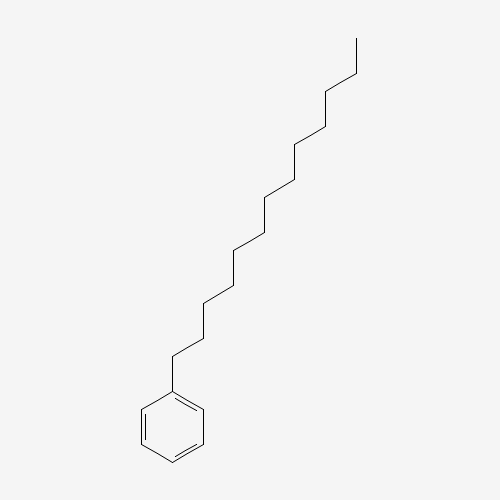
CAS123-02-4
分子式C19H32
分子量260.46 g/mol
非危品
Physical Description | Tridecylbenzene is a colorless liquid. (USCG, 1999)
科学粮草官-词典编辑部,修订于:2026-07-06
Toxicity
ToxicityFate Summary
ATMOSPHERIC FATE: According to a model of gas/particle partitioning of semivolatile organic compounds in the atmosphere(1), tridecylbenzene, which has a vapor pressure of 1.27X10⁻⁵ mm Hg at 25 °C(2) is expected to exist in both the vapor and particulate phases in the ambient atmosphere. Vapor-phase tridecylbenzene is degraded in the atmosphere by reaction with photochemically-produced hydroxyl radicals(SRC); the half-life for this reaction in air is estimated to be 18 hrs(SRC), calculated from its estimated rate constant of 2.1X10⁻¹¹ cu cm/molecule-sec at 25 °C(SRC)determined using a structure estimation method(3). Particulate-phase tridecylbenzene may be removed from the air by wet and dry deposition(SRC).
Soil Adsorption / Mobility
The Koc of tridecylbenzene is estimated as 2.9X10+6(SRC), using an estimated log Kow of 9.4(1,SRC) and a regression-derived equation(2). According to a classification scheme(3), this estimated Koc value suggests that tridecylbenzene is expected to be immobile in soil.
Environmental Biodegradation
The bacteria Norcardia Salmanicolor is able to use tridecylbenzene as a sole source of carbon and energy(1). River die-away tests have shown linear alkyl benzenes are readily biodegradable with half-lives of 4.3 and 8.4 days for C-13 isomers(2). Linear alkyl benzene compounds are readily biodegradable in natural waters(2).
Environmental Bioconcentration
An estimated BCF of 3.2 was calculated for tridecylbenzene(SRC), using a log Kow of 9.36(1) and a regression-derived equation(2). According to a classification scheme(3), this BCF suggests the potential for bioconcentration in aquatic organisms is low. The BCF for linear alkylbenzene (LAB) was studied for bluegill fish(4). A BCF value of 35 was determined from the mean exposure concentration of 0.092 mg/l and the steady state whole fish residue concentration of 2.3 ug/g(4). This low value is suspected to be due mainly to metabolism(4).
Volatilization from Water / Soil
The Henry's Law constant for tridecylbenzene is estimated as 0.178 atm-cu m/mole(SRC) using a fragment constant estimation method(1). This Henry's Law constant indicates that tridecylbenzene is expected to volatilize rapidly from water surfaces(2). Based on this Henry's Law constant, the volatilization half-life from a model river (1 m deep, flowing 1 m/sec, wind velocity of 3 m/sec)(2) is estimated as 4.7 hrs(SRC). The volatilization half-life from a model lake (1 m deep, flowing 0.05 m/sec, wind velocity of 0.5 m/sec)(2) is estimated as 153 hrs(SRC). However, the volatilization half-life does not take into account the effects of adsorption. An estimated Koc of 2.9X10+6(SRC), from a log Kow of 9.4(3) and a regression-derived equation(2), suggests that volatilization could be attenuated...
Environmental Abiotic Degradation
The rate constant for the vapor-phase reaction of tridecylbenzene with photochemically-produced hydroxyl radicals has been estimated as 2.1X10⁻¹¹ cu cm/molecule-sec at 25 °C(SRC) using a structure estimation method(1). This corresponds to an atmospheric half-life of about 18 hrs at an atmospheric concentration of 5X10+5 hydroxyl radicals per cu cm(1). Tridecylbenzene is not expected to undergo hydrolysis in the environment due to the lack of hydrolyzable functional groups(2) nor to directly photolyze due to the lack of absorption in the environmental UV spectrum.
Environmental Water Concentrations
SURFACE WATER: Tridecylbenzene was detected in water samples taken from the Besos River near Barcelona, Spain in August 1985, concentrations not specified(1).
Effluent Concentrations
In California, concentrations (of LAB) ranging from 25 to 2,200 ug/l and 78 to 302 ug/l in final sewage effluents and from 1 to 34 mg/l in marine sediments near sewage outfalls were reported(1). Investigators attribute LAB concentrations in wastewaters and the environment to residual unsulfonated LAB in linear alkylsulfonate (LAS) detergents(1).
Artificial Pollution Sources
Tridecylbenzene's production and use in linear alkylsulfonate (LAS) detergents(1) may result in its release to the environment through various waste streams. The vast majority of manufactured linear alkylbenzes (LAB) are converted to LAS detergents which may contain 1 to 3% residual unsulfonated LAB(2).
Probable Routes of Human Exposure
Occupational exposure to tridecylbenzene may occur through inhalation and dermal contact with this compound at workplaces where tridecylbenzene is produced or used(SRC). The general population may be exposed to tridecylbenzene via ingestion of drinking water(1) and use of LAS detergent(2) products containing tridecylbenzene.
Environmental Fate / Exposure Summary
Tridecylbenzene's production and use in linear alkylsulfonate (LAS) detergents may result in its release to the environment through various waste streams. If released to air, a vapor pressure of 1.27X10⁻⁵ mm Hg at 25 °C indicates tridecylbenzene will exist in both the vapor and particulate phases in the ambient atmosphere. Vapor-phase tridecylbenzene will be degraded in the atmosphere by reaction with photochemically-produced hydroxyl radicals; the half-life for this reaction in air is estimated to be 18 hrs. Particulate-phase tridecylbenzene will be removed from the atmosphere by wet and dry deposition. If released to soil, tridecylbenzene is expected to be immobile based upon an estimated Koc of 4.3X10+5. Volatilization from moist soil surfaces is expected to be an important fate proc...