

 一键配货
一键配货
化合物详情
CAS13472-45-2
分子式Na2WO4.2H2O
分子量329.86 g/mol
非危品
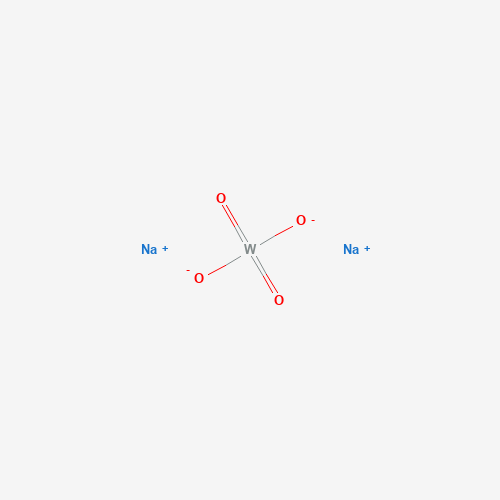
Sodium tungstate is an inorganic sodium salt having tungstate as the counterion. Combines with hydrogen peroxide for the oxidation of secondary amines to nitrones. It has a role as a NMR chemical shift reference compound and a reagent. It contains a tungstate.
科学粮草官-词典编辑部,修订于:2026-07-06
Toxicity
ToxicityBody Burden
Serum concns of tungsten in healthy subjects are of the order of 6 ug/l(1). The mean concn of tungsten in urine samples from 14 unexposed persons was 0.21 +/- 0.09 ug/l(2).
Fate Summary
ATMOSPHERIC FATE: Most tungsten compounds have low pressures at 25 °C and are expected to exist solely in the particulate phase in the ambient atmosphere. Particulate-phase tungsten compounds may be removed from the air by wet and dry deposition. (SRC)
Soil Adsorption / Mobility
The sorption coefficient for tungsten increases with decreasing pH(1). The sorption coefficient ranges from 100-50,000 at about pH 5, 10-6,000 at about pH 6.5, and 5-90 at between pH 8-9(1). The sorption behavior of tungsten is due to changes in the surface charge of the soil as the contact solution becomes more acidic or alkaline(1). These sorption coefficients suggest that tungsten compounds are expected to have moderate to no mobility in soil under normal environmental conditions(SRC).
Volatilization from Water / Soil
Tungsten compounds are expected to exist as ions or insoluble solids in the environment(1) and therefore volatilization from moist soil and water surfaces is not expected to be an important fate process(SRC). Tungsten compounds are not expected to volatilize from dry soil surfaces based upon their ionic character and low vapor pressures(SRC).
Environmental Abiotic Degradation
Tungsten exists in several oxidation states, 0, 2+, 3+, 4+, 5+, and 6+(1,2). The most stable is 6+ with the lower states being relatively unstable(2). Tungsten exist as ions in combination with one or more elements, e.g., oxygen(1). Tungsten in natural waters is in the form of tungstate (i.e., WO4- 2) and other tungsten polyanions(3). There are no reports of tungsten organic complexes(3). Bivalent tungsten exists only as halogen compounds(1). Tungsten has a strong tendency to form complexes exemplified by a large series of heteropoly acids formed with oxides of phosphorus, arsenic, vanadium, and silicon, among others (e.g., phosphotungstic acid)(2). In addition, compounds of tungsten exist in which tungsten occurs in more than one valence state(2). Tungsten forms a series of oxyhalides...
Environmental Water Concentrations
SURFACE WATER: The concn of tungsten in the waters of the Mississippi river and its tributaries was <0.2 ug/l for sampling dates, Jul-Aug 1987, Nov-Dec 1987, and May-Jun 1988(1). Seawater analysis performed in the United Kingdom showed that tungsten concns were of the order of 0.1 ug/l(2). The concn of tungsten in Pacific Ocean waters is much lower, ca 0.008 ppb, since tungsten is removed more rapidly by adsorption onto ferric hydroxide, manganese oxide, and clay minerals(2).
Food Survey Values
The mean concn of tungsten in onions from Danish agricultural crops was 16.7 ug/kg (fresh weight; range, 6.3-39 ug/kg)(1).
Plant Concentrations
The range of tungsten concns in plants ranged from <0.001-100 mg/kg (dry wt)(1). The mean concn of tungsten in agricultural plants from Iowa was 0.18 mg/kg (samples = 22; range, 0-0.35 mg/kg)(2). Tree leaves from New Zealand contained tungsten at a mean concns of 2.2 to 3.5 mg/kg (range, 0.1-13 mg/kg)(2).
Natural Pollution Sources
Tungsten deposits occur in association with metamorphic rocks and granitic igneous rocks throughout the world.
Artificial Pollution Sources
The production and use of tungsten compounds as cutting tools, abrasion resistant surfaces, and forming tools (e.g., tungsten carbide); filaments (e.g., tungsten metal and alloys); catalysts (e.g., tungsten oxides, sulfides, and heteropoly complexes); thin films (e.g., tungsten disulfide); and dyes and pigments (e.g., organic tungsten)(1) may result in the release of tungsten to the environment through various waste streams(SRC). Tungsten may be released to soil as a contaminate in phosphate fertilizers and manure(2,3). Only small concns of tungsten have been released into the atmosphere primarily by industrial emissions and nuclear fall-out(4).
Sediment/Soil Concentrations
The range of tungsten concns in surface soils was from 0.68-2.7 mg/kg(1). Agricultural soils from New Zealand had mean concns of tungsten ranging from 1.9 to 21.4 mg/kg(2). The mean tungsten concn in Iowa agricultural soils was 0.89 mg/kg (range, 0-2 mg/kg)(2).
Probable Routes of Human Exposure
LARGE AMT OF DUST...RELEASED FROM CRUSHING AND MILLING OF ORES... IN LOADING AND EMPTYING FROM FURNACES OF GRAPHITE BOATS... DUST MAY BE PRODUCED DURING MIXING OF COMPONENTS AND ALSO IN SHAPING AND GRINDING OF PRODUCTS.
Interactions
DIETARY TUNGSTATE AT 5 PPM REDUCES THE TOXIC EFFECTS OF SELENIUM IN MAMMALS. /TUNGSTATE/
RAIS Toxicity Values
Oral Subchronic Chronic Reference Dose Reference: PPRTV Current
1 or Cancer Risk Level 1E-06
Fraction of Contaminant Absorbed in Gastrointestinal Tract: 1
Antidote and Emergency Treatment
Advanced treatment: Consider orotracheal or nasotracheal intubation for airway control in the patient who is unconscious, has severe pulmonary edema, or is in respiratory arrest. Positive pressure ventilation techniques with a bag valve mask device may be beneficial. Monitor cardiac rhythm and treat arrhythmias as necessary ... . Start an IV with D5W /SRP: "To keep open", minimal flow rate/. Use lactated Ringer's if signs of hypovolemia are present. Watch for signs of fluid overload. Consider drug therapy for pulmonary edema ... . For hypotension with signs of hypovolemia, administer fluid cautiously. Watch for signs of fluid overload ... . Treat seizures with diazepam (Valium) ... . Use proparacaine hydrochloride to assist eye irrigation ... . /Poison A and B/
Hazard Quotient Level 3 or Cancer Risk Level 1E-04
Fraction of Contaminant Absorbed in Gastrointestinal Tract: 1