


 一键配货
一键配货
化合物详情
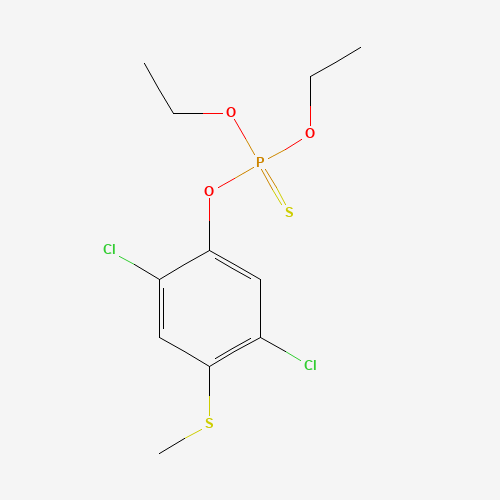
CAS60238-56-4
分子式C11H15Cl2O3PS2
分子量361.24� g/mol
危化品
Physical Description | Chlorthiophos is a yellow-brown liquid which tends to crystallize at less than 77F. Used as an insecticide and acaricide. (EPA, 1998)
科学粮草官-词典编辑部,修订于:2026-07-06
Toxicity
ToxicityEcotoxicity Values
96-Hour LC50 rainbow trout = 0.019 mg/L /conditions of bioassay not specified/
Fate Summary
ATMOSPHERIC FATE: According to a model of gas/particle partitioning of semivolatile organic compounds in the atmosphere(1), chlorthiophos, which has an estimated vapor pressure of 2.4X10⁻⁶ mm Hg at 25 °C(2,SRC), will exist in both the vapor and particulate phases in the ambient atmosphere. Vapor-phase chlorthiophos is degraded in the atmosphere by reaction with photochemically-produced hydroxyl radicals(SRC); the half-life for this reaction in air is estimated to be about 4.1 hours(3,SRC). Particulate-phase chlorthiophos may be physically removed from the air by wet and dry deposition(SRC).
Soil Adsorption / Mobility
Using a structure estimation method based on molecular connectivity indices(1), the Koc for chlorthiophos can be estimated to be about 1.3X10+4(SRC). According to a recommended classification scheme(2), this estimated Koc value suggests that chlorthiophos is expected to be immobile in soil(SRC).
Environmental Bioconcentration
An estimated BCF of 1.5X10+4 was calculated for chlorthiophos(SRC), using an estimated log Kow of 5.8(1,SRC) and a recommended regression-derived equation(2). According to a classification scheme(3), this BCF suggests that bioconcentration in aquatic organisms is very high(SRC).
Volatilization from Water / Soil
The Henry's Law constant for chlorthiophos is estimated as 1.2X10⁻⁶ atm-cu m/mole(SRC) using a fragment constant estimation method(1). This value indicates that chlorthiophos will volatilize very slowly from water surfaces(2,SRC). Based on this Henry's Law constant, the estimated volatilization half-life from a model river (1 m deep, flowing 1 m/sec, wind velocity of 3 m/sec) is estimated as approximately 58 days(2,SRC). The estimated volatilization half-life from a model lake (1 m deep, flowing 0.05 m/sec, wind velocity of 0.5 m/sec) is estimated as approximately 1.2 years(2,SRC). The volatilization half-life from an environmental pond 2 m deep is estimated to be about 1.7 years when considering adsorption to suspended solids and sediment(3). Chlorthiophos's Henry's Law constant(1,SRC)...
Environmental Abiotic Degradation
The rate constant for the vapor-phase reaction of chlorthiophos with photochemically-produced hydroxyl radicals has been estimated as 9.5X10⁻¹¹ cu cm/molecule-sec at 25 °C(SRC) using a structure estimation method(1,SRC). This corresponds to an atmospheric half-life of about 4.1 hours at an atmospheric concentration of 5X10+5 hydroxyl radicals per cu cm(1,SRC).
Artificial Pollution Sources
Chlorthiophos's use as an insecticide and acaricide(1) will result in its release to the environment(SRC).
Environmental Fate / Exposure Summary
Chlorthiophos may be released to the environment from its use as an insecticide and acaricide. If released to air, an estimated vapor pressure of 2.4X10⁻⁶ mm Hg at 25 °C indicates chlothiophos will exist in both the vapor and particulate phases in the ambient atmosphere. Vapor-phase chlorthiophos will be degraded in the atmosphere by reaction with photochemically-produced hydroxyl radicals with an estimated half-life of 4.1 hours. Particulate-phase chlorthiophos will be physically removed from the atmosphere by wet and dry deposition. If released to soil, an estimated Koc of 1.3X10+4 indicates that chlorthiophos will be immobile. Volatilization from dry soil surfaces is not expected based on this compound's vapor pressure. Volatilization of chlorthiophos from moist soil surfaces may occ...
Interactions
ANTICHOLINESTERASE (ORGANOPHOSPHORUS) INSECTICIDES ANTAGONIZE POLARIZING MUSCLE RELAXANTS. PHENOTHIAZINES /AND THIOXANTHENES/: ... MAY ENHANCE TOXIC EFFECTS OF ORGANOPHOSPHORUS INSECTICIDES. /INSECTICIDES, ORGANOPHOSPHORUS/
Adverse Effects
Other Poison - Organophosphate
RAIS Toxicity Values
Oral Subchronic Chronic Reference Dose Reference: HEAST Current
Populations at Special Risk
Those individuals who are exposed to organophosphorus pesticides with pre-existing/ organic diseases of the central nervous system, mental disorders & epilepsy, pronounced endocrine & vegetative disorders, pulmonary tuberculosis, bronchial asthma, chronic respiratory diseases, cardiovascular diseases & circulatory disorders, gastrointestinal diseases (peptic ulcer), gastroenterocolitis, diseases of liver & kidneys, eye diseases (chronic conjunctivitis & keratitis) /are at elevated risk from exposure/. The blood cholinesterase activity must be determined before work starts. In the event of prolonged work periods, this activity should be determined at intervals of 3-4 days. Persons exhibiting a fall in cholinesterase activity of 25% or more must be transferred to other work where they are...
1 or Cancer Risk Level 1E-06
Fraction of Contaminant Absorbed Dermally from Soil: 0.1
Hazard Quotient Level 3 or Cancer Risk Level 1E-04
Fraction of Contaminant Absorbed Dermally from Soil: 0.1









