


 一键配货
一键配货
化合物详情
CAS3050-88-2
分子式C45H69O3P
分子量689.01 g/mol
非危品
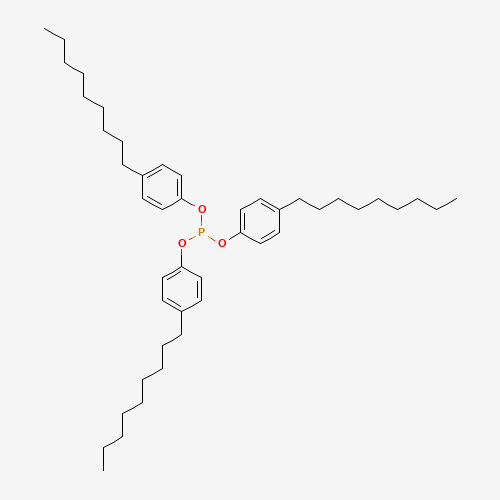
an antioxidant, used in polyethylene resin manufacture, that is a source of 4-nonylphenols, which are known endocrine disruptors; structure in first source
科学粮草官-词典编辑部,修订于:2026-07-06
Toxicity
ToxicityFate Summary
ATMOSPHERIC FATE: According to a model of gas/particle partitioning of semivolatile organic compounds in the atmosphere(1), tris(nonylphenyl)phosphite, which has an extapolated vapor pressure of 4.35X10⁻⁴ mm Hg at 25 °C(2), is expected to exist solely as a vapor in the ambient atmosphere. Vapor-phase tris(nonylphenyl)phosphite is degraded in the atmosphere by reaction with photochemically-produced hydroxyl radicals(SRC); the half-life for this reaction in air is estimated to be 7.6 hours(SRC), calculated from its rate constant of 6.5X10⁻¹¹ cu cm/molecule-sec at 25 °C(SRC) that was derived using a structure estimation method(3).
Soil Adsorption / Mobility
Using a structure estimation method based on molecular connectivity indices(1), the Koc of tris(nonylphenyl)phosphite can be estimated to be 1X10+10(SRC). According to a classification scheme(2), this estimated Koc value suggests that tris(nonylphenyl)phosphite is expected to be immobile in soil.
Environmental Biodegradation
AEROBIC: Tris(nonylphenyl)phosphite, present at 100 mg/L, reached 83% of its theoretical BOD in 4 weeks using an activated sludge inoculum at 30 mg/L in the Japanese MITI test(1); however, it was reported that the test substance hydrolyzed in water to form dinonyl phenyl phosphite and nonylphenol, and that in a stability test in water at 30 mg/L of the test substance, nearly a theoretical amount of nonylphenol was formed after 14 days(1). Using OECD Guideline 301D (Ready Biodegradability: Closed Bottle Test) and non-adapted activated sludge, <4% of initial tris(nonylphenyl)phosphite (at 15.4 mg/L) was degraded over a 28-day incubation period(2). Using OECD Guideline 301B (Ready Biodegradability: CO2 Evolution Test) and activated sludge (adaptation not specified), 1% of initial tris(nony...
Environmental Bioconcentration
An estimated BCF of 5 was calculated in fish for tris(nonylphenyl)phosphite(SRC), using an HPLC estimated log Kow of 14(1) and a regression-derived equation(2). According to a classification scheme(3), this BCF suggests the potential for bioconcentration in aquatic organisms is low(SRC). A low bioconcentration was reported for tris(nonylphenyl)phosphite based on test results using carp (Cyprinus carpio)(4); however, actual BCF values were not reported(SRC).
Volatilization from Water / Soil
The Henry's Law constant for tris(nonylphenyl)phosphite is estimated as 6.5X10⁻⁴ atm-cu m/mole(SRC) using a fragment constant estimation method(1). This Henry's Law constant indicates that tris(nonylphenyl)phosphite is expected to volatilize from water surfaces(2). Based on this Henry's Law constant, the volatilization half-life from a model river (1 m deep, flowing 1 m/sec, wind velocity of 3 m/sec)(2) is estimated as 11 hours(SRC). The volatilization half-life from a model lake (1 m deep, flowing 0.05 m/sec, wind velocity of 0.5 m/sec)(2) is estimated as 11.5 days(SRC). However, volatilization from water surfaces is expected to be attenuated by adsorption to suspended solids and sediment in the water column. The estimated volatilization half-life from a model pond is greater than 5 ye...
Environmental Abiotic Degradation
The rate constant for the vapor-phase reaction of tris(nonylphenyl)phosphite with photochemically-produced hydroxyl radicals has been estimated as 5.1X10⁻¹¹ cu cm/molecule-sec at 25 °C(SRC) using a structure estimation method(1). This corresponds to an atmospheric half-life of about 7.6 hours at an atmospheric concentration of 5X10+5 hydroxyl radicals per cu cm(1). Using a method similar to OECD Guideline 111 (Hydrolysis as a Function of pH), only 0.1% of initial tris(nonylphenyl)phosphite (10 ppm) was hydrolyzed over a 241-hour period as measured by nonylphenol formation(2); however, due to the very low solubility of tris(nonylphenyl)phosphite, the compound (using acetone) was dispersed in the water creating a cloudy solution containing a fine dispersion of tris(nonylphenyl)phosphite a...
ICSC Environmental Data
The substance is very toxic to aquatic organisms. The substance may cause long-term effects in the aquatic environment. It is strongly advised not to let the chemical enter into the environment.
Artificial Pollution Sources
Tris(nonylphenyl)phosphite's production and use as a stabilizer and antioxidant in the processing of various plastic materials (PVC, LLDPE, HDPE) and rubber(1) may result in its release to the environment through various waste streams(SRC).
Probable Routes of Human Exposure
NIOSH (NOES Survey 1981-1983) has statistically estimated that 44,891 workers (20,417 of these were female) were potentially exposed to tris(nonylphenyl)phosphite in the US(1). Occupational exposure to tris(nonylphenyl)phosphite may occur through inhalation and dermal contact with this compound at workplaces where tris(nonylphenyl)phosphite is produced or used. Occupational exposure may occur through the respiratory and the dermal routes with highest exposures occurring during the manufacture of tris(nonylphenyl)phosphite containing materials and a worst case inhalation exposure level of 8.58 mg/cu m (related to mixing or transforming activities at high temperatures)(2). The highest dermal exposure may occur during transfer of the substance. Consumer exposure may occur through use of pl...
Environmental Fate / Exposure Summary
Tris(nonylphenyl)phosphite's production and use as a stabilizer and antioxidant in the processing of various plastic materials (PVC, LLDPE, HDPE) and rubber may result in its release to the environment through various waste streams. If released to air, an extrapolated vapor pressure of 4.35X10⁻⁴ mm Hg at 25 °C indicates tris(nonylphenyl)phosphite will exist solely as a vapor in the atmosphere. Vapor-phase tris(nonylphenyl)phosphite will be degraded in the atmosphere by reaction with photochemically-produced hydroxyl radicals; the half-life for this reaction in air is estimated to be 7.6 hours. If released to soil, tris(nonylphenyl)phosphite is expected to have no mobility based upon an estimated Koc of 1X10+10. Volatilization from moist soil surfaces is expected to occur based upon an e...
Toxicity Summary
IDENTIFICATION AND USE: Tris(nonylphenyl)phosphite is a clear liquid with negligible to low water solubility and moderate vapor pressure. The industrial uses of Tris(nonylphenyl)phosphite include: plastics product manufacturing, plastic packaging materials production, unlaminated film and sheet manufacturing (as a stabilizer); resin and synthetic rubber manufacturing, and tire manufacturing. HUMAN EXPOSURE AND TOXICITY: A single Japanese study detected a derivative of tris (nonylphenyl) phosphite in most PVC wrapping films and gloves. PVC wrapping film was extensively used in markets, thus many kinds of foods were contaminated. Among them, fillet or minced fish and meat contained it at high levels. In 2000, manufacturers voluntarily changed their composition and all wrapping films in Ja...
Average Daily Intake
The total daily intake due to food-contact materials has been estimated to be 0.0337 mg/day (corresponding to about 0.48 ug/kg bw/day for a person of 70 kg bw)(1).
Human Toxicity Excerpts
/OTHER TOXICITY INFORMATION/ A number of endocrine disruptors have been reported in food contact articles and baby toys mainly during the second half of the 1990s. Bisphenol A, nonylphenol, phthalates, styrene dimers and trimers, and their transision are described in this article. Bisphenol A was found in polycarbonate tableware, nursing bottles and the epoxy resin coating of cans, therefore, it was also found in the canned foods and drinks. Polycarbonate is now only slightly used for tableware or nursing bottles in Japan because consumers refused them. The can manufacturers changed their coating material to the low bisphenol A resin or PET films and voluntarily regulate its migration limit to under 5 or 10 ng/ml. Nonylphenol was found in most PVC wrapping films and gloves. It was gener...
Non-Human Toxicity Values
LD50 Rat Intraperitonal > 1000 mg/kg
Non-Human Toxicity Excerpts
/ENDOCRINE MODULATION/ Food contact plastics and rubbers possibly contain many kinds of chemicals such as monomers, oligomers, additives, degradation products of polymers and additives, and impurities. Among them, bisphenol A, nonylphenol, benzylbutyl phthalate, styrene oligomers and hydroxylated benzophenones have been reported to possess estrogenic activities. In this study, other chemicals related to food contact plastics and rubbers, and their metabolites induced by the S9-mixture were tested for their estrogenic activities using the yeast two-hybrid assay. Among the 150 chemicals, 10 chemicals such as bis(4-hydroxyphenyl) methane, 4-cyclohexylphenol, 4-phenylphenol, 4,4'-isopropylidenediphenol alkylphosphite, two type of styrenated phenol (including mono type), tris(nonylphenyl) ph...
Antidote and Emergency Treatment
/SRP:/ Advanced treatment: Consider orotracheal or nasotracheal intubation for airway control in the patient who is unconscious, has severe pulmonary edema, or is in severe respiratory distress. Positive-pressure ventilation techniques with a bag valve mask device may be beneficial. Consider drug therapy for pulmonary edema ... . Consider administering a beta agonist such as albuterol for severe bronchospasm ... . Monitor cardiac rhythm and treat arrhythmias as necessary ... . Start IV administration of D5W TKO /SRP: "To keep open", minimal flow rate/. Use 0.9% saline (NS) or lactated Ringer's (LR) if signs of hypovolemia are present. For hypotension with signs of hypovolemia, administer fluid cautiously. Watch for signs of fluid overload ... . Treat seizures with diazepam or lorazepam...









