


 一键配货
一键配货
化合物详情
CAS122-79-2
分子式C8H8O2
分子量136.15 g/mol g/mol
危化品
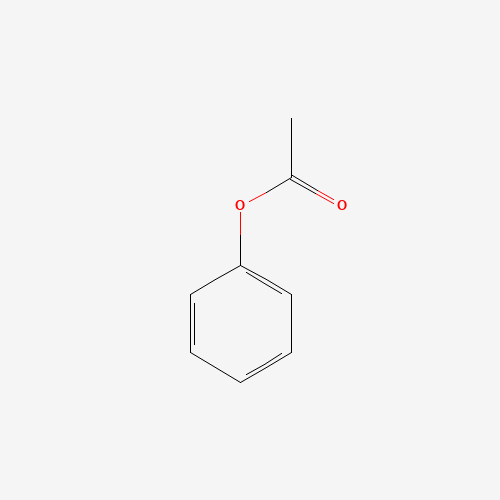
Physical Description | Phenol acetate appears as a clear colorless liquid with a sweetish solvent odor. Difficult to ignite. Used as a laboratory reagent and in the production of some organic chemicals.
科学粮草官-词典编辑部,修订于:2026-07-06
Toxicity
ToxicityFate Summary
ATMOSPHERIC FATE: According to a model of gas/particle partitioning of semivolatile organic compounds in the atmosphere(1), phenyl acetate, which has an estimated vapor pressure of 0.398 mm Hg at 25 °C(2,SRC), is expected to exist solely as a vapor in the ambient atmosphere. Vapor-phase phenyl acetate is degraded in the atmosphere by reaction with photochemically-produced hydroxyl radicals(SRC); the half-life for this reaction in air is estimated to be 8 days(3,SRC).
Soil Adsorption / Mobility
The Koc of phenyl acetate is estimated as approximately 150(SRC), using a log Kow value of 1.49(1) and a regression-derived equation(2,SRC). According to a classification scheme(3), this estimated Koc value suggests that phenyl acetate is expected to have moderate to high mobility in soil(SRC).
Environmental Biodegradation
13% of the theoretical BOD was reached in 30 hours with a lag period ranging from 0 to 5 hours; a first-order rate constant of 0.060/hr was calculated from this process(1).
Environmental Bioconcentration
An estimated BCF of 8 was calculated for phenyl acetate(SRC), using a log Kow value of 1.49(1) and a regression-derived equation(2). According to a classification scheme(3), this BCF suggests the potential for bioconcentration in aquatic organisms is low(SRC).
Volatilization from Water / Soil
The Henry's Law constant for phenyl acetate is estimated as 6.5X10⁻⁵ atm-cu m/mole(SRC) using a fragment constant estimation method(1). This Henry's Law constant indicates that phenyl acetate is expected to volatilize from water surfaces(2,SRC). Based on this Henry's Law constant, the estimated volatilization half-life from a model river (1 m deep, flowing 1 m/sec, wind velocity of 3 m/sec) is estimated as approximately 19 hours(2,SRC). The estimated volatilization half-life from a model lake (1 m deep, flowing 0.05 m/sec, wind velocity of 0.5 m/sec) is estimated as approximately 9 days(2,SRC). Phenyl acetate's Henry's Law constant(1,SRC) indicates that volatilization from moist soil surfaces may occur(SRC). Phenyl acetate is not expected to volatilize from dry soil surfaces based on an...
Environmental Abiotic Degradation
The rate constant for the vapor-phase reaction of phenyl acetate with photochemically-produced hydroxyl radicals has been estimated as 2.05X10⁻¹² cu cm/molecule-sec at 25 °C(SRC) using a structure estimation method(1,SRC). This corresponds to an atmospheric half-life of about 8 days at an atmospheric concn of 5X10+5 hydroxyl radicals per cu cm(1,SRC). A base-catalyzed second-order hydrolysis rate constant of 1.3 L/mol-sec(2) was measured at 25 °C; this corresponds to half-lives of 61 and 6 days at pH values of 7 and 8, respectively(2,SRC).
Environmental Water Concentrations
DRINKING WATER: Groundwater, after distribution for drinking water purposes, was found to contain phenyl acetate at unreported concns in 1978 from an unreported source in England(1).
Effluent Concentrations
A process water sample from an in situ coal gasification process in Gillette, WY contained phenyl acetate at 4 ppb(1).
Natural Pollution Sources
/PHENYL ACETATE IS A/ COMPD IN NATURAL COCOA AROMA. /FROM TABLE/
Artificial Pollution Sources
Phenyl acetate's production and use as a solvent(1), chemical intermediate(2), and as a laboratory reagent(1) may result in its release to the environment through various waste streams(SRC).
Probable Routes of Human Exposure
Limited monitoring data indicate that non-occupational exposures can occur from the ingestion of contaminated drinking water. The most probable human exposure would be occupational exposure, which may occur through dermal contact or inhalation at workplaces where it is produced or used. (SRC)
Environmental Fate / Exposure Summary
Phenyl acetate's production and use as a solvent, chemical intermediate, and as a laboratory reagent may result in its release to the environment through various waste streams. If released to air, an estimated vapor pressure of 0.398 mm Hg at 25 °C indicates phenyl acetate will exist solely as a vapor in the ambient atmosphere. Vapor-phase phenyl acetate will be degraded in the atmosphere by reaction with photochemically-produced hydroxyl radicals; the half-life for this reaction in air is estimated to be 8 days. If released to soil, phenyl acetate is expected to have high to moderate mobility based upon an estimated Koc of 150. In alkaline soils and waters, hydrolysis of phenyl acetate is expected to be an important fate process; a half-life of 6 days at pH 8 has been calculated based...
Symptoms
Eye Exposure: Redness. Pain.
Adverse Effects
Neurotoxin - Acute solvent syndrome
Exposure Routes
The substance can be absorbed into the body by ingestion.
Non-Human Toxicity Excerpts
... The aim of this study was to determine the teratogenicity of phenylalanine and phenylalanine metabolites. The system of whole embryo culture was employed and D9 (neurulating) mouse embryos were exposed to phenylalanine, phenylethylamine (PEA), phenylpyruvate (PPA), phenylacetate (PAA), 2-OHphenylacetate (2-OH), and phenyllacetate (PLA) at concentrations from 0.01 mM to 10 mM for 24 hr. Embryos were examined for morphological abnormalities and protein content. Phenylalanine at 1 and 6 mM concentrations was not teratogenic, however, 10 mM produced NTD's in 82% of the embryos. Phenylethylamine was the most toxic factor at concentrations of 1 and 10 mM were embryo lethal whereas NTD's were observed at 0.1 mM in 70% of the embryos. 2-OHphenylacetate was the next most toxic metabolite at...









