


 一键配货
一键配货
化合物详情
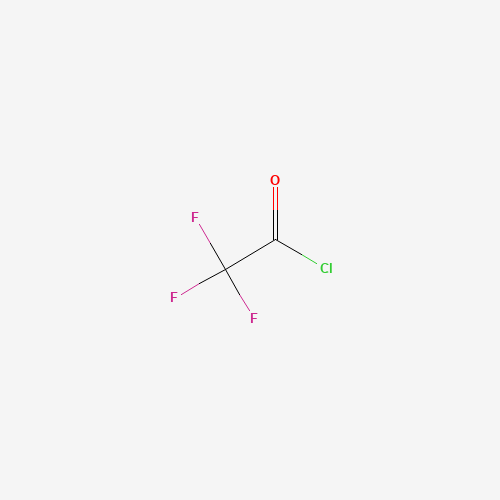
CAS354-32-5
分子式C2ClF3O
分子量132.47 g/mol
危化品
Physical Description | Trifluoroacetyl chloride appears as a colorless gas. Shipped as a liquid under own vapor pressure. Contact with the unconfined liquid may frostbite unprotected skin. Very toxic by inhalation and may severely irritate skin, eyes, and mucous membranes. Under prolonged exposure to fire or heat the containers may rupture violently and rocket.
科学粮草官-词典编辑部,修订于:2026-07-06
Toxicity
ToxicityFate Summary
ATMOSPHERIC FATE: Trifluoroacetyl chloride has a vapor pressure of 3273 mm Hg at 25 °C(1) and will exist solely as a gas in the ambient atmosphere. Results of laboratory studies have demonstrated that trifluoroacetyl chloride will react via hydrolysis with water vapor and water in the atmosphere(2,3). The tropospheric lifetime of trifluoroacetyl chloride due to hydrolysis is estimated to range from 0.04 days at 11 °C(2) to 0.2-2 days at 5 °C(3).
Soil Adsorption / Mobility
Using a structure estimation method based on molecular connectivity indices(1), the Koc of trifluoroacetyl chloride can be estimated to be 3(SRC). According to a classification scheme(2), this estimated Koc value suggests that trifluoroacetyl chloride is expected to have very high mobility in soil. However, trifluoroacetyl chloride hydrolyzes rapidly when contacted with water (half-life of 0.063 seconds at 25 °C)(3); therefore, mobility in moist soil is not expected to be an important environmental fate process(SRC).
Environmental Bioconcentration
Trifluoroacetyl chloride hydrolyzes rapidly when contacted with water (half-life of 0.063 seconds at 25 °C)(1); therefore, bioconcentration in aquatic organisms is not expected to be an important fate process(SRC).
Volatilization from Water / Soil
Trifluoroacetyl chloride is a gas at standard temperature and pressure(1) and therefore, is expected to evaporate into the atmosphere when released as a liquid from pressurized containers(SRC). Trifluoroacetyl chloride hydrolyzes rapidly when contacted with water (half-life of 0.063 seconds at 25 °C)(2); therefore, volatilization from water or moist soil may not be important fate processes(SRC).
Environmental Abiotic Degradation
Based on results of laboratory studies, the tropospheric lifetime of trifluoroacetyl chloride ranges from 0.2-2 days at 5 °C(1). The degradation of trifluoroacetyl chloride in the atmosphere is the result of hydrolysis with water and water vapor. The amount of water vapor in the atmosphere (clouds, rain, etc.) and temperature affect the hydrolysis rate(1). In another laboratory study, the tropospheric lifetime of trifluoroacetyl chloride due to hydrolysis was about 0.04 days at 11 °C(2). The hydrolysis rate constant of trifluoroacetyl chloride in pure water at 25 °C is approximately 11 per second(3) which corresponds to a half-life of 0.063 seconds(SRC).
Artificial Pollution Sources
Trifluoroacetyl chloride's production and use as an intermediate in the production of pharmaceutical chemicals, agricultural chemicals and other specialized applications(1) may result in its release to the environment through various waste streams(SRC). Gaseous trifluoroacetyl chloride provides a way to introduce trifluoromethyl groups into more complex molecules(1).
Probable Routes of Human Exposure
Occupational exposure to trifluoroacetyl chloride may occur through inhalation and dermal contact with this compound at workplaces trifluoroacetyl chloride is produced or used. (SRC)
Environmental Fate / Exposure Summary
Trifluoroacetyl chloride's production and use as an intermediate in the production of pharmaceutical chemicals, agricultural chemicals and other specialized applications may result in its release to the environment through various waste streams. If released to air, a vapor pressure of 3273 mm Hg at 25 °C indicates trifluoroacetyl chloride will exist solely as a gas in the atmosphere. Results of laboratory studies have demonstrated that trifluoroacetyl chloride will react via hydrolysis with water vapor and water in the atmosphere. The tropospheric lifetime of trifluoroacetyl chloride due to hydrolysis is estimated to range from 0.04 to 2 days at 5 to 11 °C. If released to soil, trifluoroacetyl chloride is expected to have very high mobility based upon an estimated Koc of 3. However, tri...
Toxicity Data
LCLo (rat) = 35.3 ppm/6hr
Adverse Effects
Toxic Pneumonitis - Inflammation of the lungs induced by inhalation of metal fumes or toxic gases and vapors.
Toxicity Summary
IDENTIFICATION AND USE: Trifluororacetyl chloride (TFA) is a gas that is used in chemical synthesis. TFA is also a metabolite of halothane. HUMAN STUDIES: Anesthetics such as halothane are believed to trigger hepatitis by covalently linking a TFA hapten (metabolite of halothane) to hepatic proteins. The vast majority of patients with a clinical diagnosis of halothane hepatitis have serum antibodies, which react with one or more specific liver microsomal proteins that have been covalently altered by the TFA. The serum antibodies are specific to halothane hepatitis patients and are not seen in sera of patients with other types of liver pathology. When the purified TFA 57-kD and native 57-kD proteins from liver microsomes of halothane-treated and untreated rats respectively, were used as t...
Human Toxicity Excerpts
/OTHER TOXICITY INFORMATION/ Anesthetics are believed to trigger hepatitis by covalently linking a trifluoroacetyl (TFA) chloride hapten to hepatic proteins, forming haptenated self-proteins
Non-Human Toxicity Excerpts
/IMMUNOTOXICITY/ The pathogenesis of immune-mediated drug-induced liver injury (DILI) following halogenated anesthetics, carbamazepine or alcohol has not been fully elucidated. Detecting cytochrome P450 2E1 (CYP2E1) IgG4 auto-antibodies in anesthetic DILI patients suggests a role for IL-4 in this hapten-mediated process. We investigated IL-4-mediated mechanisms using our model of experimental DILI induced by immunizing BALB/c (WT) and IL-4(-/-) (KO) mice with S100 liver proteins covalently modified by a trifluoroacetyl chloride (TFA) hapten formed following halogenated anesthetic metabolism by CYP2E1. WT mice developed more hepatitis, TFA and S100 antibodies (p<0.01), as well as T-cell proliferation to CYP2E1 and TFA (p<0.01) than KO mice. Additionally, WT CD4(+) T cells adoptively tran...
Antidote and Emergency Treatment
/SRP:/ Advanced treatment: Consider orotracheal or nasotracheal intubation for airway control in the patient who is unconscious, has severe pulmonary edema, or is in severe respiratory distress. Early intubation, at the first sign of upper airway obstruction, may be necessary. Positive-pressure ventilation techniques with a bag valve mask device may be beneficial. Consider drug therapy for pulmonary edema ... . Consider administering a beta agonist such as albuterol for severe bronchospasm ... . Monitor cardiac rhythm and treat arrhythmias as necessary ... . Start IV administration of D5W /SRP: "To keep open", minimal flow rate/. Use 0.9% saline (NS) or lactated Ringer's(LR) if signs of hypovolemia are present. For hypotension with signs of hypovolemia, administer fluid cautiously. Cons...









