


 一键配货
一键配货
化合物详情
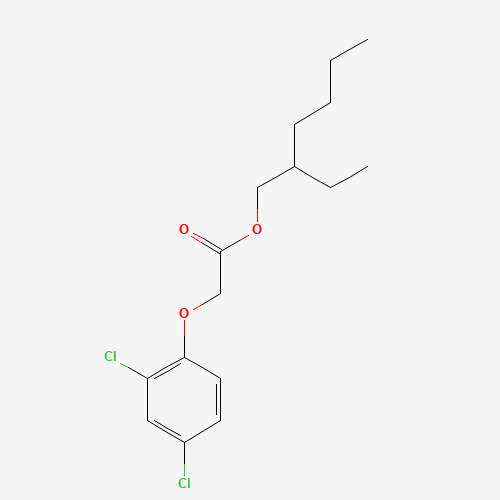
CAS1928-43-4
分子式C16H22Cl2O3
分子量333.25 g/mol
非危品
Physical Description | Sweet smelling liquid.
科学粮草官-词典编辑部,修订于:2026-07-06
Toxicity
ToxicityEPA Ecotoxicity
Pesticide Ecotoxicity Data from EPA: 83
Ecotoxicity Values
LC50 Colinus virginianus (Northern bobwhite, juvenile) dietary 7187 ppm/8 days
Fate Summary
ATMOSPHERIC FATE: According to a model of gas/particle partitioning of semivolatile organic compounds in the atmosphere(1), 2,4-D, 2-ethylhexyl ester, which has a vapor pressure of 3.59X10⁻⁴ mm Hg at 25 °C(2) is expected to exist solely as a vapor in the ambient atmosphere. Vapor-phase 2,4-D, 2-ethylhexyl ester is degraded in the atmosphere by reaction with photochemically-produced hydroxyl radicals(SRC); the half-life for this reaction in air is estimated to be 27 hrs(SRC), calculated from its rate constant of 15X10-12 cu cm/molecule-sec at 25 °C(SRC) that was derived using a structure estimation method(3). 2,4-D, 2-ethylhexyl has been reported to be stable to light(2).
Soil Adsorption / Mobility
The Koc of 2,4-D, 2-ethylhexyl ester is estimated as 33,000(SRC), using a log Kow of 5.78(1) and a regression-derived equation(2). According to a classification scheme(3), this estimated Koc value suggests that 2,4-D, 2-ethylhexyl ester is expected to be immobile in soil.
Environmental Bioconcentration
An estimated BCF of 5,600 was calculated for 2,4-D, 2-ethylhexyl ester(SRC), using a log Kow of 5.78(1) and a regression-derived equation(2). According to a classification scheme(3), this BCF suggests the potential for bioconcentration in aquatic organisms is very high(SRC), provided the compound is not altered physically or chemically once released into the environment(SRP).
Volatilization from Water / Soil
The Henry's Law constant for 2,4-D, 2-ethylhexyl ester is 1.8X10⁻⁵atm-cu m/mole(1). This Henry's Law constant indicates that 2,4-D, 2-ethylhexyl ester is expected to volatilize from water surfaces(2). Based on this Henry's Law constant, the volatilization half-life from a model river (1 m deep, flowing 1 m/sec, wind velocity of 3 m/sec)(2) is estimated as 94.4 hours(SRC). The volatilization half-life from a model lake (1 m deep, flowing 0.05 m/sec, wind velocity of 0.5 m/sec)(2) is estimated as 34.2 days(SRC). However, volatilization from water surfaces is expected to be attenuated by adsorption to suspended solids and sediment in the water column. The estimated volatilization half-life from a model pond is 51 months when adsorption is considered(3). Volatilization of 2,4-D, 2-ethylhexy...
Environmental Abiotic Degradation
The rate constant for the vapor-phase reaction of 2,4-D, 2-ethylhexyl ester with photochemically-produced hydroxyl radicals has been estimated 15X10-12 cu cm/molecule-sec at 25 °C(SRC) using a structure estimation method(1). This corresponds to an atmospheric half-life of about 27 hours at an atmospheric concentration of 5X10+5 hydroxyl radicals per cu cm(1). Hydrolysis of 2,4-D, 2-ethylhexyl ester is expected to yield the parent compound 2,4-D acid(SRC). A base-catalyzed second-order hydrolysis rate constant of 2.3 L/mole-sec(SRC) was estimated using a structure estimation method(2); this corresponds to half-lives of 35 and 3.5 days at pH values of 7 and 8, respectively(2). 2,4-D, 2-ethylhexyl has been reported to be stable to light(3).
Ecotoxicity Excerpts
/AQUATIC SPECIES/ The esters of 2,4-D are clearly more toxic to invertebrate species such as the tidewater silverside (Menidia beryllina), Atlantic silverside (Menidia menidia), grass shrimp (Palaemonetes puqio), pink shrimp (Panaeus duorarum), and Dungeness crab (Cancer magister) than is the dimethylamine salt or the acid. The same is true for formulated 2-ethylhexyl ester.
Artificial Pollution Sources
2,4-D, 2-ethylhexyl ester production may result in its release to the environment through various waste streams; its use as a herbicide(1) will result in its direct release to the environment(SRC).
Probable Routes of Human Exposure
Occupational exposure to 2,4-D, 2-ethylhexyl ester may occur through inhalation and dermal contact with this compound at workplaces where 2,4-D, 2-ethylhexyl ester is produced or used. (SRC)
Environmental Fate / Exposure Summary
2,4-D, 2-ethylhexyl ester's production may result in its release to the environment through various waste streams; its use as a herbicide will result in its direct release to the environment. If released to air, a vapor pressure of 3.59X10⁻⁴ mm Hg at 25 °C indicates 2,4-D, 2-ethylhexyl ester will exist solely as a vapor in the ambient atmosphere. Vapor-phase 2,4-D, 2-ethylhexyl ester will be degraded in the atmosphere by reaction with photochemically-produced hydroxyl radicals; the half-life for this reaction in air is estimated to be 27 hours. If released to soil, 2,4-D, 2-ethylhexyl ester is expected to have no mobility based upon an estimated Koc of 33,000. Volatilization from moist soil surfaces is expected to be an important fate process based upon a Henry's Law constant of 1.8X10-...
Toxicity Data
LC50 (rat) > 5,400 mg/m3
Adverse Effects
Occupational hepatotoxin - Secondary hepatotoxins: the potential for toxic effect in the occupational setting is based on cases of poisoning by human ingestion or animal experimentation.
Non-Human Toxicity Values
LD50 Rat oral 896 mg/kg
Non-Human Toxicity Excerpts
/LABORATORY ANIMALS: Subchronic or Prechronic Exposure/ The influence of sublethal doses of 2,4-dichlorophenoxyacetic acid (2,4-D) on serum T3 & T4 concns in Hsd Cpb: Wistar rats of both sexes was studied. The trial was performed on 24 males & females respectively, each divided into three groups of 8 animals (control, groups 1 & 2). Aqueous soln of the compound (11 mg/kg bw--group 1 & 110 mg/kg bw--group 2) or clean tap water (control group) was used. Aliquots of 2.4 mL/kg bw were administered with a stomach tube from the 1st-10th day of the experiment. Three days before the first treatment & on the 6th & 13th day of the experiment the serum T3 & T4 concns were determined by commercial radioimmunoassay kits (Byk-Sangtec Diagnostica), validated for rats. A significant decr of serum T4 (P...
Antidote and Emergency Treatment
Hemodialysis is not likely to be of significant benefit in poisonings by chlorophenoxy compounds. It has been used in four patients who survived intoxication. However, given the highly protein-bound nature of these herbicides and lack of any other evidence, hemodialysis is not recommended. /Chlorophenoxy Herbicides/









