


 一键配货
一键配货
化合物详情
CAS7784-40-9
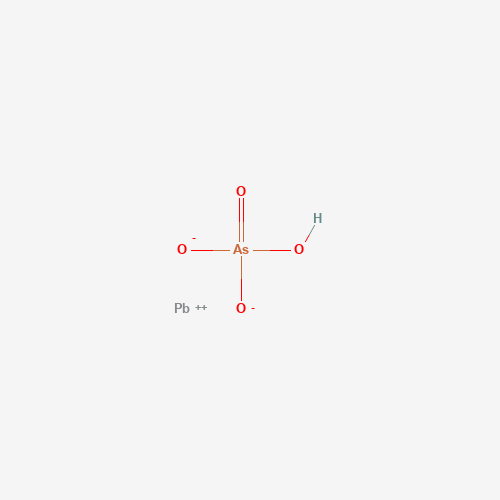
分子式AsH3O4.Pb
分子量347.13 g/mol
非危品
Physical Description | Lead arsenate is a white powder. It is insoluble in water. It is toxic by skin absorption, inhalation and by ingestion.
科学粮草官-词典编辑部,修订于:2026-07-06
Toxicity
ToxicityEPA Ecotoxicity
Pesticide Ecotoxicity Data from EPA: 1
Fate Summary
ATMOSPHERIC FATE: If released to air, lead arsenate will exist in the particulate-phase and will be removed from the atmosphere by wet and dry deposition. (SRC)
Environmental Water Concentrations
Arsenic levels were <0.005 mg/L in ground water samples collected in four counties in Virginia and West Virginia under previously contaminated apple orchards that used lead arsenate from 1925 to 1955(1).
Ecotoxicity Excerpts
/FIELD STUDIES/ No reduction in yield was observed in tobacco grown in a sandy loam soil, to which 142 ppm lead arsenate was added for 3 yr.
Plant Concentrations
A residue of < 0.5 ppm lead arsenate was found in grapefruit oil /from plants/ grown in a hydroponic solution containing 960 ppm lead arsenate.
Animal Concentrations
Mean levels of lead and arsenic detected in eight darkling beetle samples collected at a former orchard site contaminated by the application of lead arsenate in Hanford, Washington were 3.9 and 5.4 mg/kg dry weight, respectively(1).
ICSC Environmental Data
The substance is harmful to aquatic organisms. This substance may be hazardous to the environment. Special attention should be given to birds. This substance does enter the environment under normal use. Great care, however, should be taken to avoid any additional release, for example through inappropriate disposal.
Natural Pollution Sources
Occurs in nature as the mineral schultenite.
Atmospheric Concentrations
SOIL: Lead arsenate spraying in orchards can lead to atmospheric arsenic levels of 20-260,000 ug/cu m.
Artificial Pollution Sources
Lead arsenate's former production and use as a insecticide(1,2) resulted in its release to the environment through various waste streams(SRC).
Sediment/Soil Concentrations
SOIL: Arsenic residues of 440 ppm have been reported in orchard soils with a history of lead arsenate applications. ... Survey reports indicate residues of up to 2500 ppm in soils treated with lead arsenate in the 1930's.
Environmental Fate / Exposure Summary
Lead arsenate is an insecticide that was commonly used in apple orchards from its introduction in 1892 until the early 1940s. Its use declined, but was banned from use in the US in 1988. Lead arsenate is found in the mineral schultenite. If released to air, lead arsenate will exist in the particulate-phase and will be removed from the atmosphere by wet and dry deposition. Lead arsenate released to soil will dissolve to lead ion and arsenic that will bind to organic particles in the soil. Lead is retained in the upper levels of the soil, however arsenic has been shown to wash out in runoff of disturbed field soils. Lead arsenate is expected to adsorb to suspended solids and sediment in aqueous environments. (SRC)
Symptoms
Exposure to lower levels of arsenic can cause nausea and vomiting, decreased production of red and white blood cells, abnormal heart rhythm, damage to blood vessels, and a sensation of burn (T1).
Treatment
Both arsenic and poisoning can be treated by chelation therapy, using chelating agents such as dimercaprol, EDTA or DMSA. Charcoal tablets may also be used for less severe cases. In addition, maintaining a diet high in sulfur helps eliminate arsenic from the body. (L20)
Toxicity Data
LD50: 175 mg/kg (Oral, Rat) (L2) LD50: 128 mg/kg (Intraperitoneal, Mouse) (T14)
Health Effects
Arsenic poisoning can lead to death from multi-system organ failure, probably from necrotic cell death, not apoptosis. Arsenic is also a known carcinogen, esepcially in skin, liver, bladder and lung cancers. Lead is a neurotoxin and has been known to cause brain damage and reduced cognitive capacity, especially in children. Lead exposure can result in nephropathy, as well as blood disorders such as high blood pressure and anemia. Lead also exhibits reproductive toxicity and can results in miscarriages and reduced sperm production. (T1, L20, L21)
Adverse Effects
NTP Carcinogen - Reasonably anticipated to be a human carcinogen.
Exposure Routes
Oral (L2); inhalation (L2); dermal (L2)
Toxicity Summary
Arsenic and its metabolites disrupt ATP production through several mechanisms. At the level of the citric acid cycle, arsenic inhibits pyruvate dehydrogenase and by competing with phosphate it uncouples oxidative phosphorylation, thus inhibiting energy-linked reduction of NAD+, mitochondrial respiration, and ATP synthesis. Hydrogen peroxide production is also increased, which might form reactive oxygen species and oxidative stress. Arsenic's carginogenicity is influenced by the arsenical binding of tubulin, which results in aneuploidy, polyploidy and mitotic arrests. The binding of other arsenic protein targets may also cause altered DNA repair enzyme activity, altered DNA methylation patterns and cell proliferation. Lead mimics other biologically important metals, such as zinc, calcium...
Minimum Risk Level
Acute Oral: 0.005 mg/kg/day (Arsenic) (L134) Chronic Oral: 0.0003 mg/kg/day (Arsenic) (L134) Chronic Inhalation: 0.01 mg/m3 (Arsenic) (L134) Chronic Inhalation: 0.05 mg/m3 (Lead) (L134)
Acceptable Daily Intakes
WHO= 0.002 mg/kg. /Inorganic arsenic compounds, as As; from table/
Carcinogen Classification
1, carcinogenic to humans. (L135)









