


 一键配货
一键配货
化合物详情
CAS75-59-2
分子式C4H13NO
分子量91.15 g/mol g/mol
危化品
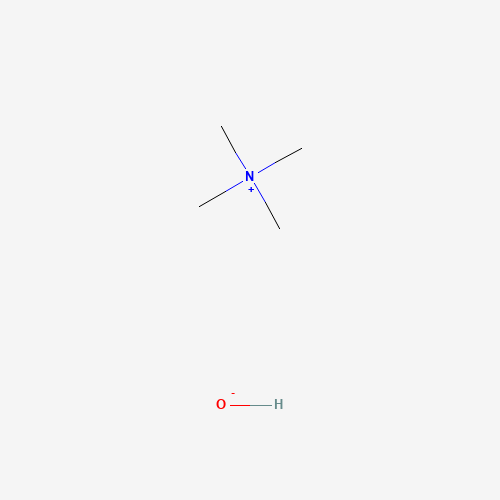
Physical Description | Tetramethylammonium hydroxide is a solid in the hydrated form or a colorless liquid with a strong ammonia-like odor. It is soluble in water. It is corrosive to metals and tissue.
科学粮草官-词典编辑部,修订于:2026-07-06
Toxicity
ToxicityFate Summary
ATMOSPHERIC FATE: According to a model of gas/particle partitioning of semivolatile organic compounds in the atmosphere(1), tetramethylammonium hydroxide, which has an estimated vapor pressure of 1.2X10⁻⁶ mm Hg at 25 °C(SRC), determined from a fragment constant method(2), will exist in both the vapor and particulate phases in the ambient atmosphere. Vapor-phase tetramethylammonium hydroxide is degraded in the atmosphere by reaction with photochemically-produced hydroxyl radicals(SRC); the half-life for this reaction in air is estimated to be 2 days(SRC), calculated from its rate constant of 5.1X10⁻¹² cu cm/molecule-sec at 25 °C(SRC) that was derived using a structure estimation method(3). Particulate-phase tetramethylammonium hydroxide may be removed from the air by wet and dry depositi...
Soil Adsorption / Mobility
Using a structure estimation method based on molecular connectivity indices(1), the Koc of tetramethylammonium hydroxide can be estimated to be 8(SRC). According to a classification scheme(2), this estimated Koc value suggests that tetramethylammonium hydroxide is expected to have very high mobility in soil.
Environmental Biodegradation
AEROBIC: Tetramethylammonium hydroxide, present at 100 mg/L, reached 96% of its theoretical BOD in 2 weeks using an activated sludge inoculum at 30 mg/L in the Japanese MITI test(1).
Environmental Bioconcentration
An estimated BCF of 3 was calculated in fish for tetramethylammonium hydroxide(SRC), using an estimated log Kow of -2.47(1) and a regression-derived equation(1). According to a classification scheme(2), this BCF suggests the potential for bioconcentration in aquatic organisms is low(SRC).
Volatilization from Water / Soil
The Henry's Law constant for tetramethylammonium hydroxide is estimated as 4.36X10⁻¹⁶ atm-cu m/mole(SRC) using a fragment constant estimation method(1). This Henry's Law constant indicates that tetramethylammonium hydroxide is expected to be essentially nonvolatile from water surfaces(2). Tetramethylammonium hydroxide is not expected to volatilize from dry soil surfaces(SRC) based upon an estimated vapor pressure of 1.2X10⁻⁶ mm Hg(SRC), determined from a fragment constant method(3).
Environmental Abiotic Degradation
The rate constant for the vapor-phase reaction of tetramethylammonium hydroxide with photochemically-produced hydroxyl radicals has been estimated as 5.1X10⁻¹² cu cm/molecule-sec at 25 °C(SRC) using a structure estimation method(1). This corresponds to an atmospheric half-life of about 2 days at an atmospheric concentration of 5X10+5 hydroxyl radicals per cu cm(1). Tetramethylammonium hydroxide is not expected to undergo hydrolysis in the environment due to the lack of functional groups that hydrolyze under environmental conditions(2). Tetramethylammonium hydroxide does not contain chromophores that absorb at wavelengths >290 nm(2) and, therefore, is not expected to be susceptible to direct photolysis by sunlight(SRC).
Artificial Pollution Sources
Tetramethylammonium hydroxide's production and use as an etchant in circuit board production(1) and as a buffering agent, titrant, chemical reagent, and in digestion of biological samples(2) may result in its release to the environment through various waste streams(SRC).
Probable Routes of Human Exposure
NIOSH (NOES Survey 1981-1983) has statistically estimated that 6,413 workers (1,446 of these were female) were potentially exposed to tetramethylammonium hydroxide in the US(1). Occupational exposure to tetramethylammonium hydroxide may occur through inhalation and dermal contact with this compound at workplaces where tetramethylammonium hydroxide is produced or used. General population exposure should be low or non-existent since tetramethylammonium hydroxide is not present in consumer end-use products(SRC).
Environmental Fate / Exposure Summary
Tetramethylammonium hydroxide's production and use as an etchant in circuit board production and as a buffering agent, titrant, chemical reagent, and in digestion of biological samples may result in its release to the environment through various waste streams. If released to air, an estimated vapor pressure of 1.2X10⁻⁶ mm Hg at 25 °C indicates tetramethylammonium hydroxide will exist in both the vapor and particulate phases in the atmosphere. Vapor-phase tetramethylammonium hydroxide will be degraded in the atmosphere by reaction with photochemically-produced hydroxyl radicals; the half-life for this reaction in air is estimated to be 2 days. Particulate-phase tetramethylammonium hydroxide will be removed from the atmosphere by wet and dry deposition. Tetramethylammonium hydroxide does...
Adverse Effects
Toxic Pneumonitis - Inflammation of the lungs induced by inhalation of metal fumes or toxic gases and vapors.
Human Toxicity Excerpts
/CASE REPORTS/ A 22 year old male engineer was accidentally drenched with concentrated tetramethylammonium hydroxide solution (TMAH) (25%, pH13.5) while conducting routine examination of the pipe system in a plant manufacturing thin film transistor liquid crystal displays (TFT0LCDs). He was wearing a clean room suit with plastic goggles, but not a mask. As TMAH sprayed over his head, he closed the valve and took a shower at the nearby emergency shower facility immediately for decontamination. When he was found by a co-worker about 15 minutes later, he suffered from general weakness and moderate salivation but was still conscious enough to describe the accident. the paramedical team arrived about 30 minutes after the accident and found the patient losing his consciousness with a Glasgow...
Non-Human Toxicity Values
LD50 Sprague-Dawley rats dermal 28.7 mg/kg /25% solution/
Non-Human Toxicity Excerpts
/OTHER TOXICITY INFORMATION/ To evaluate the role of the chemical burns caused by hydroxide ion in the fatal effects of tetramethylammonium ion (TMA) in dermal exposure to tetramethylammonium hydroxide (TMAH), /the researchers/ conducted a rat study consisting of two-step treatments with dermal exposure to NaOH and tetramethylammonium chloride (TMACl). In the first step, NaOH or saline was administered in the gauze on the shaved skin for 5 min, and in the second step, TMAH, TMACl, or saline was administered in the same way. The mean blood pressure (MBP), heart rate (HR), and survival in rats were compared among seven groups. Dermal exposure to saline and then 2.75 M TMACl introduced limited and temporary non-fatal effects. Exposure to 2.75 M NaOH and then saline had almost no effects an...
Antidote and Emergency Treatment
Tetramethylammonium hydroxide (TMAH), used in microelectronic industries and research and development, has both corrosive properties and systemic toxicity. Two fatal TMAH occupational exposure cases have been published. Studies comparing initial TMAH decontamination with Diphoterine versus tap water were performed: an in vitro pH titration study and an MTT (3-(4,5-dimethylthiazol-2-yl)-2,5-diphenyltetrazolium bromide) in vitro cytotoxicity cell viability assay. For pH normalization, 17 times more tap water than Diphoterine was required. In the cytotoxicity test, two-thirds of the cells remained viable after Diphoterine washing, compared with only one-third after tap water washing (p < .001). Diphoterine washing is a promising TMAH decontamination method.









