


 一键配货
一键配货
化合物详情
CAS754-91-6
分子式C8H2F17NO2S
分子量499.14 g/mol
非危品
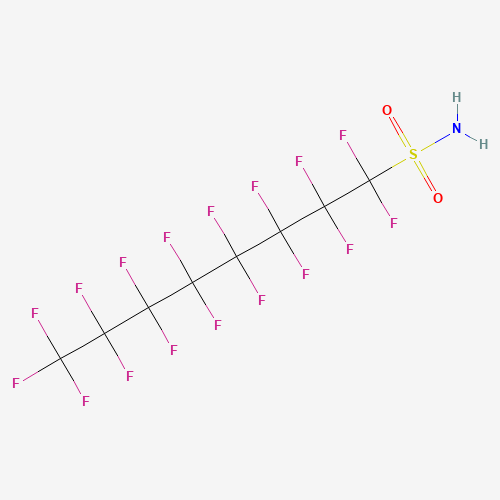
Perfluorooctanesulfonamide is a perfluorinated compound that is perfluorooctane in which one of the terminal fluorines has been replace by a sulfamoyl group. It has a role as a persistent organic pollutant. It is a perfluorinated compound and a sulfonamide.
科学粮草官-词典编辑部,修订于:2026-07-06
Toxicity
ToxicityBody Burden
[Table#7997]: IiIsIkRvY2tlcnMiLCJGYXJtZXJzIiwiRmlzaC1kaXNoIGZhbmNpZXJzIiwiUmVmIGdyb3VwIG1lYW4gKHBnL21MKSIKIm1lYW4gKHBnL21MKSIsIjM3MCIsIjMwMCIsIjk5MCIsIjQ0MCIKIm1lZGlhbiAocGcvbUwpIiwiMjIwIiwiMjEwIiwiMTEwMCIsIjM3MCIKInJhbmdlIChwZy9tTCkiLCI1Ni0xMTAwIiwiMTEwLTEwMDAiLCIyODAtMjYwMCIsIjUzLTkwMCIK
Fate Summary
ATMOSPHERIC FATE: According to a model of gas/particle partitioning of semivolatile organic compounds in the atmosphere(1), perfluorooctanesulfonamide, which has an estimated vapor pressure of 0.31 mm Hg at 25 °C(SRC), determined from a fragment constant method(2), is expected to exist solely as a vapor in the ambient atmosphere. Vapor-phase perfluorooctanesulfonamide is not expected to react with photochemically-produced hydroxyl radicals(SRC). Perfluorooctanesulfonamide does not contain chromophores that absorb at wavelengths >290 nm(3) and therefore is not expected to be susceptible to direct photolysis by sunlight(SRC).
Soil Adsorption / Mobility
Using a structure estimation method based on molecular connectivity indices(1), the Koc of perfluorooctanesulfonamide can be estimated to be 3.6X10+5(SRC). According to a classification scheme(2), this estimated Koc value suggests that perfluorooctanesulfonamide is expected to be immobile in soil. The log Koc for perfluorooctanesulfonamide was 4.1 measured in three sediments(3).
Environmental Biodegradation
Biodegradation data in soil or in water were not available. (2012, SRC)
Environmental Bioconcentration
An estimated BCF of 3100 was calculated in fish for perfluorooctanesulfonamide(SRC), using an estimated log Kow of 5.8(1) and a regression-derived equation(2). According to a classification scheme(3), this BCF suggests the potential for bioconcentration in aquatic organisms is very high(SRC), provided the compound is not metabolized by the organism(SRC). Trophic level biomagnification factors were reported as: ringed seal:cod 0.1, beluga:cod 31, beluga:herring 52, beluga:Artic cisco 26, cod:calanus hyperboreus 0.5, cod:themisto libellula 1.2(4). Ringed seal appear to metabolize perfluorooctanesulfonamide more readily than beluga whales do(4).
Volatilization from Water / Soil
The Henry's Law constant for perfluorooctanesulfonamide is estimated as 1.8 atm-cu m/mole(SRC) using a fragment constant estimation method(1). This Henry's Law constant indicates that perfluorooctanesulfonamide is expected to volatilize rapidly from water surfaces(2). Based on this Henry's Law constant, the volatilization half-life from a model river (1 m deep, flowing 1 m/sec, wind velocity of 3 m/sec)(2) is estimated as 6.5 hours(SRC). The volatilization half-life from a model lake (1 m deep, flowing 0.05 m/sec, wind velocity of 0.5 m/sec)(2) is estimated as 8.8 days(SRC). However, volatilization from water surfaces is expected to be attenuated by adsorption to suspended solids and sediment in the water column. The volatilization half-life from a model pond is about 11 years when adso...
Environmental Abiotic Degradation
Vapor-phase perfluorooctanesulfonamide is not expected to react with photochemically-produced hydroxyl radicals or be susceptible to direct photolysis by sunlight(SRC). Perfluorooctanesulfonamide is not expected to undergo hydrolysis in the environment due to the lack of functional groups that hydrolyze under environmental conditions(1). Perfluorooctanesulfonamide does not contain chromophores that absorb at wavelengths >290 nm(1) and therefore is not expected to be susceptible to direct photolysis by sunlight(SRC).
Environmental Water Concentrations
SURFACE WATER: Perfluorooctanesulfonamide was not detected in seawater samples taken from Finland, Denmark or the Faeroe Islands, in lake water from Norway, or in rain water samples taken from Finland and Sweden(1). Five stream flowing into Lake Shihwa, Korea had perfluorooctanesulfonamide concentrations of <0.05 to 2.36 ng/L, concentrations in Lake Shihwa and Gyeonggi Bay were <0.05 ng/L, all samples were collected in Dec of 2004(2). Perfluorooctanesulfonamide was not detected (detection limit 3.7 ng/L) in river water samples from Kyoto area in Japan, samples were collected Feb and March 2005(3). Water samples taken from tributaries of the Pearl River in Guangzhou and along the Yangtze River had perfluorooctanesulfonamide concentrations of 0.073-0.34 and <0.005-0.053 ng/L, respectively...
Milk Concentrations
Perfluorooctanesulfonamide was not detected (detection limit 0.7 ng/mL) in two human milk samples, collection information was not provided(1).
Ecotoxicity Excerpts
/AQUATIC SPECIES/ Perfluorinated surfactants (PFSs) in Asian freshwater fish species were analyzed to investigate tissue distribution, temporal trends, extent of pollution, and level of PFS exposure through food intake. Freshwater fish species, namely carp, snakehead, and catfish, were collected in Japan, Vietnam, India, Malaysia, and Thailand, and 10 PFSs, including perfluorooctanesulfonate (PFOS) and perfluorooctanoate, were analyzed by liquid chromatography-tandem mass spectrometry. PFSs in carp in Tokyo were more concentrated in kidneys (sum of 10 PFSs = 257 +/- 95 ng/g wet weight [ww]) and livers (119 +/- 36 ng/g ww) than in ovaries (43 +/- 2 ng/g ww) and muscles (24 +/- 17 ng/g ww). Concentrations of PFOS and its precursor, perfluorooctane sulfonamide, in livers of carp and in wat...
Animal Concentrations
[Table#7989]: IlllYXIiLCJOby4gQ29sbGVjdGVkIiwiQ29uY24gKG5nL2cgd2V0IHdlaWdodCkiCiIxOTg2IiwiMiIsIjwwLjAxIgoiMTk4NyIsIjQiLCI8MC4wMS0wLjI3IgoiMTk4OSIsIjIiLCI8MC4wMSIKIjE5OTAiLCIxIiwiPDAuMDEiCiIxOTkxIiwiNSIsIjwwLjAxLTAuMTkiCiIxOTkyIiwiNiIsIjwwLjAxIgoiMTk5MyIsIjUiLCI8MC4wMS0wLjA3IgoiMTk5NCIsIjUiLCI8MC4wMS0wLjQ1IgoiMTk5NSIsIjQiLCI8MC4wMS0wLjA4IgoiMTk5NiIsIjQiLCI8MC4wMSIKIjE5OTciLCI1IiwiPDAuMDEtMC4wNCIKIjE5OTgiLCI3IiwiPDAuMDEtMC4wNCIKIjE5OTkiLCI1IiwiPDAuMDEtMC4xMyIKIjIwMDAiLCI1IiwiPDAuMDEtMC4yMyIKIjIwMDEiLCI1IiwiPDAuMDEtMC4wNCIKIjIwMDIiLCI1IiwiPDAuMDEtMC4wNCIKIjIwMDMiLCI1IiwiPDAuMDEiCiIyMDA0IiwiMTAiLCI8MC4wMS0wLjExIgoiMjAwNSIsIjUiLCI8MC4wMSIKIjIwMDYiLCI0IiwiPDAuMDEiCiIyMDA3IiwiNCIsIjwwLjAxIgoiMjAwOCIsIjUiLCI8MC4wMSIKIjIwMDkiLCI1IiwiPDAuMDEtMC4xNiIK
Effluent Concentrations
Perfluorooctanesulfonamide was not detected in sewage effluent samples from Finland, Norway and the Faeroe Islands nor in landfill effluent samples taken from Finland and Norway(1).
Atmospheric Concentrations
UNREVIEWED | RUARL/REMOTE: Although there is limited data for atmospheric concentrations of perfluorooctanesulfonamide(SRC, 2012), perfluoroalkyl contaminants have been shown to be widespread(1-2).
Fish/Seafood Concentrations
[Table#8001]: IkZpc2giLCJHZW51cyBzcGVjaWVzIiwiTGFrZSBWYXR0ZXJuIiwiQmFsdGljIFNlYSIKIlBlcmNoIiwiUGVyY2EgZmx1dmlhdGlsaXMiLCIwLjQyLTEuNDEiLCI8MC4yNS0wLjQ1IgoiQnVyYm90IiwiTG90YSBsb3RhIiwiMS4wMi0yLjIxIiwiMC40Ny0zLjMwIgoiV2hpdGVmaXNoIiwiQ29yZWdvbnVzIGxhdmFyZXR1cyIsIjwwLjI1LTEuNDYiLCI8MC4yNS0wLjUyIgoiU2FsbW9uIiwiU2FsbW8gc29sYXIiLCIwLjYyLTAuNzQiLCI8MC4yNSIKIkJyb3duIHRyb3V0IiwiU2FsbW8gdHJ1dHRhIiwiMC40MS0wLjY4IiwiMC40NC0wLjcyIgo=
Artificial Pollution Sources
Perfluorochemicals like perfluorooctanesulfonamide have been widely used since the 1950s in many industrial and consumer products, including protective coatings for fabrics and carpet, paper coatings, insecticide formulations, and surfactants(1). Perfluorooctanesulfonamide's production and use may result in its release to the environment through various waste streams(SRC).
Sediment/Soil Concentrations
SEDIMENT: Sediment samples, collected from the Hudson Bay region of northeastern Canada May to Sept 1999 to 2003, had perfluorooctanesulfonamide concentrations in 22% of <0.01-0.04 ng/g dry weight(1). Perfluorooctanesulfonamide was not detected (detection limit 1.5 ng/g dry weight) in five sediment samples taken from the Ariake Sea in Jan 2004(2). Perfluorooctanesulfonamide was detected in river sediments at <0.1-6.5 ng/g dry weight in samples from five rivers in Kyoto, Japan, samples were collected Dec 2003 and Feb and March 2005(3).
Probable Routes of Human Exposure
Occupational exposure to perfluorooctanesulfonamide may occur through inhalation and dermal contact with this compound at workplaces where perfluorooctanesulfonamide is produced or used. Monitoring data indicate that the general population are exposed to perfluorooctanesulfonamide via ingestion of food and drinking water(SRC). Studies have found perfluorooctylsulfonate chemicals in very small quantities in the blood of the general human population as well as in wildlife, indicating that exposure to the chemicals, including pristine environments, is widespread(1).
Other Environmental Concentrations
Perfluorooctanesulfonamide was detected in 41 dust samples from Norwegian households at 0.22 to 41 ng/g(1). Perfluorooctanesulfonamide was found in indoor dust samples with a mean value of 0.56 ng/g dry weight and a range of <0.19-0.88 ng/g dry weight, samples were collected from homes in Nanchang, Shanghai, Beijing and Tianjin, China(2).
Environmental Fate / Exposure Summary
Perfluorochemicals like perfluorooctanesulfonamide have been widely used since the 1950s in many industrial and consumer products, including protective coatings for fabrics and carpet, paper coatings, insecticide formulations, and surfactants. Perfluorooctanesulfonamide's production and use may result in its release to the environment through various waste streams. If released to air, an estimated vapor pressure of 0.31 mm Hg at 25 °C indicates perfluorooctanesulfonamide will exist solely as a vapor in the atmosphere. Vapor-phase perfluorooctanesulfonamide is not expected to react with photochemically-produced hydroxyl radicals or be susceptible to direct photolysis by sunlight. If released to soil, perfluorooctanesulfonamide is expected to have no mobility based upon an estimated Koc o...
Effect Level
collection=toxvaldb&kind=^EL$
Lethal Dose
collection=toxvaldb&kind=^LD$
Human Toxicity Excerpts
/BIOMONITORING/ /Reaserchers/ studied occurrence and levels of PFCs in human milk in relation to maternal serum together with the temporal trend in milk levels between 1996 and 2004 in Sweden. Matched, individual human milk and serum samples from 12 primiparous women in Sweden were analyzed together with composite milk samples (25-90 women/year) from 1996 to 2004. Eight PFCs were detected in the serum samples, and five of them were also above the detection limits in the milk samples. Perfluorooctanesulfonate (PFOS) and perfluorohexanesulfonate (PFHxS) were detected in all milk samples at mean concentrations of 0.201 ng/mL and 0.085 ng/mL, respectively. Perfluorooctanesulfonamide (PFOSA), perfluorooctanoic acid (PFOA), and perfluorononanoic acid (PFNA) were detected less frequently. The...
Non-Human Toxicity Values
LD50 Rat Oral: >172 mg/kg
Non-Human Toxicity Excerpts
/ALTERNATIVE and IN VITRO TESTS/ /Researchers/ evaluated perfluorooctane sulfonate (PFOS), perfluorooctanoic acid (PFOA), perfluorooctane sulfonamide (PFOSA), and perfluorobutane sulfonate (PFBS) in undifferentiated and differentiating PC12 cells, a neuronotypic line used to characterize neurotoxicity. /And/ assessed inhibition of DNA synthesis, deficits in cell numbers and growth, oxidative stress, reduced cell viability, and shifts in differentiation toward or away from the dopamine (DA) and acetylcholine (ACh) neurotransmitter phenotypes. In general, the rank order of adverse effects was PFOSA > PFOS > PFBS approximately PFOA. However, superimposed on this scheme, the various agents differed in their underlying mechanisms and specific outcomes. Notably, PFOS promoted differentiation...
Antidote and Emergency Treatment
/SRP:/ Advanced treatment: Consider orotracheal or nasotracheal intubation for airway control in the patient who is unconscious, has severe pulmonary edema, or is in severe respiratory distress. Positive-pressure ventilation techniques with a bag valve mask device may be beneficial. Consider drug therapy for pulmonary edema ... . Consider administering a beta agonist such as albuterol for severe bronchospasm ... . Monitor cardiac rhythm and treat arrhythmias as necessary ... . Start IV administration of D5W /SRP: "To keep open", minimal flow rate/. Use 0.9% saline (NS) or lactated Ringer's if signs of hypovolemia are present. For hypotension with signs of hypovolemia, administer fluid cautiously. Watch for signs of fluid overload ... . Treat seizures with diazepam or lorazepam ... . Use...









