


 一键配货
一键配货
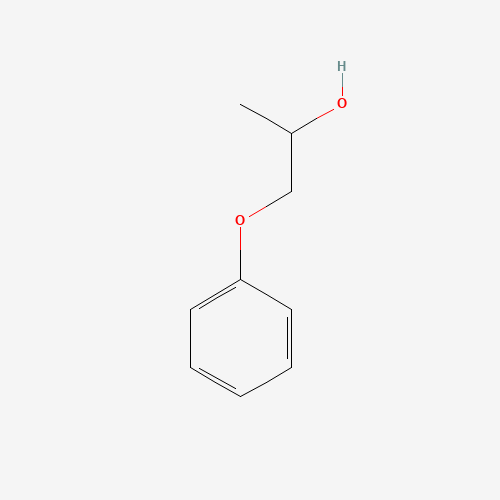
化合物详情
CAS770-35-4
分子式C9H12O2
分子量152.19 g/mol g/mol
危化品
科学粮草官-词典编辑部,修订于:2026-07-06
Toxicity
ToxicityEcotoxicity Values
EC50; Species: Scenedesmus subspicatus (algae), 10000 cells/mL test volume, initially; Conditions: freshwater, static, 23 + or - 2 °C; Concentration: 74.5 mg/L for 72 hr; Effect: growth rate
Fate Summary
ATMOSPHERIC FATE: According to a model of gas/particle partitioning of semivolatile organic compounds in the atmosphere(1), propylene glycol phenyl ether, which has a vapor pressure of 0.00218 mm Hg at 25 °C(2), is expected to exist solely as a vapor in the ambient atmosphere. Vapor-phase propylene glycol phenyl ether is degraded in the atmosphere by reaction with photochemically-produced hydroxyl radicals(SRC); the half-life for this reaction in air is estimated to be about 10 hours(SRC), calculated from its rate constant of 3.7X10⁻¹¹ cu cm/molecule-sec at 25 °C(SRC) that was derived using a structure estimation method(3). Propylene glycol phenyl ether does not contain chromophores that absorb at wavelengths >290 nm(4) and, therefore, is not expected to be susceptible to direct photoly...
Soil Adsorption / Mobility
Using a structure estimation method based on molecular connectivity indices(1), the Koc of propylene glycol phenyl ether can be estimated to be 23(SRC). According to a classification scheme(2), this estimated Koc value suggests that propylene glycol phenyl ether is expected to have very high mobility in soil.
Environmental Biodegradation
AEROBIC: In aerobic soil biodegradation studies using two sandy loam soils and one sandy soil collected in Michigan, propylene glycol phenyl ether had an initial 50% removal rate of <1 day in the sandy loam soils and <5 days in the sandy soil at initial concentrations of 1.4-1.5 ppm(1); at initial concentrations of 107-108 ppm, 50% removal was <5 days in the sandy loam soils and <23 days in the sandy soil(1); maximum percentage of 14-CO2 evolved ranged from 31-66%(1); negligible removal occurred in sterile soil controls(1). Using the three Michigan soils, after 2 months under anaerobic conditions (at a nominal concentration of 10 ppm), a 16% reduction in propylene glycol phenyl ether was observed in sodium acetate supplemented microcosms whereas, in the sterile controls, a 7% reduction...
Environmental Bioconcentration
An estimated BCF of 2.5 was calculated in fish for propylene glycol phenyl ether(SRC), using a log Kow of 1.50(1) and a regression-derived equation(2). According to a classification scheme(2), this BCF suggests the potential for bioconcentration in aquatic organisms is low(SRC).
Volatilization from Water / Soil
The Henry's Law constant for propylene glycol phenyl ether is estimated as 2.9X10⁻⁸ atm-cu m/mole(SRC) derived from its vapor pressure, 0.00218 mm Hg(1), and water solubility, 1.51X10+4 mg/L(2). This Henry's Law constant indicates that propylene glycol phenyl ether is expected to be essentially nonvolatile from water surfaces(3). Propylene glycol phenyl ether's estimated Henry's Law constant indicates that volatilization from moist soil surfaces is not expected to occur(SRC). Propylene glycol phenyl ether enters the environment through evaporation from solvent or coating applications(4); therefore, it is expected to volatilize from dry soil surfaces(SRC).
Environmental Abiotic Degradation
The rate constant for the vapor-phase reaction of propylene glycol phenyl ether with photochemically-produced hydroxyl radicals has been estimated as 3.7X10⁻¹¹ cu cm/molecule-sec at 25 °C(SRC) using a structure estimation method(1). This corresponds to an atmospheric half-life of about 10 hours at an atmospheric concentration of 5X10+5 hydroxyl radicals per cu cm(1). Propylene glycol phenyl ether is not expected to undergo hydrolysis in the environment due to the lack of functional groups that hydrolyze under environmental conditions(2). Propylene glycol phenyl ether does not contain chromophores that absorb at wavelengths >290 nm(2) and, therefore, is not expected to be susceptible to direct photolysis by sunlight(SRC).
Artificial Pollution Sources
Propylene glycol phenyl ether's production and use as a solvent in paints, coatings, inks and adhesives, as a latex coalescent and dye carrier, and as an antibacterial agent in soaps and cosmetics(1) may result in its release to the environment through various waste streams(SRC).
Probable Routes of Human Exposure
Occupational exposure to propylene glycol phenyl ether may occur through inhalation and dermal contact with this compound at workplaces where propylene glycol phenyl ether is produced or used(SRC). Worker exposure is most likely to occur while applying coating products containing propylene glycol phenyl ether to various surfaces(1). Use data indicate that the general population may be exposed to propylene glycol via inhalation of ambient air and dermal contact with products containing this compound(2). Limited population exposure may occur via ingestion of and dermal contact with contaminated water in the vicinity of a spill site(SRC).
Other Environmental Concentrations
The typical propylene glycol phenyl ether concentration in paint is 2 to 10%, in cosmetics and soaps 0.1 to 1%(1).
Environmental Fate / Exposure Summary
Propylene glycol phenyl ether's production and use as a solvent in paints, coatings, inks and adhesives, as a latex coalescent and dye carrier, and as an antibacterial agent in soaps and cosmetics may result in its release to the environment through various waste streams. If released to air, a vapor pressure of 0.00218 mm Hg at 25 °C indicates propylene glycol phenyl ether will exist solely as a vapor in the atmosphere. Vapor-phase propylene glycol phenyl ether will be degraded in the atmosphere by reaction with photochemically-produced hydroxyl radicals; the half-life for this reaction in air is estimated to be 10 hours. Propylene glycol phenyl ether does not contain chromophores that absorb at wavelengths >290 nm and, therefore, is not expected to be susceptible to direct photolysis b...
Lethal Dose
collection=toxvaldb&kind=^LD$
Toxicity Data
LC50 (rat) > 5,400 mg/m3/4hr
Adverse Effects
Neurotoxin - Acute solvent syndrome
Human Toxicity Excerpts
/OTHER TOXICITY INFORMATION/ Individuals applying paint or other PPh-containing coatings may be exposed to this propylene glycol ether. Dermal contact through minor spills or usage contact is a source of exposure, as is inhalation from aerosol or vapor generated during application or usage. General population exposure also is possible through inhalation of ambient air containing low concentrations of PPh that may be released from industrial processes or through evaporation of coatings or other products containing it. The rapid photochemical degradation of PPh would suggest that this means of exposure to the general population would be low. Ingestion of drinking water containing PPh as a contaminant (e.g., from a spill) also is possible. The ready biodegradability of PPh, again, would su...
Non-Human Toxicity Values
LC50 Rat inhalation (4 hr) > 5400 mg/cu m
Reference and Risk Values
collection=toxvaldb&kind=^RRV$
Non-Human Toxicity Excerpts
/LABORATORY ANIMALS: Subchronic or Prechronic Exposure/ /Wistar rat were treated for 90 days continuosly in drinking water 0, 500, 2000, and 6000 ppm/. No treatment related effects were observed at the lowest dose level (500 ppm). At 2000 ppm the only effects observed were a slight decrease in body weight (< 10%) and discoloration of urine. Those effects are not considered to be adverse. Hence, the NOAEL is 2000 ppm. /Mixture of 84.8% 1-phenoxy-propan-2-ol and 14.7% 2-phenoxy-propan-1-ol/
Antidote and Emergency Treatment
/SRP:/ Advanced treatment: Consider orotracheal or nasotracheal intubation for airway control in the patient who is unconscious, has severe pulmonary edema, or is in severe respiratory distress. Positive-pressure ventilation techniques with a bag valve mask device may be beneficial. Consider drug therapy for pulmonary edema ... . Consider administering a beta agonist such as albuterol for severe bronchospasm ... . Monitor cardiac rhythm and treat arrhythmias as necessary ... . Start IV administration of D5W /SRP: "To keep open", minimal flow rate/. Use 0.9% saline (NS) or lactated Ringer's if signs of hypovolemia are present. For hypotension with signs of hypovolemia, administer fluid cautiously. Watch for signs of fluid overload ... . Treat seizures with diazepam or lorazepam ... . Use...









