


 一键配货
一键配货
化合物详情
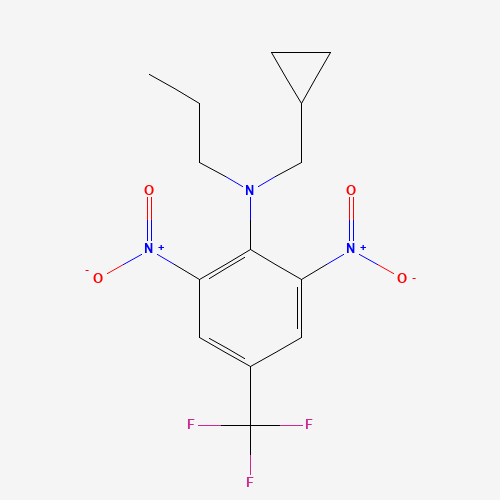
CAS26399-36-0
分子式C14H16F3N3O4
分子量347.29 g/mol
非危品
Profluralin is a C-nitro compound.
科学粮草官-词典编辑部,修订于:2026-07-06
Toxicity
ToxicityEcotoxicity Values
EC50; Species: Lyngbya sp. (Blue-green algae, exponential growth phase); Conditions: static, 24-26 °C, pH 6.6; Concentration: >10 uM for 24 hr; Effect: decreased population doubling time
Fate Summary
ATMOSPHERIC FATE: According to a model of gas/particle partitioning of semivolatile organic compounds in the atmosphere(1), profluralin, which has a vapor pressure of 6.3X10⁻⁵ mm Hg at 20 °C(1) is expected to exist in both the vapor and particulate phases in the ambient atmosphere. Vapor-phase profluralin is degraded in the atmosphere by reaction with photochemically produced hydroxyl radicals(SRC); the half-life for this reaction in air is estimated to be about 17 hours(SRC) calculated from its rate constant of 2.3X10⁻¹¹ cu cm/molecule-sec(SRC), derived using a structure estimation method(3). Profluralin absorbs light greater than 290 nm and is susceptible to photolysis(4). Particulate-phase profluralin may be physically removed from the air by wet and dry deposition(SRC).
Soil Adsorption / Mobility
The Koc of profluralin in soil was reported as 8,600(1) and 10,232(2). According to a recommended classification scheme(3), these Koc values suggest that profluralin is immobile in soil(SRC). Profluralin was adsorbed 66 to 74 percent by organic matter and 9 to 10 percent by montmorillonite after 4 hours of equilibration in an experimental study(4). Desorption solutions of water and CaCl2 (1 normal) desorbed profluralin 12.8 and 11.8 percent, respectively, from organic matter and 93.3 and 69 percent, respectively, from montmorillonite(4).
Environmental Bioconcentration
An estimated BCF value of 3,950 was calculated for profluralin(SRC), using an experimental log Kow of 5.58(1) and a regression-derived equation(2). According to a classification scheme(3), this BCF value suggests the potential for bioconcentration in aquatic organisms is very high(SRC).
Volatilization from Water / Soil
The Henry's Law constant for profluralin is estimated as 2.9X10⁻⁴ atm-cu m/mole(SRC), derived from its experimental values for vapor pressure, 6.3X10⁻⁵ mm Hg at 20 °C(1), and water solubility, 0.1 mg/L at 20 °C(1). This Henry's Law constant indicates that profluralin is expected to volatilize from water surfaces(2). Based on this Henry's Law constant, the volatilization half-life from a model river (1 m deep, flowing 1 m/sec, wind velocity of 3 m/sec)(2) is estimated as 5 hours(SRC). The volatilization half-life from a model lake (1 m deep, flowing 0.05 m/sec, wind velocity of 0.5 m/sec)(2) is estimated as 9 days(SRC). Volatilization may be attenuated due to adsorption(SRC). The volatilization half-life from a model pond was estimated as 123 days when adsorption was considered(3). Volat...
Environmental Abiotic Degradation
The rate constant for the vapor-phase reaction of profluralin with photochemically produced hydroxyl radicals has been estimated as 2.3X10⁻¹¹ cu cm/molecule-sec at 25 °C(SRC) using a structure estimation method(1). This corresponds to an atmospheric half-life of about 17 hours at an atmospheric concentration of 5X10+5 hydroxyl radicals per cu cm(1). At 20 °C, hydrolysis half-lives for profluralin were: 29 days at pH 13, 150 days at pH 1, and 1200 days in deionized water at neutral pH(2). Profluralin does not hydrolyze at environmental pH (pH 5-9) and room temperature(3). The half-life for the photodecomposition of profluralin was 44 minutes using UV light (310-410 nm)(4). After exposure to sunlight on soil thin layer plates for 7 days, profluralin did not degrade to any appreciable exte...
Environmental Water Concentrations
GROUNDWATER: Of 86 wells in Georgia that were sampled for profluralin during 1984-1991, only one well contained profluralin (concentration = 20 ug/l)(1).
Food Survey Values
Profluralin was analyzed for but not detected (detection limit = 0.050 ppm) on 6,970 produce samples(1).
Ecotoxicity Excerpts
/OTHER TERRESTRIAL SPECIES/ It is ... toxic to honey bees.
Artificial Pollution Sources
Profluralin's former production and use as a selective pre-planting herbicide(1) resulted in its direct release to the environment(SRC).
Sediment/Soil Concentrations
RESIDUES RESULTING FROM 1.7 KG CGA10832/HA IN SEQUATCHIE LOAM SOIL 120 DAYS AFTER HERBICIDE APPLICATION WERE 0.54-0.86 PPM.
Probable Routes of Human Exposure
Occupational exposure and general population exposure should be low or non-existent since profluralin is no longer produced or used in the US (profluralin's registration was cancelled April 20, 1984). In the past, profluralin was applied directly to the ground and soil incorporated and exposure to this compound was primarily by dermal contact in the field where it was applied. (SRC)
Environmental Fate / Exposure Summary
Profluralin's former production and use as a selective pre-planting herbicide resulted in its direct release to the environment. If released to air, a vapor pressure of 6.3X10⁻⁵ mm Hg at 20 °C indicates profluralin will exist in both the vapor and particulate phases in the atmosphere. Vapor-phase profluralin will be degraded in the atmosphere by reaction with photochemically-produced hydroxyl radicals; the half-life for this reaction in air is estimated to be 17 hours. Direct photolysis in the atmosphere is also likely to occur since profluralin absorbs light greater than 290 nm. Particulate-phase profluralin will be removed from the atmosphere by wet and dry deposition. If released to soil, profluralin is expected to have no mobility based upon Koc values of 8,600 and 10,232. Volatiliz...
Interactions
TOBACCO TISSUE CULTURES WERE USED IN A BIOASSAY SYSTEM FOR DETERMINING THE EFFECT OF PROFLURALIN ON GROWTH. THE MOLAR CONCN REQUIRED TO INHIBIT FRESH WT GAIN BY 50% (I50) WAS DETERMINED. EXOGENOUSLY APPLIED D-ALPHA-TOCOPHEROL ACETATE AT 100 TIMES THE I50 CONCN DECR THE INHIBITION OF TISSUE GROWTH BY PROFLURALIN.
Toxicity Data
LCLo (rat) > 3,970 mg/m3/1h
RAIS Toxicity Values
Oral Subchronic Chronic Reference Dose Reference: HEAST Current
Human Toxicity Excerpts
/SIGNS AND SYMPTOMS/ KNOWN OR SUSPECTED ADVERSE EFFECTS: Slightly to moderately irritating to skin, eyes, and mucous membranes. Does not uncouple oxidative phosphorylation. Irritation of eyes, skin, nose or throat may result from overexposure to Tolban 4E. Other symptoms may include nausea, vomiting, abdominal cramps or diarrhea (Tolban 4E). Irritation of eyes, skin, nose or throat may result from overexposure to Tolban 4E. Other symptoms may include nausea, vomiting, abdominal cramps or diarrhea (Tolban 4E).
Non-Human Toxicity Values
LC50 (4 hr) Rat inhalation >3.0 mg/L (Tolban 4E)
Non-Human Toxicity Excerpts
/LABORATORY ANIMALS: Chronic Exposure or Carcinogenicity/ Lifetime feeding studies with high dose levels of profluralin technical have produced an increased incidence of hepatic tumors in mice.
1 or Cancer Risk Level 1E-06
Fraction of Contaminant Absorbed in Gastrointestinal Tract: 1
Hazard Quotient Level 3 or Cancer Risk Level 1E-04
Fraction of Contaminant Absorbed in Gastrointestinal Tract: 1









